MCA21 v3.0 Compliance Roadmap for MSMEs in India (2025 Guide)

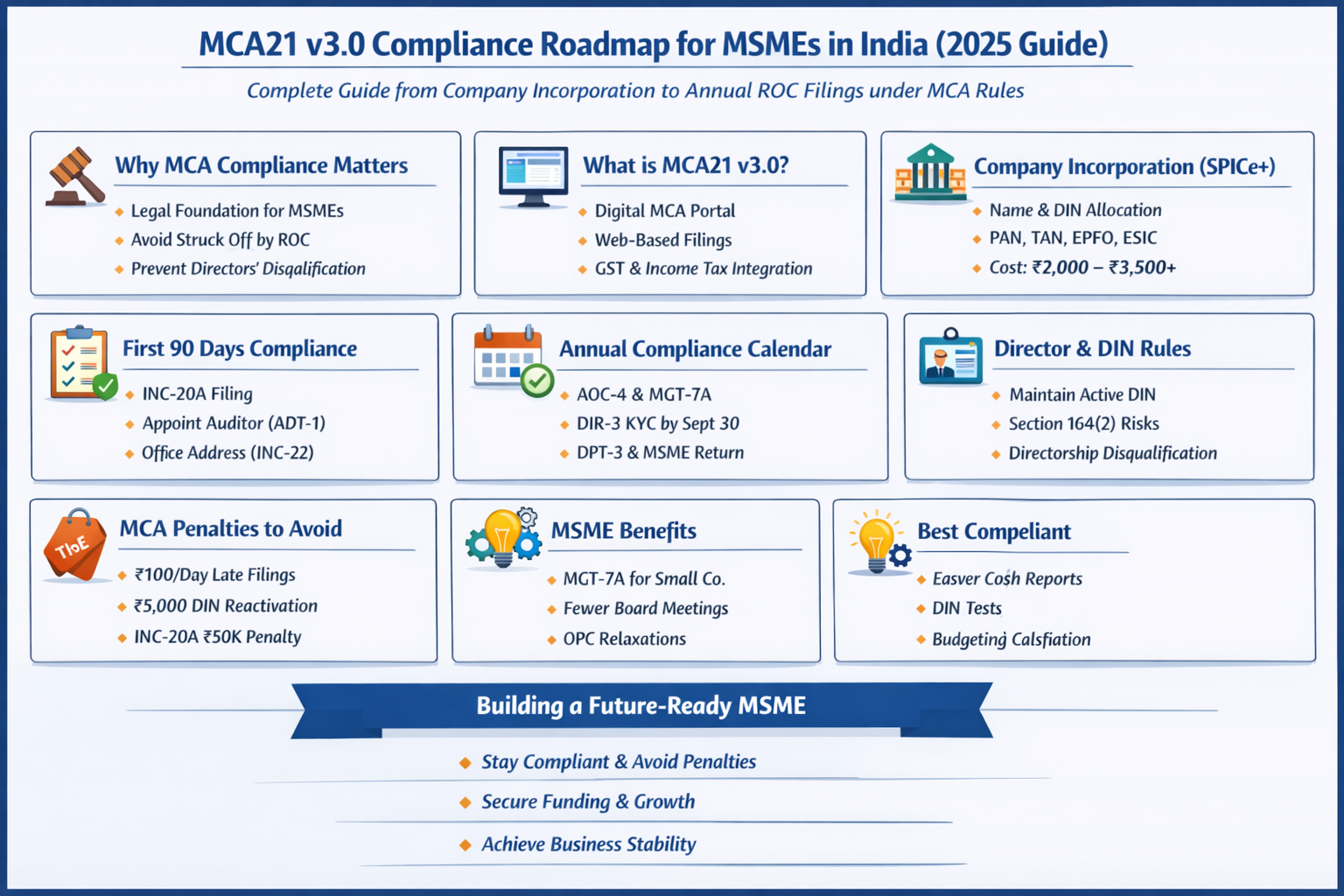
MCA21 v3.0 compliance roadmap for MSMEs in India 2025 showing incorporation, ROC filings, AOC-4, MGT-7A, DIR-3 KYC and penalties guide

Introduction – Why MCA Compliance Matters for Every MSME

For Indian MSMEs, compliance with the Ministry of Corporate Affairs (MCA) is not optional—it is the legal foundation of business continuity.

Once a company is incorporated under the Companies Act, 2013, every stage of its lifecycle—from operations to annual filings—is monitored through the MCA portal. With increasing digitization under the upgraded MCA21 v3.0 system, compliance has become faster but also more strict.

In recent years, thousands of companies have been struck off by the Registrar of Companies (ROC) due to missed filings and inactive compliance. This has resulted in financial losses, blocked business operations, and even director disqualification.

This guide breaks down MCA21 v3.0 in a simple, practical way so MSME founders, directors, CFOs, and company secretaries can manage compliance without confusion.

What is MCA21 v3.0 and Why It is Important in 2025

The upgraded MCA21 v3.0 platform is India’s new digital corporate compliance system designed by the Government of India for faster, integrated, and transparent company management.

Key improvements relevant to MSMEs include:

  • Fully web-based filing system (no offline form downloads)
  • Real-time validation of compliance forms
  • Faster approval of incorporation applications
  • Integration with GST, Income Tax, and EPFO systems
  • Centralized corporate data tracking across India
  • Improved automation for low-risk filings

With this upgrade, most filings are now system-verified, reducing manual errors but increasing the importance of accurate data entry.

Company Incorporation Process for MSMEs (SPICe+ System)

The SPICe+ (Simplified Proforma for Incorporating Company Electronically Plus) system is the unified online form used for company registration in India.

What SPICe+ Includes

Through a single application, MSMEs can complete:

  • Company name reservation (RUN system)
  • DIN allocation for directors
  • Incorporation certificate (COI)
  • Memorandum of Association (MoA) and Articles of Association (AoA) filing
  • PAN & TAN registration
  • EPFO and ESIC registration
  • Optional GST registration
  • Bank account integration support

Capital and Cost Structure

India no longer mandates minimum capital for incorporation. A company can technically start with ₹1, though ₹1 lakh is commonly preferred for credibility.

Government charges vary depending on:

  • Authorized share capital
  • State-specific stamp duty
  • ROC filing charges

Approximate setup cost:

  • Government fees: ₹2,000 – ₹3,500 (for small capital structure)
  • Professional fees: ₹8,000 – ₹25,000 depending on complexity

First 90 Days Compliance Checklist After Incorporation

The first three months after incorporation are critical for avoiding penalties.

Key Mandatory Filings

  1. INC-20A (Commencement of Business)
  • Must be filed within 180 days
  • Failure leads to heavy penalties and possible strike-off
  1. Auditor Appointment (ADT-1)
  • Auditor must be appointed within 30 days of incorporation
  1. Registered Office Filing (INC-22)
  • Required if address was not submitted at incorporation
  1. Board Meetings
  • At least 2 meetings in the first year
  • Maximum gap: 90 days between meetings

Annual MCA Compliance Calendar for MSMEs

Every registered company must follow a strict yearly compliance cycle.

Key Annual Filings

  1. AOC-4 (Financial Statements)
  • Filing of audited balance sheet and P&L
  • Due within 30 days of AGM
  1. MGT-7A (Annual Return for Small Companies)
  • Applicable for MSMEs classified as small companies
  • Due within 60 days from AGM closure
  1. DIR-3 KYC (Director KYC)
  • Mandatory annual update
  • Deadline: September 30
  1. DPT-3 (Loan & Deposit Return)
  • Reports loans from directors or shareholders
  • Due annually by June 30
  1. MSME-1 Return
  • Filed if payments to MSME vendors exceed 45 days
  • Filed twice a year

Director Responsibilities and DIN Compliance

Every director under MCA must maintain an active Director Identification Number (DIN).

Risk of Non-Compliance

Failure to comply with filing requirements can lead to:

  • DIN deactivation without prior notice
  • Disqualification under Section 164(2)
  • Inability to act as director in any company
  • Automatic removal from existing board positions

Directors involved in multiple companies must ensure all entities are compliant, as default in one company can impact all directorships.

MCA Penalties MSMEs Should Be Aware Of

Late or missed filings attract automatic penalties under the Companies Act, 2013.

Common Penalties

  • AOC-4 late filing: ₹100 per day (uncapped)
  • MGT-7/MGT-7A delay: ₹100 per day
  • DIR-3 KYC delay: ₹5,000 reactivation fee
  • Non-filing of INC-20A: ₹50,000 + ₹1,000/day
  • Auditor appointment failure: ₹25,000 penalty

These penalties accumulate quickly, making timely compliance essential.

Benefits for MSMEs and Small Companies

The MCA framework provides several relaxations for MSMEs classified as small companies.

Key Advantages

  • Simplified annual return form (MGT-7A instead of MGT-7)
  • Reduced number of board meetings (2 per year)
  • No mandatory cash flow statement requirement
  • Easier compliance structure for OPCs
  • Flexible conversion rules for one-person companies

These benefits significantly reduce administrative burden for small businesses.

Conclusion – Building a Compliant and Future-Ready MSME

MCA compliance is not just a legal requirement—it is a business protection system.

Proper adherence ensures the following:

  • Strong corporate identity
  • Protection from penalties and disqualification
  • Easier access to funding and contracts
  • Long-term business sustainability

With MCA21 v3.0, compliance has become digital-first and highly automated, making accuracy and timely filing more important than ever for MSMEs.

FAQ

What is MCA21 v3.0 in simple terms?

MCA21 v3.0 is the upgraded online system of the Ministry of Corporate Affairs that allows companies in India to complete incorporation, filing, and compliance activities through a fully digital, web-based platform with faster processing and real-time validation.

Is MCA compliance mandatory for all MSMEs?

Yes. If your MSME is registered as a Private Limited Company, LLP, OPC, or Public Company, you must follow MCA compliance rules such as annual returns, financial statements, and director KYC filings.

What happens if I miss MCA filing deadlines?

Missing deadlines leads to automatic penalties like daily late fees, DIN deactivation, and in serious cases, company strike-off by ROC. Directors may also face disqualification under the Companies Act, 2013.

What is SPICe+ and why is it important?

SPICe+ is the integrated company incorporation form used in India. It allows businesses to register a company, obtain PAN, TAN, GST, EPFO, and ESIC registrations through a single application.

Is Director KYC (DIR-3 KYC) mandatory every year?

Yes. All active directors must update their KYC annually before the deadline (usually September 30). Failure results in DIN deactivation and a ₹5,000 reactivation fee.

What is the difference between MGT-7 and MGT-7A?

MGT-7A is a simplified annual return form for small companies and MSMEs, while MGT-7 is used by larger companies with higher turnover or share capital.

Can a company be struck off for non-compliance?

Yes. If a company fails to file financial statements or annual returns for consecutive years, the ROC can strike it off from the MCA register, making it legally inactive.

What is INC-20A and who needs to file it?

INC-20A is a declaration of commencement of business. It must be filed by every newly incorporated company within 180 days before starting business operations.
Book a Call with an expert absolutely FREE for 15 minutes