
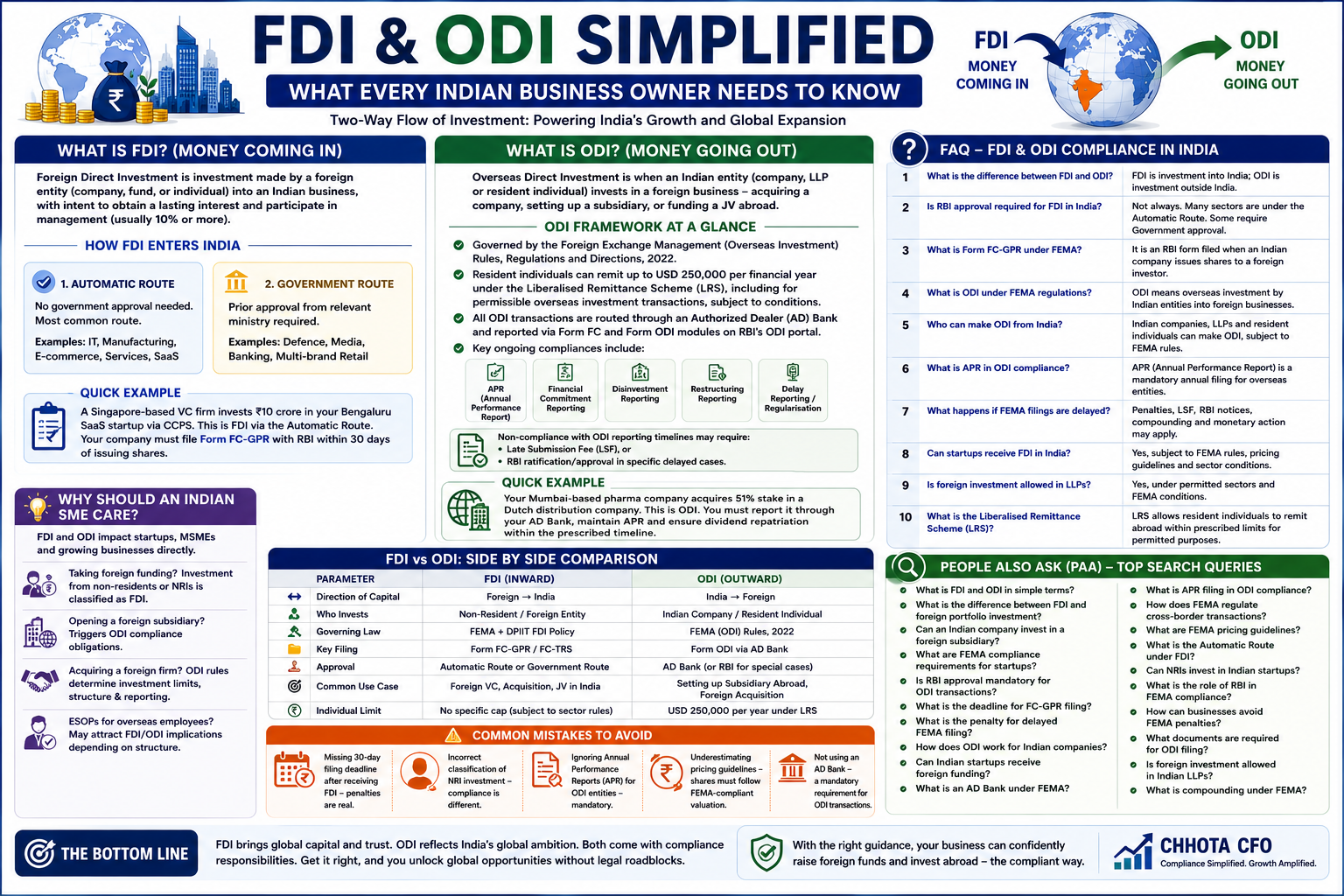
Understanding Cross-Border Investments in India
India is no longer just receiving foreign investments — Indian businesses are also expanding globally. Today, startups, MSMEs, and growing companies regularly deal with overseas investors, foreign subsidiaries, global partnerships, and international business expansion.
Two important concepts govern these transactions under FEMA regulations:
Whether you are raising funds from foreign investors or opening a subsidiary abroad, understanding FDI and ODI compliance is essential to avoid penalties and ensure smooth business operations.
Foreign Direct Investment (FDI) refers to investment made by a foreign company, foreign investor, NRI, or overseas entity into an Indian business.
In simple terms, foreign money enters India for business investment purposes.
Unlike stock market investments, FDI usually involves long-term participation and ownership in the company.
FDI commonly happens when:
FDI investments generally enter India through two routes.
Under this route:
Common sectors include:
Certain sectors must obtain approval from the government of India before receiving foreign investment.
These sectors may include:
Approval is generally processed through the relevant ministries and in accordance with DPIIT guidelines.
Suppose a Singapore-based investor invests ₹5 crore into a Bengaluru-based tech startup through CCPS shares.
This becomes an FDI transaction under FEMA regulations.
The Indian company must:
Failure to report can result in FEMA penalties and late submission fees.
ODI refers to investments made outside India by Indian residents or Indian companies.
In simple words, ODI means Indian money going abroad for business expansion or overseas investment.
Indian businesses use ODI for:
ODI transactions are governed under:
All ODI transactions are routed through an Authorized Dealer (AD) Bank.
Examples include:
Indian businesses making overseas investments must follow:
Delayed filings may attract:
Imagine a Mumbai-based pharmaceutical company acquires a majority stake in a European distributor.
This becomes an ODI transaction.
The company must:
BasisFDIODIDirection of investmentForeign money into IndiaIndian money outside IndiaInvestor typeForeign resident/entityIndian resident/companyPurposeInvest in Indian businessInvest in overseas businessKey formsFC-GPR / FC-TRSODI Forms / APRGoverning rulesFEMA + FDI PolicyFEMA ODI Rules 2022Common useStartup fundingOverseas expansion
Many small and mid-sized businesses assume FEMA rules apply only to large corporations. That is no longer true.
Even startups and MSMEs now regularly face FEMA compliance situations.
If your investor is based outside India, FEMA regulations immediately apply.
Setting up a company abroad triggers ODI compliance.
Acquiring international clients or businesses may involve ODI approvals and reporting.
Issuing ESOPs to non-resident employees may create FEMA reporting obligations.
Many companies fail to file FC-GPR or ODI reports within the prescribed timeline.
Share pricing for foreign investors must follow FEMA valuation guidelines.
Annual Performance Reports are mandatory for overseas subsidiaries, even if there is no business activity.
NRI investments may fall under different FEMA categories, and incorrect classification can create compliance issues.
Improper FEMA compliance can result in the following:
Businesses that maintain proper documentation and timely filings face fewer regulatory problems.
FDI and ODI are now part of everyday business operations for Indian startups, MSMEs, and growing companies.
While FEMA regulations may appear technical, proper planning and professional guidance can make cross-border compliance manageable and stress-free.
Businesses that understand FEMA rules early can scale globally with fewer legal and regulatory hurdles.
 GST Input Tax Credit (ITC) Guide for Startups & MSMEs (2026)
 Audit Red Flags in Due Diligence: Investor Guide (2026)
 IEM Registration Part A vs Part B under DPIIT | Complete Guide
 RBI Reporting After Foreign Investment in India | FEMA Guide 2026
 Sections 185, 186 & 188 of Companies Act, 2013: Complete Guide
 Missed a FEMA Filing? Compounding vs Late Submission: What Should You Do?
 MCA Financial Year Flexibility Comes with a Tax Reporting Catch for Companies
 Fast Track Merger without NCLT approval
 Trademark Registration Bangalore: Fees, Eligibility & Steps
 Section 185 vs Section 186: Company Loan Rules Explained

