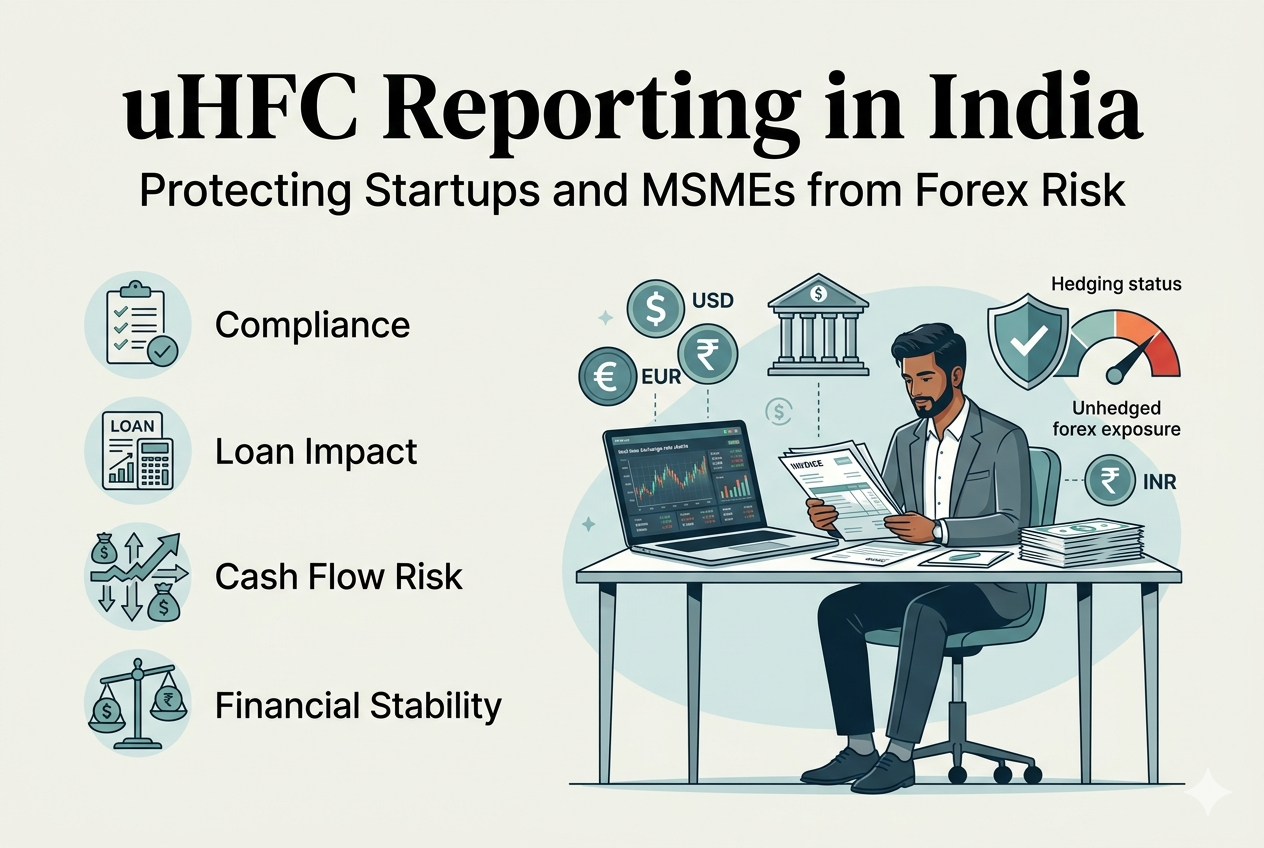
Many Indian startups and businesses handling foreign currency transactions believe compliance ends with FEMA filings or bank documentation. However, there is another important need that often gets ignored until banks raise concerns—UHFC reporting, also known as Unhedged Foreign Currency Exposure reporting.
This compliance needs to directly impact:
For startups, MSMEs, exporters, importers, and companies with foreign loans, understanding uHFC reporting is becoming increasingly important.
UHFC stands for “unhedged foreign currency exposure.”
It refers to foreign currency liabilities or receivables that are not protected against exchange rate fluctuations through hedging mechanisms.
In simple terms, if a business has foreign currency exposure but has not taken steps to protect itself from currency volatility, that exposure is considered unhedged.
Indian banks, under RBI guidelines, must require businesses to disclose such exposure periodically.
This helps lenders assess the financial risk associated with currency fluctuations.
Many companies assume UHFC reporting is only a compliance formality. In reality, it has a direct financial impact.
When a company has large unhedged forex exposure:
Simply put, higher forex risk can lead to higher borrowing costs.
Foreign exchange movements can significantly impact business finances.
If a company has foreign currency liabilities and the exchange rate moves unfavorably:
Similarly, delayed export receivables can also create financial uncertainty when exchange rates fluctuate.
Banks closely check these risks because they affect repayment capacity.
UHFC compliance generally applies to businesses that have the following:
Even businesses compliant under FEMA can face issues if UHFC reporting is inaccurate or ignored.
The Reserve Bank of India requires banks to test the financial impact of unhedged forex exposure on borrowers.
The aim is to reduce the following:
When businesses fail to manage forex risks properly, banks may consider them financially vulnerable.
Many startups and growing businesses underestimate the importance of UHFC reporting.
Some common mistakes include:
Ignoring Small Forex Exposure
Businesses often assume small exposures do not matter. However, exchange rate volatility can quickly increase risk.
No Internal Forex Tracking
Many companies depend entirely on banks and do not maintain their own forex exposure records.
Lack of Hedging Strategy
Without proper hedging policies, businesses remain exposed to unpredictable currency movements.
Delayed Reporting
Failure to submit UHFC information in a timely manner may create compliance and banking issues.
Managing unhedged exposure requires both compliance and financial planning.
Businesses should regularly calculate the following:
Companies should track the extent of exposure covered by hedging instruments.
Businesses can reduce forex risk using:
A structured policy helps maintain discipline and consistency in managing foreign currency exposure.
Ignoring UHFC reporting can lead to serious consequences, including:
In competitive industries, these issues can directly affect business growth and expansion.
As more Indian businesses engage in global trade, overseas expansion, and foreign borrowing, banks are becoming stricter about forex risk assessment.
Investors and lenders increasingly prefer businesses that:
Proper UHFC management improves financial credibility and borrowing capacity.
UHFC reporting is no longer a hidden compliance issue relevant only to large corporations.
For startups, MSMEs, exporters, importers, and companies with foreign currency transactions, managing unhedged forex exposure has become a critical part of financial planning.
Businesses that actively check and hedge their forex exposure can:
Companies that ignore UHFC compliance often face higher financial pressure and reduced flexibility during growth stages.
A proactive approach to forex risk management can help businesses build stronger banking relationships and achieve long-term financial stability.
 GST Input Tax Credit (ITC) Guide for Startups & MSMEs (2026)
 Audit Red Flags in Due Diligence: Investor Guide (2026)
 IEM Registration Part A vs Part B under DPIIT | Complete Guide
 RBI Reporting After Foreign Investment in India | FEMA Guide 2026
 Sections 185, 186 & 188 of Companies Act, 2013: Complete Guide