If your business deals with foreign investment, overseas subsidiaries, startup funding, international remittances, or cross-border transactions, you have probably come across terms like FDI, ODI, FC-GPR, ECB, APR, LRS, and AD Bank.
For founders, finance teams, chartered accountants, company secretaries, and compliance professionals, understanding these FEMA-related terms is extremely important. A small misunderstanding in cross-border compliance can lead to:
This guide explains the most commonly used FEMA terms in simple language so businesses can manage international transactions confidently and stay compliant.
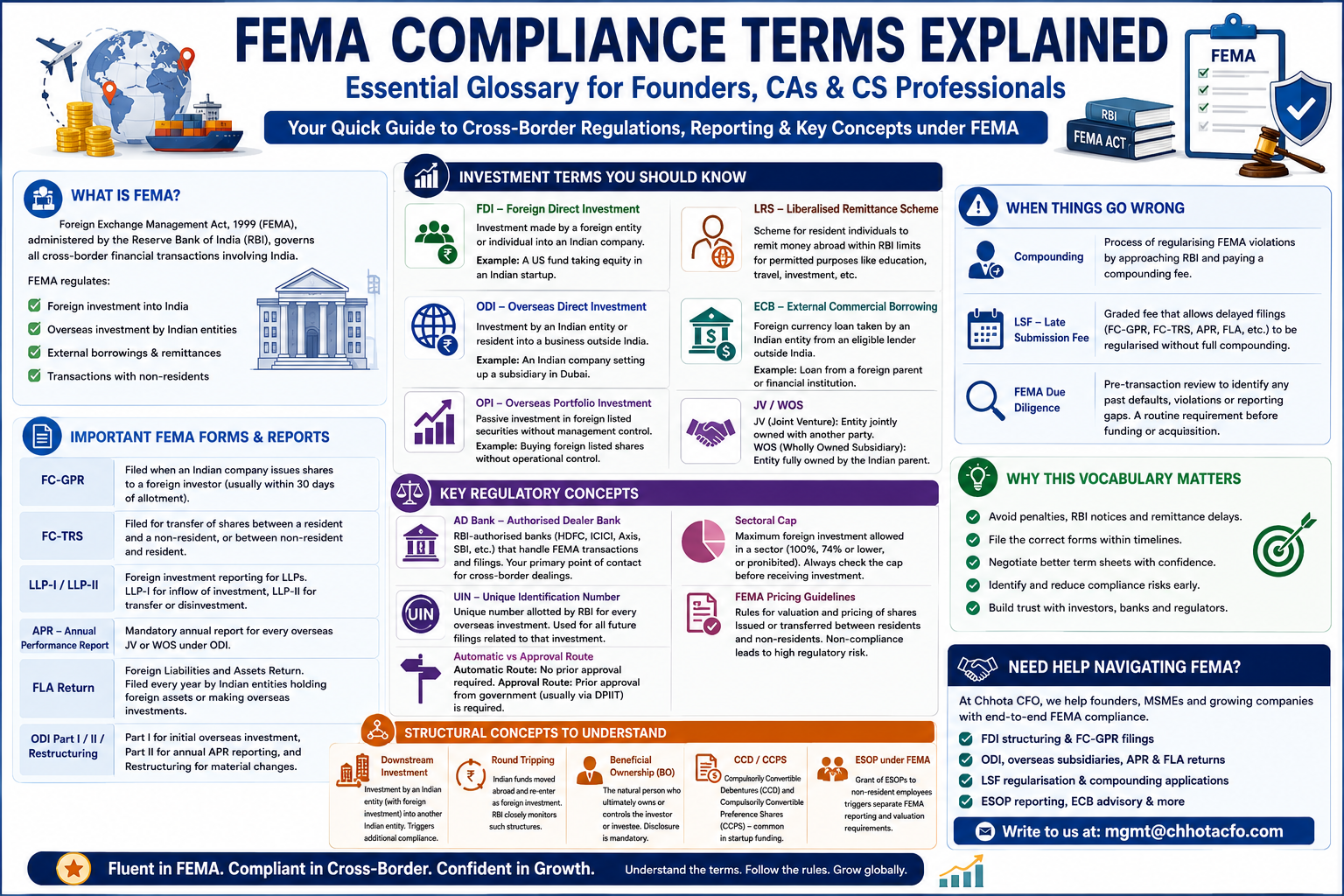
The Foreign Exchange Management Act, 1999 (FEMA), is India’s primary law for regulating foreign exchange and international financial transactions.
FEMA is administered by the Reserve Bank of India (RBI) and governs:
In simple words, whenever money moves in or out of India, FEMA rules generally apply.
FDI – Foreign Direct Investment
“FDI” refers to investment made by a foreign individual or company into an Indian business.
Example:
A Singapore investor purchasing shares in an Indian startup.
FDI is one of the most common routes for overseas funding into India.
ODI – Overseas Direct Investment
ODI refers to investment made outside India by an Indian company or resident.
Example:
An Indian company setting up a subsidiary in Dubai or Singapore.
ODI rules regulate overseas expansion by Indian businesses.
OPI – Overseas Portfolio Investment
OPI refers to passive investment in foreign-listed securities without management control.
Unlike ODI, OPI usually does not involve operational ownership or business management.
LRS – Liberalised Remittance Scheme
Under LRS, resident individuals in India can remit money abroad within prescribed RBI limits.
Funds can be sent for:
ECB – External Commercial Borrowing
ECB refers to foreign loans raised by Indian entities from eligible overseas lenders.
This is commonly used by businesses for:
JV and WOS
JV – Joint Venture
An overseas entity jointly owned by an Indian company and another foreign partner.
WOS – Wholly Owned Subsidiary
A foreign company fully owned by the Indian parent entity.
FC-GPR
Filed when an Indian company issues shares to a foreign investor.
This filing must generally be completed within 30 days of share allotment.
FC-TRS
Used when shares are transferred between:
This applies to secondary share transfers.
LLP-I and LLP-II
These forms apply to foreign investment in LLPs.
APR – Annual Performance Report
Indian entities with overseas subsidiaries or joint ventures must submit an APR to the RBI annually.
FLA Return
The Foreign Liabilities and Assets Return is filed every year by Indian companies that:
Key FEMA Regulatory Concepts
AD Bank – Authorised Dealer Bank
An AD bank is an RBI-authorized bank that handles foreign exchange transactions.
Examples include:
Almost all FEMA transactions and filings move through the AD Bank.
UIN – Unique Identification Number
RBI assigns a UIN for every overseas investment made under ODI regulations.
This number is used for future FEMA reporting and compliance tracking.
Automatic Route vs Approval Route
Automatic Route
Investment is allowed without prior government approval.
Approval Route
Government approval is required before investment can proceed.
This usually depends on sector-specific rules.
Sectoral Cap
“Sectoral cap” means the greatest foreign investment permitted in a specific industry.
Different sectors may allow:
Checking sectoral limits is critical before accepting foreign investment.
FEMA Pricing Guidelines
These rules govern the valuation and pricing of shares issued or transferred between residents and non-residents.
Improper valuation is one of the most common FEMA compliance mistakes.
This filing is submitted to the RBI annually.
Downstream Investment
When an Indian company with foreign investment invests in another Indian company, it is called a downstream investment.
This creates more FEMA compliance obligations.
Round-Tripping
“Round-tripping” refers to situations where Indian funds move abroad and re-enter India as foreign investment.
RBI closely monitors such structures.
Beneficial Ownership (BO)
BO identifies the actual individual who controls or owns an entity involved in foreign investment.
Disclosure requirements apply under both FEMA and the Companies Act.
CCD and CCPS
CCD – Compulsorily Convertible Debentures
CCPS – Compulsorily Convertible Preference Shares
These are commonly used instruments in startup funding involving foreign investors.
ESOP Under FEMA
Issuing ESOPs to non-resident employees triggers FEMA reporting and valuation compliance requirements.
Compounding Under FEMA
Compounding is the process of regularizing FEMA violations by approaching the RBI and paying a prescribed compounding amount.
LSF – Late Submission Fee
LSF allows delayed FEMA filings to be regularized without full compounding proceedings.
Applicable filings may include:
FEMA Due Diligence
Before investment or acquisition transactions, investors usually conduct thorough due diligence to identify:
Cross-border compliance is highly technical.
Understanding FEMA terminology helps businesses:
For startups, MSMEs, and growing businesses, FEMA compliance is no longer optional—it is a core part of global business operations.
As Indian businesses increasingly expand globally and attract foreign investment, understanding FEMA terminology has become essential for founders, finance teams, CAs, CS professionals, and compliance advisors.
Whether your company is:
Having clarity on FEMA concepts helps reduce compliance risks and improve business efficiency.
A strong understanding of FEMA regulations also helps businesses communicate better with investors, banks, RBI authorities, and professional advisors while managing cross-border transactions smoothly.
 GST Input Tax Credit (ITC) Guide for Startups & MSMEs (2026)
 Audit Red Flags in Due Diligence: Investor Guide (2026)
 IEM Registration Part A vs Part B under DPIIT | Complete Guide
 RBI Reporting After Foreign Investment in India | FEMA Guide 2026
 Sections 185, 186 & 188 of Companies Act, 2013: Complete Guide