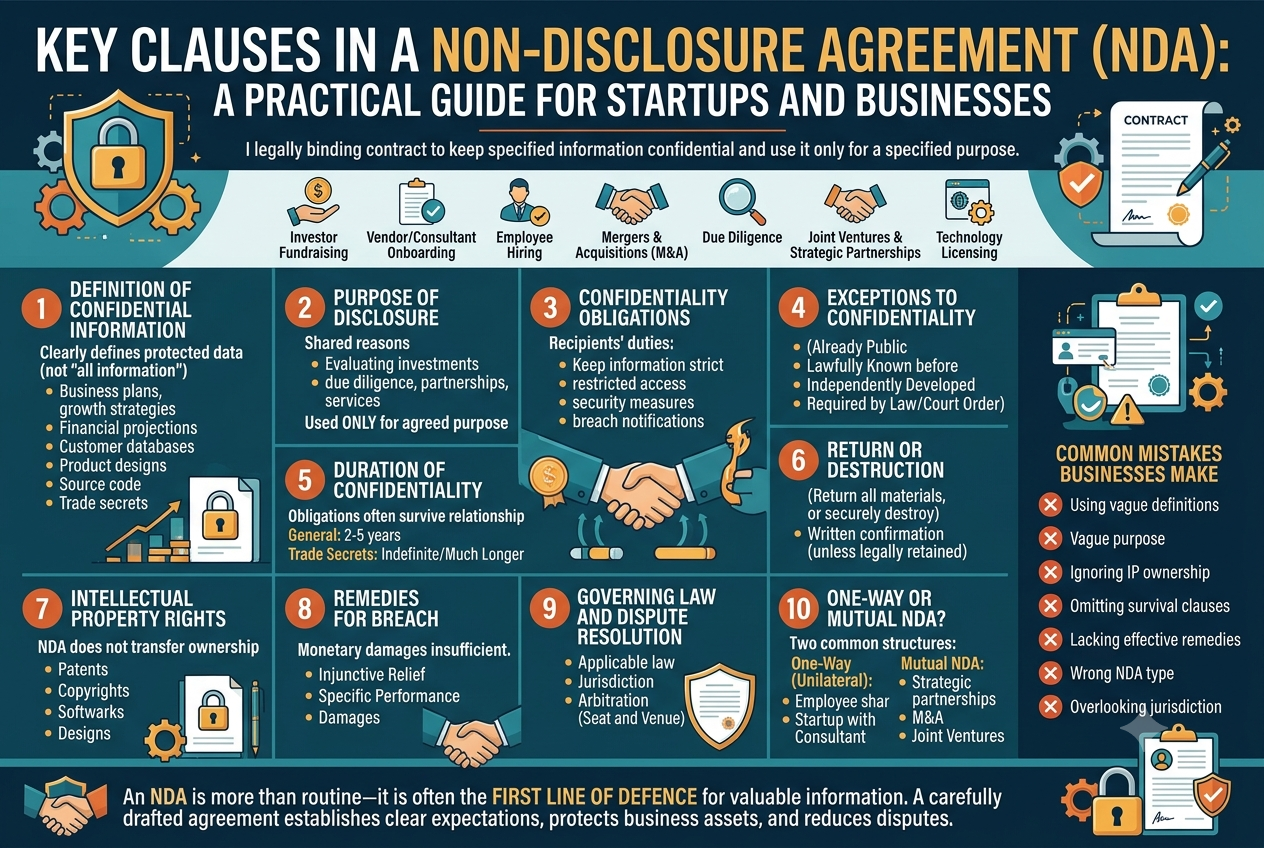
Key Clauses in a Non-Disclosure Agreement (NDA): A Practical Guide for Startups and Businesses

Key Clauses in a Non-Disclosure Agreement (NDA)", detailing 10 critical sections including Definition of Confidential Information, Purpose of Disclosure, Confidentiality Obligations, and common pitfalls for startups.

A Non-Disclosure Agreement is a legally binding contract under which one or both parties agree to keep certain information confidential and use it only for a specified purpose.

NDAs are commonly signed during:

  • Investor and fundraising discussions
  • Vendor or consultant onboarding
  • Employee hiring
  • Mergers and acquisitions (M&A)
  • Due diligence exercises
  • Joint ventures and strategic partnerships
  • Technology licensing arrangements

Need a Professionally Drafted NDA to Protect Your Business?

10 Key Clauses Every NDA Should Include

  1. Definition of Confidential Information

This is the foundation of every NDA.

Rather than stating that “all information is confidential,” the agreement should clearly define what information is protected. A precise definition reduces ambiguity and makes enforcement easier.

Confidential Information may include:

  • Business plans and growth strategies
  • Financial statements and projections
  • Customer and supplier databases
  • Product designs and prototypes
  • Source code and technical documentation
  • Pricing models and commercial strategies
  • Trade secrets and proprietary know-how

The clearer the definition, the stronger the protection.

  1. Purpose of Disclosure

Every NDA should clearly state why the confidential information is being shared.

Examples include:

  • Evaluating an investment opportunity
  • Conducting legal or financial due diligence
  • Exploring a strategic partnership
  • Providing consultancy or professional services
  • Negotiating a commercial transaction

The recipient should only use the information for this agreed purpose and not for any unrelated business activity.

  1. Confidentiality Obligations

The NDA should clearly set out the responsibilities of the receiving party.

Typically, the recipient should agree to:

  • Keep the information strictly confidential
  • Use it only for the agreed-upon purpose
  • Restrict access to employees, advisers or representatives on a need-to-know basis
  • Protect the information using reasonable security measures
  • Promptly notify the disclosing party in case of any unauthorised disclosure or breach

This clause forms the operational framework for protecting confidential information.

  1. Exceptions to Confidentiality

A well-balanced NDA also identifies information that will not be treated as confidential.

Common exceptions include information that:

  • Is already publicly available
  • Was lawfully known to the recipient before disclosure
  • Is independently developed without reference to the confidential information
  • Is required to be disclosed under applicable law, regulation or court order

These carve-outs make the agreement fair and commercially reasonable.

  1. Duration of Confidentiality

One of the most common misconceptions is that confidentiality obligations end when business discussions conclude.

In reality, they usually survive termination of the relationship.

Depending on the nature of the transaction:

  • General confidential information may remain protected for 2–5 years, while
  • Trade secrets and highly sensitive proprietary information may continue to be protected for a much longer period or indefinitely where legally permissible.

The survival period should be appropriate to the nature of the information being shared.

  1. Return or Destruction of Confidential Information

At the end of the discussions or upon request, the recipient should be required to:

  • Return all confidential documents and materials; or
  • Securely destroy them and confirm such destruction in writing.

Except where retention is required by law, regulation, or internal compliance obligations.

This helps ensure sensitive information does not remain in circulation after the relationship ends.

  1. Intellectual Property Rights

An NDA protects confidential information—it does not transfer ownership.

The agreement should clearly state that disclosure of confidential information does not grant the recipient any ownership, licence or other rights in respect of:

This avoids future disputes over ownership of business assets and innovations.

  1. Remedies for Breach

If confidential information is disclosed without authorization, monetary compensation alone may not adequately protect the business.

Accordingly, the NDA should provide that the disclosing party is entitled to seek appropriate legal remedies, including the following:

  • Injunctive relief to restrain further disclosure
  • Specific performance, where applicable
  • Damages and other remedies available under law
  1. Governing Law and Dispute Resolution

Cross-border and commercial transactions often involve parties from different jurisdictions.

An NDA should therefore specify:

  • The governing law applicable to the agreement
  • The jurisdiction of courts, if litigation is preferred
  • Whether disputes will be resolved through arbitration
  • The seat and venue of arbitration, where applicable
  1. One-Way or Mutual NDA?

Not every NDA is structured the same way.

One-Way (Unilateral) NDA

Used where only one party is disclosing confidential information—for example, an employer sharing proprietary information with an employee or a startup sharing information with a consultant.

Mutual NDA

Used when both parties exchange confidential information, such as during strategic partnerships, M&A discussions, or joint ventures.

Selecting the correct structure ensures the agreement reflects the commercial relationship between the parties.

Common Mistakes Businesses Make

Many businesses simply download an NDA template from the internet and assume it will work for every transaction. Unfortunately, a generic agreement often fails to address transaction-specific risks.

Some of the most common mistakes include:

  • Using vague or overly broad definitions of confidential information
  • Failing to specify the purpose for which information is disclosed
  • Ignoring intellectual property ownership provisions
  • Omitting post-termination confidentiality obligations
  • Not providing effective remedies for breach
  • Using the wrong type of NDA (mutual versus one-way)
  • Overlooking jurisdiction and dispute resolution clauses

An NDA is much more than a routine legal document—it is often the first line of defence for your business’s confidential information.

Whether you are raising capital, negotiating a commercial deal, hiring key personnel, or entering into a strategic partnership, a carefully drafted NDA establishes clear expectations, protects valuable business information, and reduces the risk of future disputes.

Before signing an NDA, don’t just check whether it contains the standard clauses. Also, check whether those clauses adequately protect your commercial interests, reflect the nature of the transaction, and provide practical remedies if things go wrong.

📞 Contact Chhota CFO today for expert NDA drafting, contract review, and legal advisory services tailored to your business needs.

FAQ

What are the essential clauses in a Non-Disclosure Agreement (NDA)?

A well-drafted NDA should include clauses on confidential information, purpose of disclosure, confidentiality obligations, exceptions, duration, intellectual property rights, return of information, remedies for breach, governing law, and dispute resolution.

What is the purpose of an NDA?

An NDA protects confidential business information shared during business negotiations, employment, fundraising, mergers, vendor engagements, and strategic partnerships.

What is the difference between a One-Way NDA and a Mutual NDA?

A One-Way NDA protects information shared by only one party, while a Mutual NDA protects confidential information exchanged by both parties during a business relationship.

How long does an NDA remain valid?

The confidentiality period depends on the agreement. Business information is commonly protected for 2–5 years, while trade secrets may remain protected indefinitely where permitted by law.

Can an NDA protect intellectual property?

An NDA protects confidential information but does not transfer ownership of intellectual property. Separate IP agreements may be required for licensing or ownership transfers.

What happens if someone breaches an NDA?

The disclosing party may seek legal remedies such as injunctions, damages, specific performance, or other remedies available under applicable law.

Is an NDA legally enforceable in India?

Yes. A properly drafted NDA supported by valid consideration and lawful objectives is generally enforceable under the Indian Contract Act, 1872, subject to applicable laws.

When should startups use an NDA?

Startups should use NDAs before sharing confidential information with investors, consultants, employees, vendors, technology partners, or potential acquirers.

Can an NDA be signed electronically?

Yes. NDAs can generally be executed electronically using valid electronic signatures, subject to legal requirements and the nature of the transaction.

Should every business use a customised NDA?

Yes. A customised NDA addresses transaction-specific risks, business objectives, industry practices, and legal requirements more effectively than a generic template.
Book a Call with an expert absolutely FREE for 15 minutes