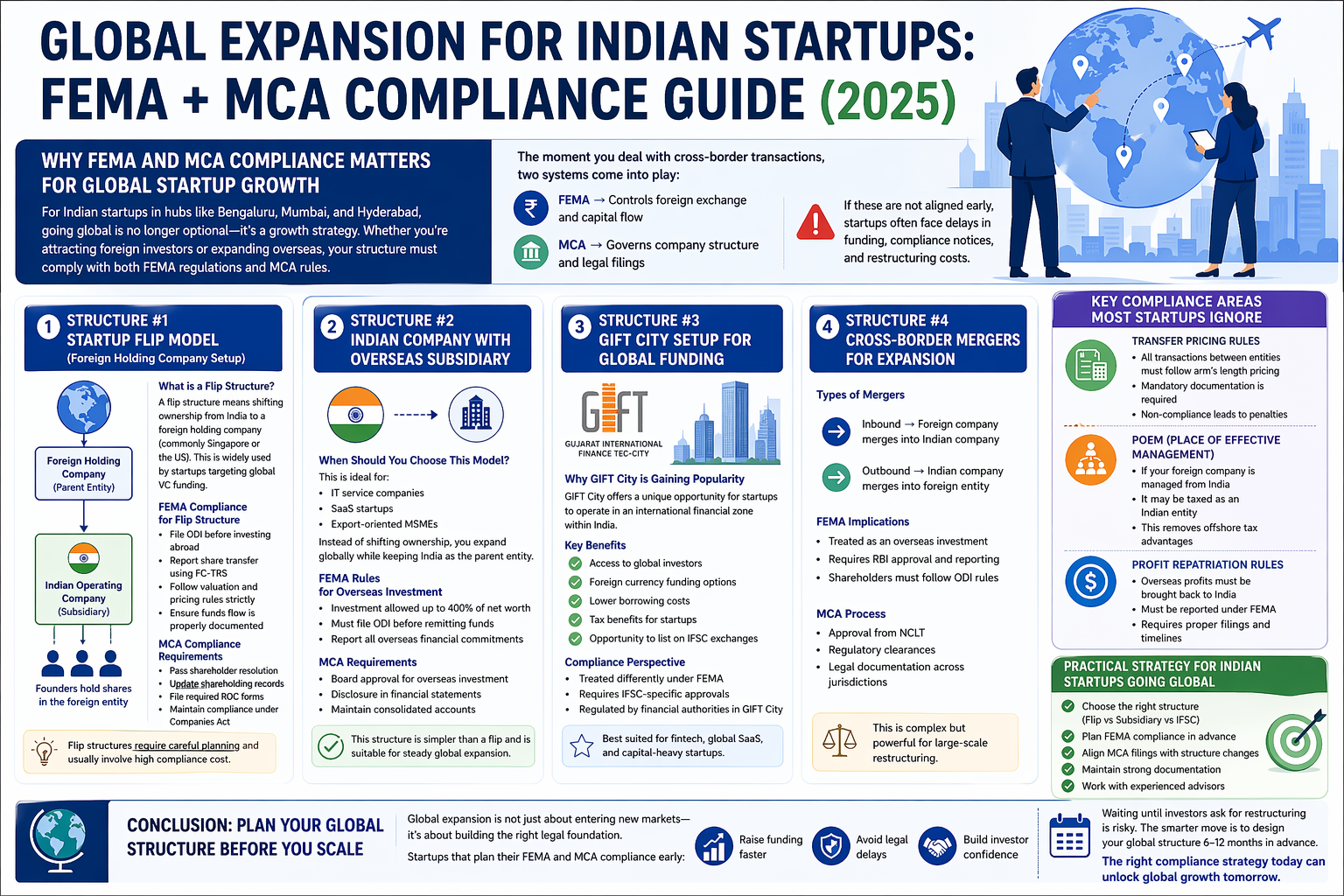
Why FEMA and MCA Compliance Matter for Global Startup Growth
For Indian startups in hubs like Bengaluru, Mumbai, and Hyderabad, going global is no longer optional—it’s a growth strategy. Whether you’re attracting foreign investors or expanding overseas, your structure must comply with both FEMA compliance and MCA rules.
The moment you deal with cross-border transactions, two systems come into play:
If these are not aligned early, startups often face delays in funding, compliance notices, and restructuring costs.
A flip structure means shifting ownership from India to a foreign holding company (commonly Singapore or the US). This is widely used by startups targeting global VC funding.
👉 Flip structures require careful planning and usually involve high compliance costs.
This is ideal for:
Instead of shifting ownership, you expand globally while keeping India as the parent entity.
👉 This structure is simpler than a flip and is suitable for steady global expansion.
GIFT City offers a unique opportunity for startups to operate in an international financial zone within India.
👉 Best suited for fintech, global SaaS, and capital-heavy startups.
👉 This is complex but powerful for large-scale restructuring.
Once you operate internationally:
If your foreign company is managed from India:
Before expanding internationally:
✔ Choose the right structure (flip vs. subsidiary vs. IFSC)
✔ Plan FEMA compliance in advance
✔ Align MCA filings with structure changes
✔ Maintain strong documentation
✔ Work with experienced advisors
Global expansion is not just about entering new markets—it’s about building the right legal foundation.
Startups that plan their FEMA and MCA compliance early:
Waiting until investors ask for restructuring is risky. The smarter move is to design your global structure 6–12 months in advance.
👉 The right compliance strategy today can unlock global growth tomorrow.
 GST Input Tax Credit (ITC) Guide for Startups & MSMEs (2026)
 Audit Red Flags in Due Diligence: Investor Guide (2026)
 IEM Registration Part A vs Part B under DPIIT | Complete Guide
 RBI Reporting After Foreign Investment in India | FEMA Guide 2026
 Sections 185, 186 & 188 of Companies Act, 2013: Complete Guide