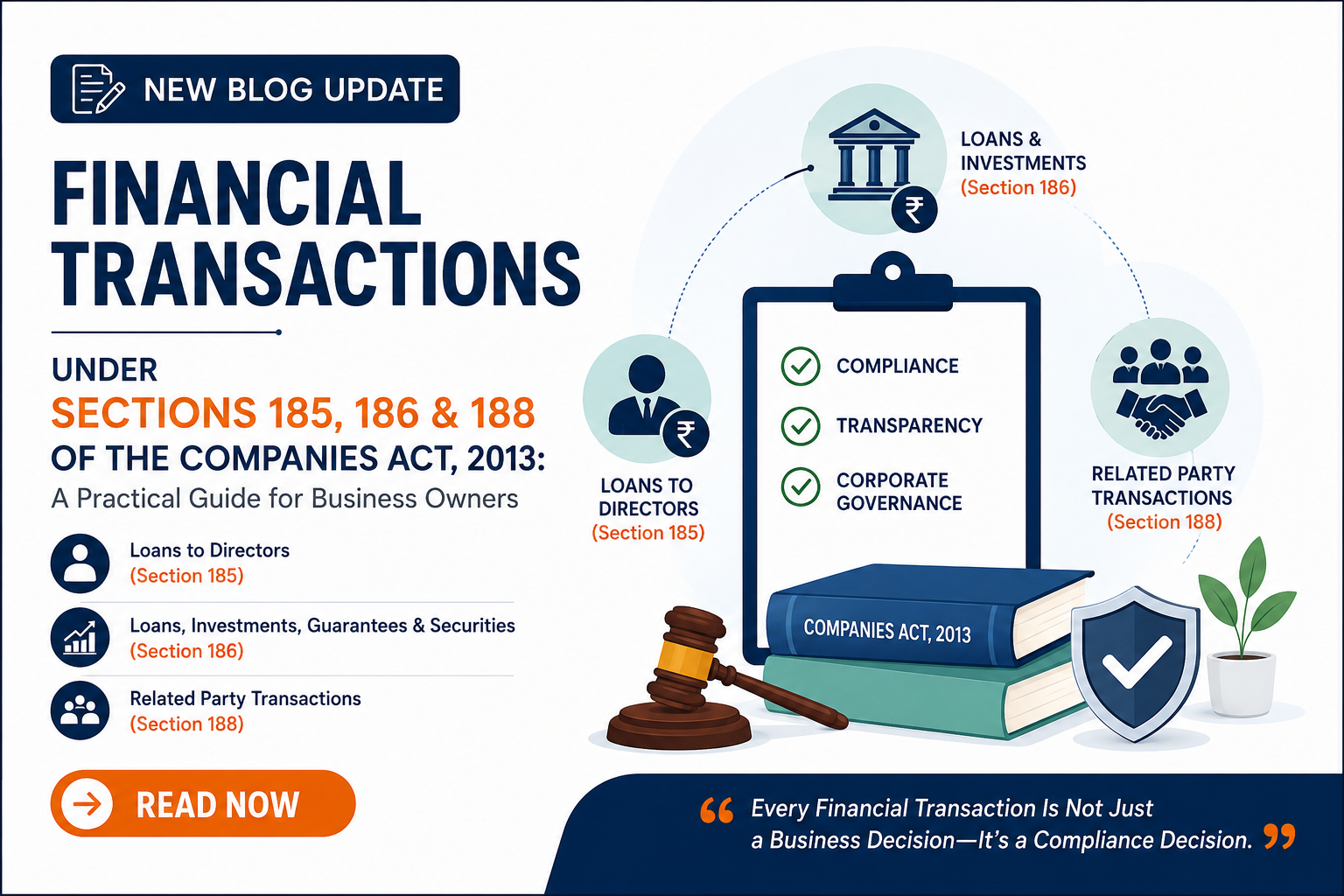
Growing businesses frequently engage in financial transactions such as lending money to group companies, providing corporate guarantees to banks, investing in subsidiaries, advancing funds to directors, or entering into contracts with related parties.
While these transactions may appear commercially justified, they are also regulated under the Companies Act, 2013. follow to comply with the applicable provisions can result in regulatory scrutiny, financial penalties, and questions on corporate governance.
Understanding the scope of these provisions is essential for every business owner, director, CFO, and investor.
Need Expert Advice on Loans, Investments, Corporate Guarantees or Related Party Transactions?
Businesses often assume that transactions within a group of companies or with promoters can be undertaken without significant legal formalities. However, the Companies Act places checks and balances on such transactions to ensure transparency, protect shareholders, and prevent conflicts of interest.
Whether you are funding a subsidiary, extending a corporate guarantee, investing surplus funds, or entering into a contract with a related party, these provisions may apply.
The key is knowing which section governs which transaction
Section 185 restricts companies from providing financial help to directors or to entities in which directors have an interest, except in specific circumstances permitted by law.
The goal is to prevent misuse of corporate funds for the personal benefit of those managing the company.
Section 185 generally applies to:
Before extending any financial help, companies should test:
Ignoring these checks may expose both the company and its officers to penalties.
While Section 185 focuses on who receives financial help, Section 186 regulates how much a company may lend, invest, guarantee or secure.
It is one of the most important provisions governing treasury and group funding decisions.
Section 186 applies to:
Companies should assess:
Section 186 promotes financial discipline by ensuring that companies do not expose themselves to excessive financial risk without appropriate approvals.
Business relationships with promoters, directors, relatives, holding companies, subsidiaries and associate companies are common. However, these transactions must be undertaken transparently and on commercial terms.
Section 188 regulates contracts and arrangements entered into with related parties.
Some common related party transactions include:
Before entering into a related party transaction, companies should test:
A transparent approval process protects both the company and its management from allegations of conflict of interest.
Details | Section 185 | Section 186 | Section 188 |
Primary Goal | Restricts loans to directors and interested entities | Regulates loans, investments, guarantees and securities | Regulates related party transactions |
Focus | Recipient of financial help | Amount and nature of financial help | Transactions with related parties |
Applies To | Directors and specified connected entities | Any person or body corporate | Related parties |
Transactions Covered | Loans, guarantees and securities | Loans, investments, guarantees and securities | Sale, buy, services, leasing, appointments and other contracts |
Board Approval | Generally required | Required | Required |
Shareholder Approval | Required in specified cases | Required beyond prescribed limits | Required where thresholds are exceeded or applicable exemptions are unavailable |
Purpose | Prevent misuse of company funds | Ensure prudent financial management | Promote transparency and fairness in related party dealings |
Yes
A single transaction may attract more than one provision of the Companies Act.
For example:
Accordingly, businesses should test every financial transaction holistically rather than considering these provisions in isolation.
Many businesses inadvertently expose themselves to regulatory risks by:
These oversights are frequently identified during statutory audits, secretarial audits, due diligence exercises, and investor reviews.
Before entering into any significant financial transaction, businesses should:
A proactive compliance approach not only reduces legal risk but also strengthens corporate governance and investor confidence.
Financial transactions are integral to business growth, but every transaction must be viewed through the lens of corporate compliance.
Sections 185, 186, and 188 are designed to ensure that companies deploy their financial resources responsibly, transparently, and in the interests of all stakeholders. Understanding the purpose and interplay of these provisions enables businesses to make informed decisions while avoiding costly compliance failures.
For founders, directors, CFOs, and investors, these sections are not merely legal requirements—they are fundamental principles of sound corporate governance.
At Chhota CFO, we assist businesses in structuring financial transactions, reviewing compliance under Sections 185, 186 and 188, drafting Board and Shareholder Resolutions, maintaining statutory registers, advising on related party transactions, and ensuring end-to-end compliance under the Companies Act, 2013.
Whether you are planning a loan, investment, corporate guarantee, or related party transaction, our team helps you execute the transaction with confidence, clarity, and compliance.