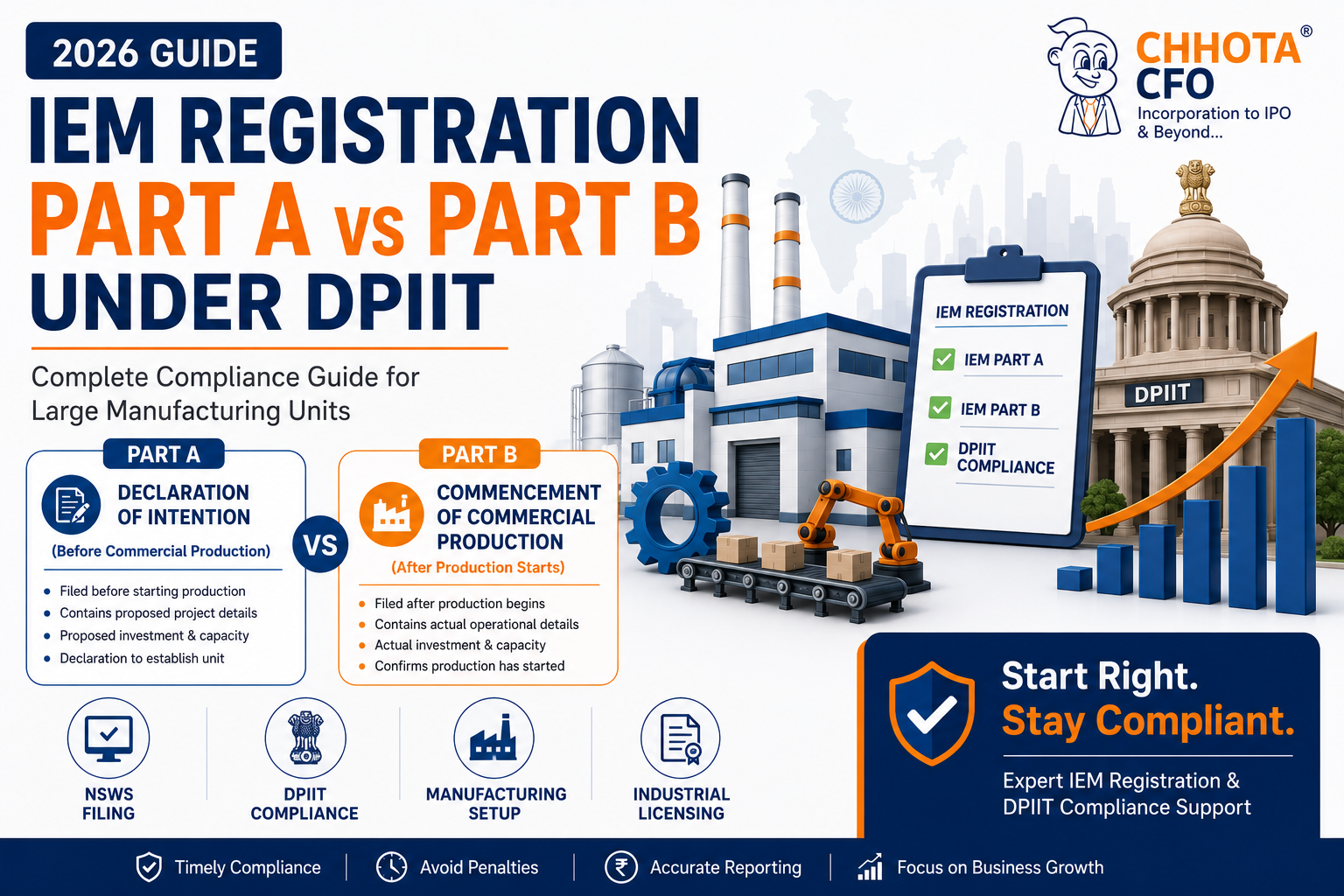
Planning to Set Up a Large Manufacturing Unit? Here’s What You Need to Know About IEM Part A and Part B
India has significantly simplified the process of establishing manufacturing industries through the Industrial Entrepreneur Memorandum (IEM) framework. Instead of obtaining an industrial license for most de-licensed sectors, eligible large-scale manufacturing enterprises are required to file an Industrial Entrepreneur Memorandum (IEM) with the Department for Promotion of Industry and Internal Trade (DPIIT).
One of the most common questions entrepreneurs ask is
Need Help with IEM Registration or DPIIT Compliance?
Although both are part of the same registration process, they serve entirely different purposes. Understanding the distinction is essential to ensure timely compliance and avoid regulatory issues.
An Industrial Entrepreneur Memorandum (IEM) is a self-declaration filed with DPIIT by eligible large-scale industrial undertakings operating in sectors that do not require a compulsory industrial license.
An IEM is not an approval or license. It is an acknowledgement of information furnished by the industrial undertaking regarding its proposed or operational manufacturing project. Eligible enterprises typically include large-scale units in de-licensed sectors with investment in plant and machinery exceeding ₹125 crore and/or turnover exceeding ₹500 crore.
Today, all new IEM filings, including Part A, Part B, and amendments, are made through the National Single Window System (NSWS), following the migration of services from the earlier G2B portal.
Part A is the Declaration of Intention
IEM Part A is filed before commencing commercial production. It informs DPIIT that an industrial undertaking proposes to establish a manufacturing facility.
Think of Part A as the project’s formal declaration to the government before production begins.
The filing primarily records:
This information enables DPIIT to maintain industrial statistics and monitor investments in India’s manufacturing sector.
Part A should be filed before the commencement of commercial production.
Businesses generally complete this filing during the project planning or implementation stage, before the factory starts manufacturing.
The applicant is generally required to furnish:
While Part A represents an intention to establish a manufacturing unit, Part B confirms that the industrial undertaking has actually commenced commercial production.
Part B is therefore filed after commercial production begins.
The objective of Part B is to update DPIIT with the actual operational details of the manufacturing unit.
These include:
Upon filing, DPIIT issues an acknowledgement of Part B, completing the reporting cycle for the project.
Once commercial production commences, the industrial undertaking should promptly file IEM Part B through the NSWS portal.
Particulars | IEM Part A | IEM Part B |
Purpose | Declaration of intention to establish a manufacturing unit | Intimation of commencement of commercial production |
Filing Stage | Before commercial production | After commercial production begins |
Nature | Proposed project details | Actual operational details |
Investment | Proposed investment | Actual investment |
Capacity | Proposed production capacity | Actual production capacity |
Employment | Expected employment | Actual employment |
Outcome | IEM Part A Acknowledgement | IEM Part B Acknowledgement |
Can Changes Be Made After Filing Part A?
Yes.
If there are changes in:
The applicant should file an amendment to Part A before or along with the applicable compliance process, as permitted under the DPIIT framework. DPIIT has issued separate Standard Operating Procedures for Part A amendments.
All fresh applications, Part B filings, and amendments are now processed exclusively through the National Single Window System (NSWS). Existing users of the legacy G2B portal are required to register afresh on NSWS for future IEM services.
Many applicants face delays due to avoidable errors, including:
Proper planning and accurate disclosures help ensure a smooth filing process.
Our team assists manufacturers, investors, and industrial enterprises with:
Whether you are setting up a new manufacturing facility or expanding an existing industrial undertaking, we provide end-to-end compliance support to help your project move forward efficiently.
IEM Part A and Part B are two essential stages of compliance for eligible large-scale manufacturing units operating in de-licensed sectors. Part A communicates the intention to establish an industrial undertaking, while Part B confirms that commercial production has commenced.
Understanding the purpose, timing, and requirements of each filing enables businesses to remain compliant while supporting the government’s objective of maintaining reliable industrial data and promoting ease of doing business in India.
Contact Chhota CFO today for expert guidance on IEM registration and manufacturing compliance.