Every month, thousands of Indian startups and MSMEs pay their GST dues diligently, file their returns on time, and move on. What most of them don’t realise is that buried inside the GST framework is a mechanism designed to prevent the cascading effect of double taxation — one that could be putting real money back into their working capital. It’s called Input Tax Credit, and for a startling number of growing businesses, it remains almost entirely unclaimed.
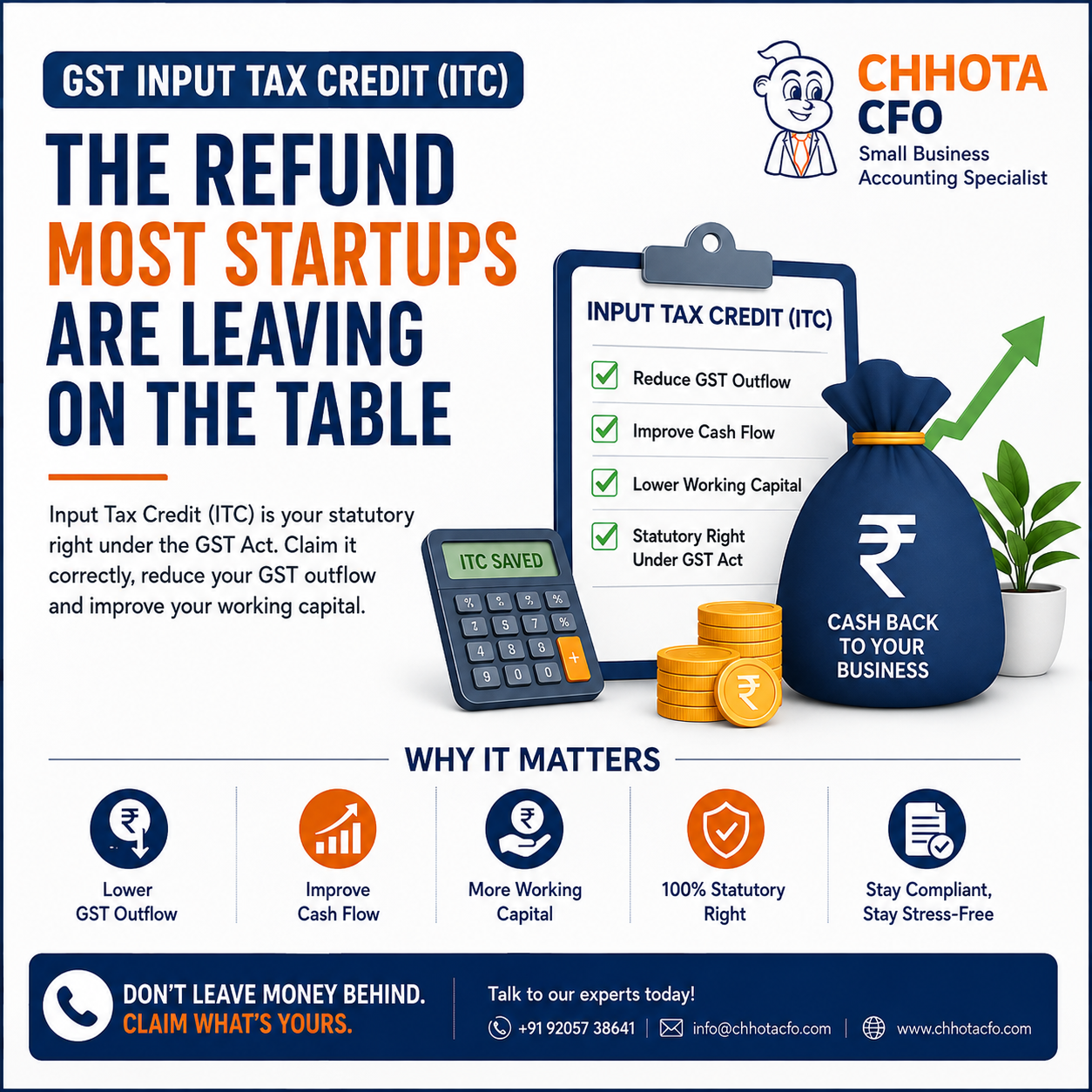
This isn’t a loophole or a workaround. Input Tax Credit is a statutory right. The GST Act explicitly allows businesses to offset the tax they’ve paid on purchases — raw materials, software subscriptions, professional services, office equipment — against the tax they collect on their sales. In theory, it’s elegantly simple. In practice, it’s where most founders quietly haemorrhage cash.
Maximize Your GST Input Tax Credit with Expert Support
When your business pays GST on a vendor invoice, that tax doesn’t have to be a sunk cost. If that buy was made in the course of your business and meets the eligibility criteria under the GST Act, the tax paid becomes a credit you can use to reduce your output tax liability. The more you buy to run your business, the more credit you accumulate. Used correctly, ITC can substantially reduce your monthly GST outflow and improve cash flow—especially for startups in high-growth phases where input costs are high.
For a bootstrapped startup burning ₹20–30 lakhs a month on operations, cloud infrastructure, contractor fees, and marketing- all GST-bearing expenses- the unclaimed ITC can run into several lakhs per year. That’s not accounting inefficiency. That’s cash sitting on the table.
Contact Chhota CFO today for a comprehensive GST health check and unlock every eligible input tax credit your business deserves.
The GST Act makes ITC available broadly, but with important guardrails. Before a credit can be claimed, three conditions must be satisfied.
Purchases made for personal use or for exempt supplies do not qualify. A subscription to a project management tool? Eligible. A restaurant bill from a client dinner? Not eligible under Section 17(5), which blocks ITC on food and beverages except in specific circumstances.
This is where many founders are caught off-guard. Even if you have a valid tax invoice and have paid GST on a buy, you can only claim that credit if your vendor has correctly reported the invoice in their own GSTR-1 filing and if it appears in your GSTR-2B. If your supplier is non-compliant, their lapse becomes your problem.
This sounds obvious, but in practice, many startups deal with vendors who issue incomplete invoices: missing GSTINs, incorrect HSN codes, and wrong place of supply. Each of these errors can make a credit ineligible until corrected.
The GSTR-2B is the auto-populated statement that tells you exactly how much ITC is available to you based on what your suppliers have reported. Many businesses claim ITC based on their own buy records without reconciling against GSTR-2B. When the two don’t match, the excess claim becomes a liability with interest currently at 18% per annum.
Section 17(5) of the GST Act lists specific categories where ITC is explicitly disallowed: motor vehicles (with exceptions), food and beverages, health and life insurance (unless offered as a statutory employee benefit), and works contract services. Founders who unknowingly claim these face demand notices, penalties, and interest during scrutiny or audit.
ITC must be claimed by the earlier of two dates: the filing of the annual return for that financial year or 30th November of the following year. Many startups—particularly those with backlogs in bookkeeping—discover unclaimed credits only after this window has closed, making them permanently irrecoverable.
For service businesses operating across states, incorrectly classifying IGST as CGST+SGST (or vice versa) can render credits ineligible even when the underlying transaction is legitimate. This is especially common for startups managing multi-state operations without dedicated finance support.
Recovering unclaimed or under-claimed ITC starts with a thorough reconciliation, not just for the current month, but retroactively for the last two to three years where the window is still open. This involves matching every purchase invoice against the GSTR-2B, identifying gaps, following up with non-compliant vendors, and ensuring your books correctly classify eligible versus ineligible credits.
For most growing businesses, this is a task that requires both accounting rigor and GST expertise. It’s not a one-time exercise either; ITC management needs to be embedded into the monthly close process so that credits are captured in real time, reconciliation is done before the return is filed, and no eligible amount is left behind.
This is precisely where having a finance partner with deep compliance expertise makes a tangible difference. Chhota CFO, a Bengaluru-based virtual CFO firm working with startups and MSMEs across India, works with founders to build exactly this kind of systematic financial infrastructure. Their team of Chartered Accountants, Cost Accountants, Company Secretaries, and Advocates provides services spanning taxation consultancy, GST compliance, bookkeeping, and audit; meaning ITC management is addressed not in isolation, but as part of a complete financial picture.
For a founder already stretched across product, sales, and hiring, the value of that isn’t just the recovered credit. It’s the confidence that someone with the right expertise is watching the numbers closely enough to catch what you’d otherwise miss.
ITC is one of the more visible examples of a wider truth: the GST framework, while complex, was designed with legitimate relief mechanisms built in. The problem is that accessing those mechanisms requires systematic financial management—which most early-stage businesses simply haven’t had the bandwidth to build.
The startups that come out ahead aren’t necessarily the ones who raised more or hired faster. They’re the ones who built financial discipline early, who knew what they were owed, claimed what was legitimate, and kept their compliance clean. In a cash-constrained environment, the difference between disciplined ITC management and a casual approach to compliance isn’t a line item. It’s months of runway.
If you haven’t audited your ITC position recently, the question to ask isn’t whether there’s money being left behind. It almost certainly is. The question is how much and how quickly you can get it back.