Every startup founder spends time thinking about product, customers, and fundraising. Few think about governance until an investor, auditor, or regulator asks uncomfortable questions. That’s where a company secretary (CS) becomes indispensable—not merely as a compliance professional, but as someone who helps build a company that is legally sound, investor-ready, and built to scale.
Ask a founder what a company secretary (CS) does, and you’ll often hear some version of “handles paperwork” or “files stuff with the ROC.” It’s an understandable guess and a costly one. Treating the CS function as clerical is one of the more common blind spots among early-stage founders, and it tends to surface at the worst possible time: during a funding round, an audit, or a compliance notice that could have been avoided months earlier.
In reality, the company secretary sits at the intersection of law, governance, and strategy. A good CS doesn’t just keep your company compliant—it keeps your business investable, auditable, and defensible when stakeholders begin asking tough questions. Here’s what the role actually covers and how to think about when your startup needs one.
Need Company Secretarial Support for Your Startup?
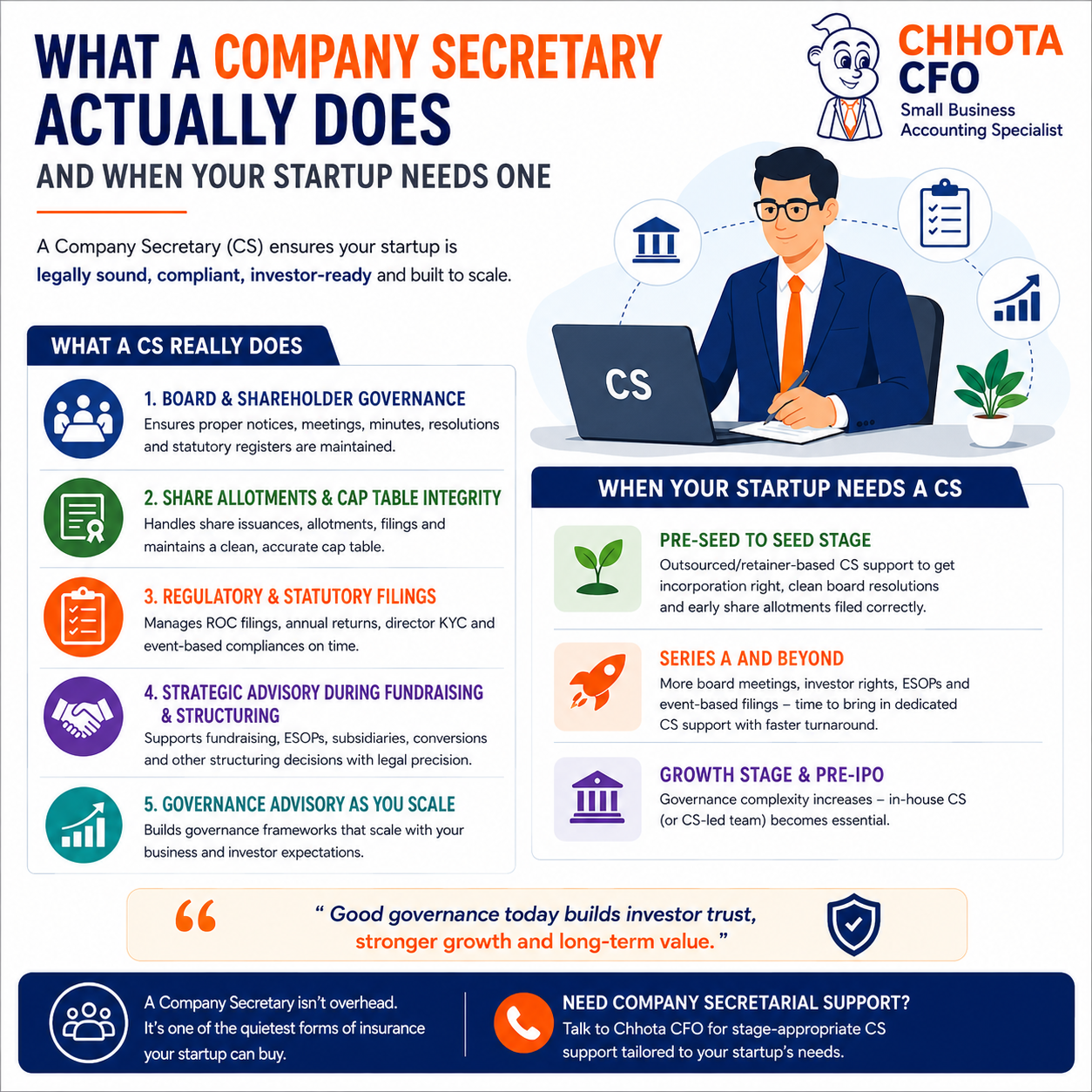
Every board resolution, every shareholder meeting, every corporate decision of consequence needs to be documented in a legally sound way. This isn’t box-ticking. Minutes and resolutions are the paper trail that proves your company made decisions properly. When an investor’s legal team runs due diligence, incomplete or informal board records are one of the fastest ways to slow down or kill a deal. A CS ensures notices are issued correctly, quorum requirements are met, resolutions are drafted with the right legal language, and statutory registers are maintained without gaps.
Every time you issue shares to a co-founder, an early employee, an angel investor, or during a priced round, there’s a statutory process behind it: board approval, shareholder approval where required, filing of allotment forms, updating the register of members, and issuing share certificates. Get this wrong, and you end up with a cap table that doesn’t match your legal filings—a problem that’s expensive and time-consuming to unwind and one that almost always surfaces during a Series A or acquisition due diligence process. A CS keeps your equity structure legally clean as it evolves.
Annual returns, financial statement filings, director KYC, and event-based compliances tied to changes in directors, registered office, capital structure, or charges. The list of filings a private limited company owes the Registrar of Companies is longer than most founders expect, and each has its own timeline and penalty structure for delay. A CS tracks this calendar so it never becomes a fire drill, and so your company doesn’t accumulate late fees or, worse, disqualification risk for directors.
This is where the CS role stops looking clerical altogether. During fundraising, a CS is often the person coordinating between founders, investors’ counsel, and auditors to ensure the transaction, share subscription agreements, shareholders’ agreements, ESOP pools, and conversion of instruments are executed and filed correctly, not just negotiated well. The same applies to structuring decisions: setting up subsidiaries, ESOP trusts, or preparing for conversion from an LLP or partnership to a private limited company. A CS who understands the commercial context, not just the compliance checklist, becomes a genuine strategic partner in these moments.
As a company grows, more directors, more investors, and more complex approval matrices, governance itself becomes a design problem. What needs board approval versus shareholder approval? What are the related-party transaction rules once you have institutional investors on the cap table? A CS who’s involved early helps you build governance habits that scale, rather than retrofitting them under pressure once a lead investor’s term sheet demands it.
Get Company Secretarial Support
The honest answer: from day one, in some form but not necessarily in-house.
Pre-seed to seed stage: Most startups don’t need a full-time CS yet. What they need is reliable access to CS expertise on a retainer or outsourced basis—someone who ensures incorporation is done right, the first board resolutions are clean, and early share allotments (founder shares, ESOP pool creation, and first angel cheques) are filed correctly from the start. This is also the stage where mistakes are cheapest to avoid and most expensive to fix later.
Series A and beyond: Once you’re running board meetings more frequently, managing investor rights, issuing ESOPs regularly, and filing more event-based compliances, the volume and urgency of CS work usually justify bringing someone in-house or on a dedicated retainer with faster turnaround. This is also typically when due diligence starts getting serious, and a CS who already knows your company’s history is far more valuable than one starting cold.
Growth stage and pre-IPO: By this point, an in-house CS (or a CS-led compliance team) is close to non-negotiable. Governance complexity, the number of subsidiaries or group entities, and regulatory exposure all increase, and the CS often becomes a key liaison with the board, auditors, and regulators.
The mistake most founders make isn’t hiring a CS too late in a literal sense. It’s treating the function as an afterthought until an investor’s diligence checklist forces the issue. By then, cleaning up two or three years of informal governance and messy filings is a slow, expensive exercise that eats into deal timelines and founder bandwidth.
At Chhota CFO, we work with founders who are focused on building their product and their market, not on tracking ROC deadlines or drafting board resolutions. Alongside our finance and CFO-advisory services, we help startups access company secretarial support that’s structured to match their stage: outsourced and retainer-based early on, scaling up as governance complexity grows. The goal is simple: make sure compliance and governance are never the reason a deal slows down, a fundraise stalls, or an audit turns into a scramble.
For founders, the takeaway is this: a company secretary isn’t overhead. Done right, it’s one of the quieter forms of insurance your company can buy, protecting your cap table, your governance record, and ultimately, your ability to raise capital and exit cleanly when the time comes.
Founders often think governance can wait. In reality, good governance compounds just like good financial discipline. Bringing company secretarial expertise into your business early isn’t about satisfying regulators—it’s about building a company investors trust, auditors respect, and future acquirers value.