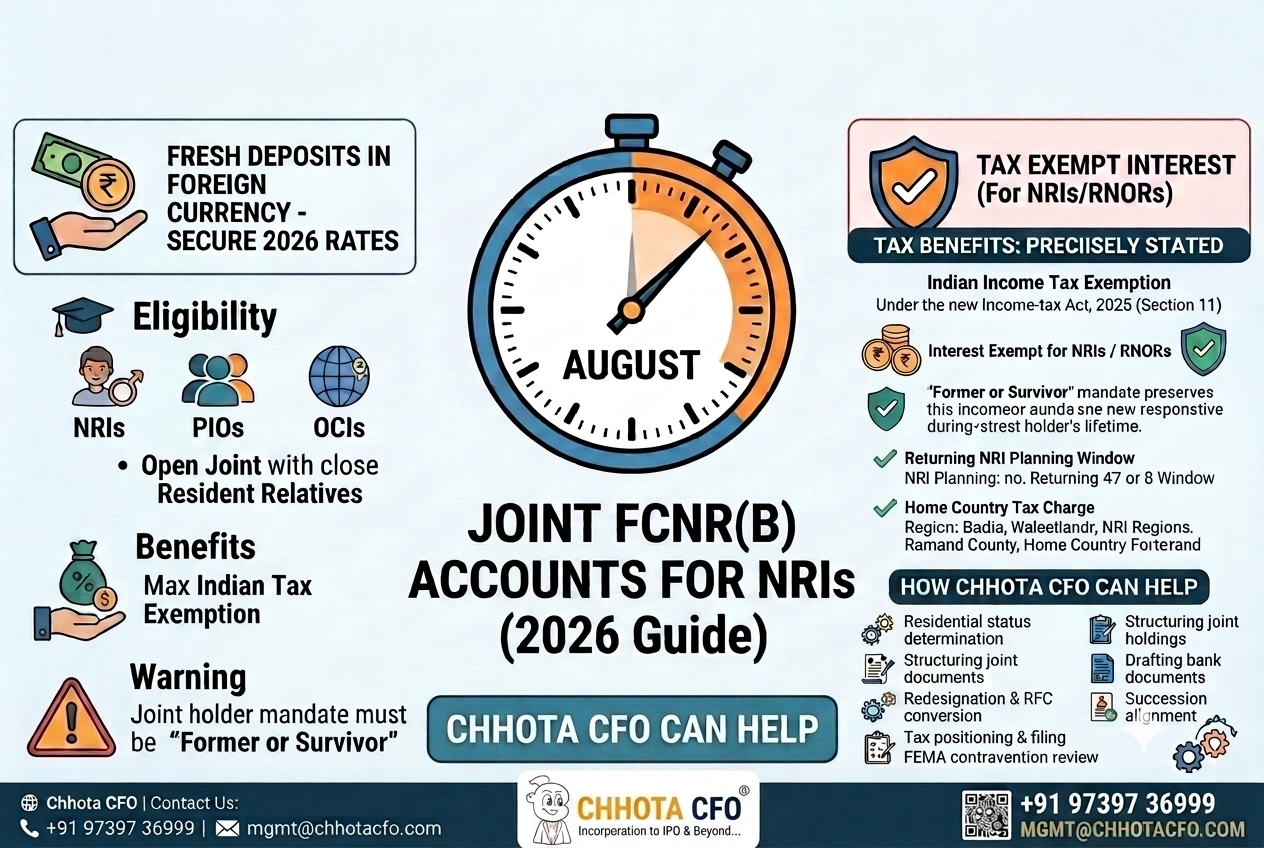
On 8 June 2026, the Reserve Bank of India opened a special US Dollar–Rupee swap facility for fresh FCNR(B) deposits of three to five years, simultaneously suspending the interest rate ceiling on that tenor band and exempting such deposits from CRR and SLR maintenance. The response was extraordinary: deposits mobilised under the facility crossed USD 52 billion by mid-August 2026, against roughly USD 946 million of FCNR(B) inflows in the whole of FY 2025-26.
The window was originally to run until 30 September 2026. By six amendment directions dated 25 August 2026 (RBI/2026–27/243 to 248), the Reserve Bank has brought that date forward to 31 August 2026.
Fresh FCNR(B) deposits must be mobilised on or before that date to fall within the special arrangement;
banks may execute the corresponding swaps with the Reserve Bank for a short period thereafter.
If a joint FCNR(B) structure is on your agenda, the structuring decision and the booking decision now have to be taken together, and quickly. That is precisely the point at which families tend to get the paperwork wrong.
Planning a Joint FCNR(B) Deposit? Get the Structure Right Before You Book
A Foreign Currency Non-Resident (Bank) deposit is a term deposit denominated and repaid in a permitted foreign currency, maintained with an authorised dealer bank in India. It is governed by the Foreign Exchange Management (Deposit) Regulations, 2016 (Notification No. FEMA 5(R)/2016-RB), read with Schedule II thereto, and operationally by the RBI Master Direction on Deposits and Accounts, as updated through 29 June 2026.
Its defining characteristic is that no rupee conversion ever takes place. You remit dollars; you are repaid dollars. The movement of the rupee during the tenure is irrelevant to your return. This is the single feature that an NRE fixed deposit cannot replicate, and it is why FCNR(B) tends to be the instrument of choice for NRIs whose liabilities and long-term spending are in foreign currency.
The essential mechanics:
Permitted currencies: any freely convertible currency the bank chooses to offer — commonly USD, GBP, EUR, AUD, CAD, JPY and SGD.
Tenor: one year to five years generally. Deposits under the 2026 special arrangement carry a minimum tenor of three years and a maximum of five, with a mandatory one-year lock-in.
Interest: computed on a 360-day year, compounded at intervals of 180 days.
Repatriability: principal and interest are fully repatriable without monetary limit.
Security value: banks may grant rupee or foreign currency loans and overdrafts against the deposit, to the depositor or to a third party, subject to margin norms.
Eligibility flows from FEMA residential status, not from citizenship and not from income-tax residency. The account may be opened by a person resident outside India under FEMA — in practice, a Non-Resident Indian, a Person of Indian Origin, or an Overseas Citizen of India.
Two qualifications are worth noting:
Nationals of Pakistan require prior approval of the Reserve Bank. Nationals of Bangladesh require a valid visa and a valid residential permit issued by the concerned Foreigners Regional Registration Office.
An OCI who returns to India intending to stay for an indefinite period ceases to be eligible and must have the account redesignated. Physical presence in India beyond 182 days with settled intent is the trigger; the label on the account is not.
Funding must come from permissible sources: inward remittance from abroad, transfer from an existing NRE or FCNR(B) account, proceeds of foreign currency notes or instruments tendered personally on a visit to India, or such other credits as the Reserve Bank generally or specially permits.
This is where the enquiries come in, and where the errors are concentrated.
Where all the joint holders are non-residents — NRIs, PIOs or OCIs — the position is straightforward. The bank may permit joint holding and may offer operating mandates such as Either or Survivor, subject to its own account terms. There is no regulatory compulsion to designate a first holder in any particular way.
Where a resident Indian is added, the arrangement is tightly constrained. Two conditions are mandatory and non-negotiable:
(a) The NRI, PIO or OCI must be the first holder. (b) The mandate must be ‘Former or Survivor‘. No other mandate is permitted.
The consequence is often misunderstood by the family that requests it. Former or Survivor means the resident joint holder has no operating rights whatsoever during the lifetime of the non–resident holder. The resident cannot withdraw, cannot instruct, and cannot deal with the deposit. Their rights crystallise only on the death of the first holder.
Families frequently ask for a joint account expecting the arrangement to solve a convenience problem — an elderly parent in India needing to manage funds while the son or daughter is abroad. It does not. A joint holding is a succession device, not an operational one.
If the objective is day-to-day management, the instrument is a Power ofAttorney or a mandate in favour of a resident, which may be the same person as the joint holder. A PoA holder may operate the account for permissible local payments on behalf of the non-resident.
But the boundary is strict: the PoA holder may not create any beneficial interest in favour of himself. The funds remain the non-resident’s throughout. A PoA holder who applies the funds for his own benefit is not merely in breach of the mandate — he has exposed the account holder to a contravention of FEMA, with penalties under Section 13 running up to three times the sum involved, subject to compounding.
The Reserve Bank adopts the definition of “relative” in Section 2(77) of the Companies Act, 2013, read with Rule 4 of the Companies (Specification of Definitions Details) Rules, 2014. The list is exhaustive:
Members of a Hindu Undivided Family Husband and wife
Father, including step-father Mother, including step-mother Son, including step-son
Son’s wife
Daughter
Daughter’s husband
Brother, including step-brother Sister, including step-sister
Not included: cousins, uncles, aunts, nephews, nieces, grandchildren, friends, business partners and in-laws other than a son’s wife and a daughter’s husband. Banks will decline these, and correctly so.
Individual banks may operate a narrower internal list than the statutory definition permits. Confirm the specific bank’s position before committing to a structure.
These are separate mechanisms and should be used together, not interchangeably.
| Joint holding | Nomination |
Rights during first holder’s lifetime | None (under Former or Survivor) | None |
On death of the depositor | Survivor becomes entitled to the deposit | Nominee receives proceeds as trustee for the legal heirs |
Residential status of the other party | Must be an eligible close relative | Nominee need not be a non-resident |
Effect on succession | Passes by survivorship | Does not override succession law |
A well-constructed FCNR(B) holding usually has both a joint holder and a nominee, chosen deliberately and consistently with the depositor’s will.
Speak to an NRI Tax & FEMA Advisor
On the death of the non-resident first holder, the surviving resident joint holder becomes entitled to the deposit. Three things follow, and all three are routinely missed:
The deposit may generally be allowed to run to its contracted maturity at the contracted rate, subject to the bank’s policy and RBI norms.
On maturity, it must be redesignated — as a resident rupee account, or credited to a Resident Foreign Currency (RFC) account where the survivor is eligible. It cannot continue as an FCNR(B) deposit in resident hands.
The tax character of the interest changes from the date of death. Interest attributable to the period after the survivor holds the deposit in her own right, as a resident, does not enjoy the non-resident exemption. This is the point at which a tax liability appears in a year when the family is least expecting one.
The onus of informing the bank of the change in status rests on the account holder, not the bank.
Interest on an eligible FCNR(B) deposit with a scheduled bank is exempt from Indian income tax in the
hands of an individual who is a non-resident, or a resident but not ordinarily resident (RNOR).
For tax years up to 2025-26, the exemption sat in Section 10(15)(iv)(fa) of the Income-tax Act, 1961. With the Income-tax Act, 2025 in force from 1 April 2026, the same exemption now operates through Section 11 read with Schedule IV, Serial No. 14. The substance is unchanged — the newAct has not withdrawn the benefit — but the citation in your advisor’s file note, your bank declaration and your return should be updated.
Because the income is exempt, no tax is deducted at source. There is no refund to chase and no Form
15G/15H equivalent to file.
The exemption is not attached to the name on the passbook. It requires:
the depositor to be a person resident outside India under FEMA (or an eligible RNOR); and the deposit to be maintained in accordance with FEMA and the Reserve Bank’s directions.
Fail either limb and the exemption fails with it, however the account is labelled. An account that ought to have been redesignated on return to India, but was not, is not saved by the fact that the bank’s records still say “FCNR”.
No — provided the structure is correct. Under a Former or Survivor mandate the resident second holder has no beneficial interest and no right to the income during the first holder’s lifetime. The interest continues to accrue to the non-resident alone, and the exemption is unaffected. There is no clubbing consequence and no deemed gift on the mere addition of a joint holder, because no ownership passes.
What disturbs the position is a defective structure: a resident credited with funds of her own into the account, a resident permitted to operate it as though it were her own, or a mandate other than Former or Survivor. Each of these creates a FEMA exposure, and each invites the Assessing Officer to look through the arrangement.
This is the most valuable planning window in the entire product, and the most frequently squandered.
An existing FCNR(B) deposit may be allowed to run to its original maturity at the contracted rate even after the depositor returns to India.
Interest remains exempt for so long as the depositor is a non–resident or RNOR.
Once the depositor becomes resident and ordinarily resident, the interest becomes taxable — even though the Reserve Bank permits the deposit itself to continue.
On maturity, proceeds should be credited to an RFC account where eligibility exists, which preserves foreign-currency holding and, during the RNOR period, continued exemption.
Sequencing the date of return, the deposit maturity dates and the RFC conversion is worth real money.
Doing it after the fact is not possible.
Interest on a deposit is not consideration for a taxable supply and attracts no GST. What does attract GST at 18% is the fee component of banking services — account maintenance charges, remittance and swift charges, duplicate statements and the like — under SAC 9971. Nothing in the current GST framework affects the FCNR(B) product itself.
India’s exemption is India’s alone. Most jurisdictions tax residents on worldwide income:
United States: FCNR(B) interest is fully taxable at ordinary rates and reportable on Schedule B. Because India levies no tax, no foreign tax credit arises. The account is reportable on FBAR (FinCEN 114) and, where thresholds are met, on Form 8938.
United Kingdom: taxable on the arising basis under Self Assessment.
UAE, Qatar, Kuwait, Oman, Bahrain and Saudi Arabia: no personal income tax on such interest, which is why the Gulf diaspora finds the product particularly efficient.
Treaty relief is of no assistance where the source country has levied nothing. Plan for the home-country charge before you book, not after.
Adding a joint holder for convenience. It does not achieve convenience. A PoA does.
Continuing an FCNR(B) or NRE account after becoming resident under FEMA. The two residency tests
— FEMA and income tax — diverge, and it is the FEMA test that governs the account. Crediting a resident joint holder‘s own funds into the account. A clear contravention. Assuming the exemption survives ROR status. It does not.
Nominating one person and willing the deposit to another. Survivorship and nomination do not override succession; inconsistency guarantees a dispute.
Booking a deposit under the special 2026 arrangement without noting the one-year lock-in. No interest is payable on withdrawal within the first year.
Selecting a joint holder outside Section 2(77). The bank will reject the application, usually after the remittance has already landed.
Overlooking Schedule FA and foreign-asset reporting in the first year of ROR status.
We advise NRI families, returning professionals and their Indian relatives on the full arc of this decision:
Residential status determination under FEMA and under the Income-tax Act, 2025, including RNOR window mapping and return-date planning
Structuring joint holdings — selecting the correct mandate, verifying relative eligibility, and drafting the
Power of Attorney or mandate so that operational needs are met without a FEMA exposure
Drafting and vetting bank documentation, declarations and account-opening paperwork Redesignation and RFC conversion on change of residential status, with the sequencing worked out in advance
Succession alignment — reconciling nomination, survivorship and testamentary disposition
Tax position papers and return filing for non-residents and RNORs, including foreign-asset disclosure
FEMA contravention review and compounding applications where an account has already gone wrong
Speak to us before 31 August 2026
If you are weighing an FCNR(B) deposit under the current arrangement — alone or jointly — the
structuring call and the booking call now have to happen in the same week.
Chhota CFO | CLAAT Corporate Advisors LLP Jayanagar, Bengaluru mgmt@chhotacfo.com | +91 97397 36999 www.chhotacfo.com
Write to us with your residential status, intended tenor and proposed joint holder, and we will revert with a structuring note.