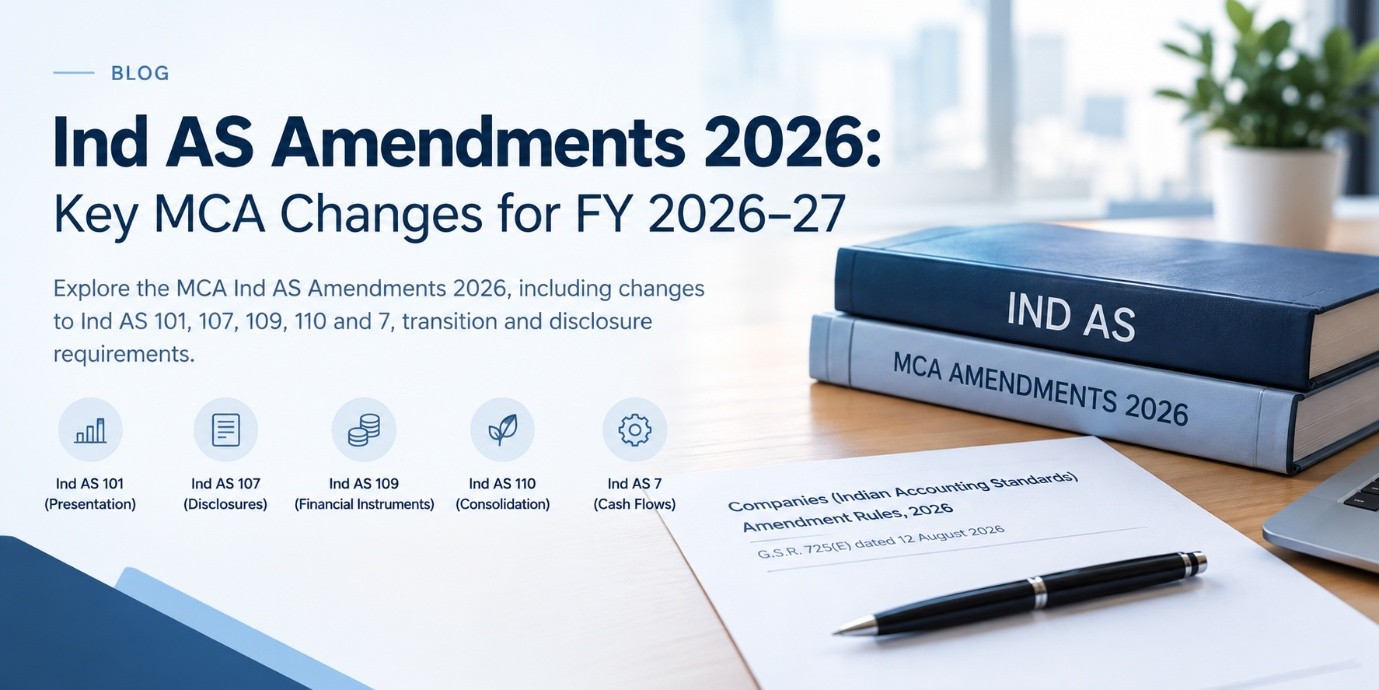
The Ministry of Corporate Affairs has notified the Companies (Indian Accounting Standards) Amendment Rules, 2026, through G.S.R. 725(E) dated 12 August 2026, in exercise of its powers under section 133 read with section 469 of the Companies Act, 2013 and in consultation with the National Financial Reporting Authority. The Rules amend Ind AS 101, Ind AS 107, Ind AS 109, Ind AS 110 and Ind AS 7. They came into force on the date of publication in the Official Gazette, and the substantive amendments apply to annual reporting periods beginning on or after 1 April 2026 — that is, from the financial year 2026–27.
This is not a housekeeping notification. It brings India substantially into line with the International Accounting Standards Board’s post-implementation review of the classification and measurement requirements for financial instruments, and it introduces an entirely new accounting and disclosure architecture for renewable power purchase arrangements. For any company that borrows on sustainability-linked terms, invests through structured or non-recourse arrangements, settles material payables electronically, or has signed a solar or wind power purchase agreement, the amendments will change numbers, disclosures, or both.
Stay ahead of the latest accounting requirements with professional Ind AS compliance and accounting services from Chhota CFO.
The amendments apply to every entity that prepares its financial statements under Ind AS pursuant to Rule 4 of the Companies (Indian Accounting Standards) Rules, 2015. In practice this covers all listed companies and companies in the process of listing, unlisted companies meeting the prescribed net worth threshold, and the holding companies, subsidiaries, joint ventures and associates of such companies. Banks, insurers and non-banking financial companies continue to follow their own notified roadmaps.
Companies that report under the Companies (Accounting Standards) Rules, 2021 are outside the scope of this particular notification. That framework was separately amended earlier in 2026 in relation to Accounting Standard 22 on accounting for taxes on income, and should be assessed on its own terms.
The principal rules were published as G.S.R. 111(E) dated 16 February 2015 and were last amended by G.S.R. 549(E) dated 13 August 2025. That earlier notification, the Companies (Indian Accounting Standards) Second Amendment Rules, 2025, dealt with the classification of liabilities as current or non-current and non-current liabilities with covenants under Ind AS 1, disclosure of supplier finance arrangements under Ind AS 7 and Ind AS 107, and the Pillar Two international tax reform amendments to Ind AS 12, most of them effective from 1 April 2025.
The consequence is that the financial statements for FY 2026–27 will be the first set to carry both waves in full: the 2025 amendments in their first comparative year and the 2026 amendments in their year of initial application. Disclosure checklists built for FY 2025–26 will be incomplete.
The most commercially significant change sits in the application guidance to the solely payments of principal and interest test. New paragraph B4.1.8A states that the assessment of interest focuses on what the entity is being compensated for rather than how much compensation it receives, while acknowledging that the quantum may itself signal compensation for something other than basic lending risks and costs. Cash flows indexed to a variable that is not a basic lending risk or cost — the value of equity instruments, a commodity price, or a share of the debtor’s revenue or profit — are inconsistent with a basic lending arrangement, however common such terms may be in the relevant market.
New paragraph B4.1.10A addresses the question that has troubled lenders and borrowers across the sustainable finance market: what happens where a contingent event does not relate directly to basic lending risks and costs, such as an interest rate step-down linked to a contractually specified reduction in carbon emissions. The answer is a comparison test. Such an asset meets the solely payments of principal and interest condition if, and only if, in all contractually possible scenarios the contractual cash flows would not be significantly different from those on an otherwise identical instrument without the contingent feature. The assessment may be qualitative in straightforward cases and quantitative where the margin adjustment is material.
Two illustrative instruments have been inserted into the standard to anchor the analysis. A loan whose rate adjusts by a fixed number of basis points on achievement of a carbon reduction target, where the maximum cumulative adjustment would not significantly change the interest rate, passes the test. A loan whose rate tracks a market-determined carbon price index does not, because it is indexed to a variable that is not a basic lending risk or cost.
New paragraph B4.1.16A defines a non-recourse feature as one where the entity’s ultimate right to receive cash flows is contractually limited to the cash flows generated by specified assets, so that the entity is primarily exposed to the performance risk of those assets rather than the debtor’s credit risk. Paragraph B4.1.17 confirms that a non-recourse feature does not by itself disqualify an asset from amortised cost or fair value through other comprehensive income measurement, but requires the creditor to look through to the underlying assets and to consider the effect of other arrangements such as subordinated debt or equity issued by the debtor.
Paragraph B4.1.20 now describes the waterfall payment structure and concentration of credit risk that characterise contractually linked instruments, and new paragraph B4.1.20A carves out arrangements that merely look like tranching but are in substance lending structures designed to give a creditor enhanced credit protection. Where a structured entity issues senior and junior debt and the sponsor holding the junior instrument has no practical ability to sell it without the senior instrument becoming payable, the holder applies the ordinary paragraphs B4.1.7 to B4.1.19 rather than the contractually linked instruments analysis. Paragraph B4.1.23 has also been tightened on which lease receivables may sit in the underlying pool, excluding those subjects to residual value risk or indexed to a variable that is not a basic lending risk or cost.
Ind AS 107 gains paragraphs 20B to 20D. For each class of financial assets measured at amortised cost or at fair value through other comprehensive income, and each class of financial liabilities measured at amortised cost, an entity must disclose a qualitative description of the nature of any contingent event that could change contractual cash flows, quantitative information about the possible range of changes, and the gross carrying amount or amortised cost of the instruments subject to those terms. The standard names sustainability-linked liabilities expressly: the example given is a class of financial liabilities whose contractual cash flows change if the entity achieves a reduction in its carbon emissions.
Paragraphs 11A and 11B have also been amended. Disclosures for equity investments designated at fair value through other comprehensive income are now required for each class of investment, with the fair value at the end of the reporting period, the fair value gain or loss recognised in other comprehensive income during the period split between investments derecognised and investments still held, and any transfers of cumulative gain or loss within equity relating to derecognised investments.
New paragraph B3.1.2A confirms the default position that a financial liability is derecognised on the settlement date. New paragraph B3.3.8 then creates a narrow accounting policy election. Where a financial liability, or part of one, is settled in cash through an electronic payment system, the entity may deem it discharged before the settlement date if, and only if, it has initiated a payment instruction such that it has no practical ability to withdraw, stop or cancel the instruction; it has no practical ability to access the cash to be used for settlement; and the settlement risk associated with that electronic payment system is insignificant.
Paragraph B3.3.9 explains that settlement risk is insignificant where completion follows a standard administrative process and the interval between the first two conditions being met and cash reaching the counterparty is short. It is not insignificant where completion remains subject to the entity’s ability to deliver cash on the settlement date. Critically, paragraph B3.3.10 requires that an entity electing to apply this treatment must apply it to all settlements made through the same electronic payment system — the election is made by system, not by transaction.
For Indian corporates settling high volumes through NEFT, RTGS and comparable channels, this bears directly on year-end cash and trade payable balances and on the cut-off procedures that support them. The election should be evaluated deliberately rather than allowed to emerge by default from an ERP configuration.
This is the newest body of thinking in the notification and the one most likely to be underestimated. New paragraph 2.3A of Ind AS 109 defines contracts referencing nature-dependent electricity as contracts that expose an entity to variability in the underlying amount of electricity because the source of generation depends on uncontrollable natural conditions such as weather. The definition captures both physical contracts to buy or sell such electricity and financial instruments referencing it. Paragraph 2.3B expressly prohibits applying the new requirements by analogy to any other contract, item or transaction.
New paragraphs B2.7 and B2.8 acknowledge the commercial reality of a pay-as-produced renewable power purchase agreement: the buyer must take delivery when the electricity is generated and may be exposed to intervals in which it cannot use that electricity, with market design compelling the sale of unused volumes within a specified time. Such forced sales are not necessarily inconsistent with the own-use exemption. The entity is treated as holding the contract in accordance with its expected usage requirements if it has been, and expects to be, a net purchaser of electricity over the contract period, meaning it buys sufficient electricity to offset sales of unused electricity in the same market. In assessing this, the entity considers reasonable and supportable information available without undue cost or effort about past, current and expected transactions over a reasonable amount of time — determined by reference to the seasonal cycle of generation and the entity’s own operating cycle, and, for the backward-looking test, not exceeding twelve months.
New paragraph 6.10.1 permits an entity designating such a contract as a hedging instrument in a hedge of forecast electricity transactions to designate as the hedged item a variable nominal amount of forecast transactions aligned with the variable volume expected to be delivered by the generation facility. Paragraph 6.10.2 provides that where the cash flows of the hedging instrument are conditional on the occurrence of the designated forecast transaction, that transaction is presumed to be highly probable. All other hedge accounting requirements continue to apply.
Ind AS 107 introduces paragraphs 5B to 5D and 30A to 30C. An entity must present, in a single note, information enabling users to understand the effect of these contracts on the amount, timing and uncertainty of future cash flows and on financial performance. The note must cover contractual features exposing the entity to volume variability and to the risk of buying electricity it cannot use; unrecognised commitments including estimated future cash flows by appropriate time bands and the assumptions used in assessing whether a contract may become onerous under Ind AS 37; and, for the reporting period, the cost of electricity purchased with separate disclosure of unused volumes, the proceeds of selling unused electricity, and the cost of purchases made to offset those sales. Where related information appears in other notes, cross-references must be given.
The fourth stream is narrower in scope but broader in reach, touching five standards.
Standard | What has changed |
Ind AS 101 | Paragraphs B5 and B6 recast, clarifying how a first-time adopter deals with hedging relationships carried forward from previous GAAP, including designation of an individual item or a net position as the hedged item on transition. |
Ind AS 107 | Paragraph B38 rewritten to sharpen the disclosure of gains or losses on derecognition where the entity retains continuing involvement, including whether the fair value measurement relied on significant unobservable inputs. |
Ind AS 109 | Paragraph 2.1(b)(ii) confirms that lease liabilities recognised by a lessee are subject to the derecognition requirements of Ind AS 109; paragraph 5.1.3 clarifies initial measurement of trade receivables without a significant financing component; Appendix A definitions realigned. |
Ind AS 110 | Paragraph B74 redrafted on de facto agents, requiring an investor to consider the agent’s decision-making rights and indirect exposure to variable returns alongside its own when assessing control. |
Ind AS 7 | Paragraph 37 amended so that, for an investment in an associate, joint venture or subsidiary carried at cost, the investor reports only the cash flows between itself and the investee, such as dividends and advances. |
The amendments to the classification and measurement of financial instruments are applied retrospectively in accordance with Ind AS 8, subject to two reliefs. Prior periods need not be restated, and may be restated only where this is possible without hindsight. Where prior periods are not restated, the effect of initial application is recognized as an adjustment to the opening balances of financial assets and financial liabilities, with the cumulative effect adjusted against opening retained earnings or another appropriate component of equity at the date of initial application. For each class of financial assets that changes measurement category, the entity must disclose the category and carrying amount immediately before and immediately after application.
The nature-dependent electricity amendments follow a similar retrospective-without-restatement model, with the date of initial application permitted to be the beginning of a reporting period that is not an annual period. An entity may, at that date, irrevocably designate a contract falling outside the scope of Ind AS 109 as measured at fair value through profit or loss, and may discontinue an existing hedging relationship where the same hedging instrument is redesignated under the new paragraphs. Hedge accounting under paragraphs 6.10.1 and 6.10.2 is applied prospectively to new designations.
The point most likely to be missed is this: early application of the classification and measurement amendments is not permitted in India. Appendix 1 to Ind AS 109 records that paragraph 7.1.13 of IFRS 9, which permits early adoption, has deliberately not been carried into Ind AS 109. Entities that have been anticipating the amendments in advance of FY 2026–27 should revisit that position.
A related practical matter deserves attention. The Rules were notified on 12 August 2026, after the first interim reporting period of FY 2026–27 had closed and, for many listed entities, after quarterly results had been approved. Groups should assess the consequences for their interim financial reporting under Ind AS 34 and for the comparative and reconciliation disclosures that will follow.
Companies assessing these changes can also seek professional accounting and compliance support.
The notification records that the Central Government acted in consultation with the National Financial Reporting Authority. That phrase is easy to skim past, and it should not be. NFRA was constituted on 1 October 2018 under sub-section (1) of section 132 of the Companies Act, 2013. Its duties under sub-section (2) are to recommend accounting and auditing policies and standards, to monitor and enforce compliance with those standards, to oversee the quality of service of the professions associated with such compliance, and to perform incidental functions. The regulator that helped shape these amendments is the same regulator that will test whether they have been applied.
The monitoring apparatus is public and worth studying. The NFRA portal maintains Financial Reporting Quality Review reports, Audit Quality Review reports, circulars, consultation papers, inspection guidelines and firm inspection reports, together with orders and debarments. A company that wants to understand how its own disclosures will be read should read what the regulator has already said about other companies’ disclosures.
The precedent in this specific area is instructive. NFRA’s first Financial Reporting Quality Review Report, on KIOCL Limited for FY 2019–20, concluded that the company’s accounting policy for foreign exchange forward contracts was erroneous and non-compliant with the classification and measurement requirements of Ind AS 109, and recommended that the company examine whether restated financial statements were required under Ind AS 8 and section 131 of the Companies Act, 2013. Classification and measurement under Ind AS 109 is precisely the territory that the 2026 amendments have now enlarged and made more judgemental.
Recent NFRA activity reinforces the direction of travel. The Authority conducted a webinar on expected credit loss under Ind AS 109 in January 2026, and its Auditor–Audit Committee Interaction Series has been running through judgement-heavy topics, most recently the audit of provisions, contingent liabilities and contingent assets under Ind AS 37 read with SA 540 and SA 501. Its newsletter, NFRA संवाद, and a staff series on technology in audit indicate a regulator communicating expectations in advance rather than only after the event. Audit committees that engage with this material are better placed than those that do not.
One further development deserves the attention of every finance leader. In January 2026, NFRA and IndiaAI launched the IndiaAI Financial Reporting Compliance Challenge, inviting Indian companies and startups to build an engine that extracts text, tables and financial data from multi-format documents, segments them into logical sections, and validates each section for completeness, integrity and compliance against a defined framework, producing explainable compliance reports and risk analytics. The programme carries a prize pool of ₹1.5 crore and the prospect of a two-year deployment contract worth up to ₹1 crore. The practical inference is straightforward: disclosure gaps that once required a human reviewer to notice will increasingly be surfaced at scale. Boilerplate and omission are becoming detectable defects.
A related point of governance hygiene: NFRA periodically publishes lists of audit firms that have not filed, or have incompletely filed, Form NFRA-2. Companies selecting or reappointing auditors of public interest entities should treat that filing record as part of ordinary due diligence.
This article is a summary and no summary is a substitute for the instrument itself. The notification text should be read from the MCA portal at www.mca.gov.in under notifications for the Companies Act, 2013, searching for G.S.R. 725(E) dated 12 August 2026, alongside the principal Companies (Indian Accounting Standards) Rules, 2015 and the consolidated Ind AS as amended. The NFRA portal at www.nfra.gov.in should be consulted for circulars, consultation papers, Financial Reporting Quality Review and Audit Quality Review reports, inspection reports and orders that shape how compliance is assessed in practice. Where a judgement is finely balanced, the regulator’s published views on comparable facts are often more useful than commentary.
The notification also signals the shape of the next wave. In several places the amended text records that paragraph numbers have been retained solely for consistency with IFRS because the corresponding Indian standards are still being formulated — Ind AS 118 corresponding to IFRS 18, Presentation and Disclosure in Financial Statements, and Ind AS 119 corresponding to IFRS 19, Subsidiaries without Public Accountability: Disclosures. Ind AS 118 in particular will restructure the statement of profit and loss, introduce defined categories and subtotals, and formalize the disclosure of management-defined performance measures. Finance functions would be well advised to treat FY 2026–27 as the year in which to build the data foundations for that change rather than to wait for the notification.
At Chhota CFO, we work with MSMEs, growth-stage companies and promoter-led groups that need the technical depth of a large finance function without the cost of one. On this notification, our support typically covers a diagnostic impact assessment across the amended standards, contract-level review of financing and power purchase arrangements, transition workings and opening balance adjustments, drafting of accounting policy notes and the new Ind AS 107 disclosures, audit committee briefing material, and support through the statutory audit cycle.
If your company reports under Ind AS, the work to be done between now and 31 March 2027 is largely analytical and can be completed calmly if it is started now. If your company does not yet report under Ind AS but is approaching the threshold through growth, fundraising or a proposed listing, this is the right moment to model the transition rather than to encounter it.
Prepare confidently for FY 2026–27 with expert guidance. Talk to Chhota CFO for accounting, compliance, and financial reporting support.
Write to us at mgmt@chhotacfo.com or call +91 97397 36999 for an initial discussion on how the Companies (Indian Accounting Standards) Amendment Rules, 2026 affect your reporting for FY 2026–27.
 MCA Financial Year Flexibility Comes with a Tax Reporting Catch for Companies
 Fast Track Merger without NCLT approval
 Trademark Registration Bangalore: Fees, Eligibility & Steps
 Section 185 vs Section 186: Company Loan Rules Explained
 Joint FCNR(B) Account: NRI Eligibility, Rules & Tax Benefits