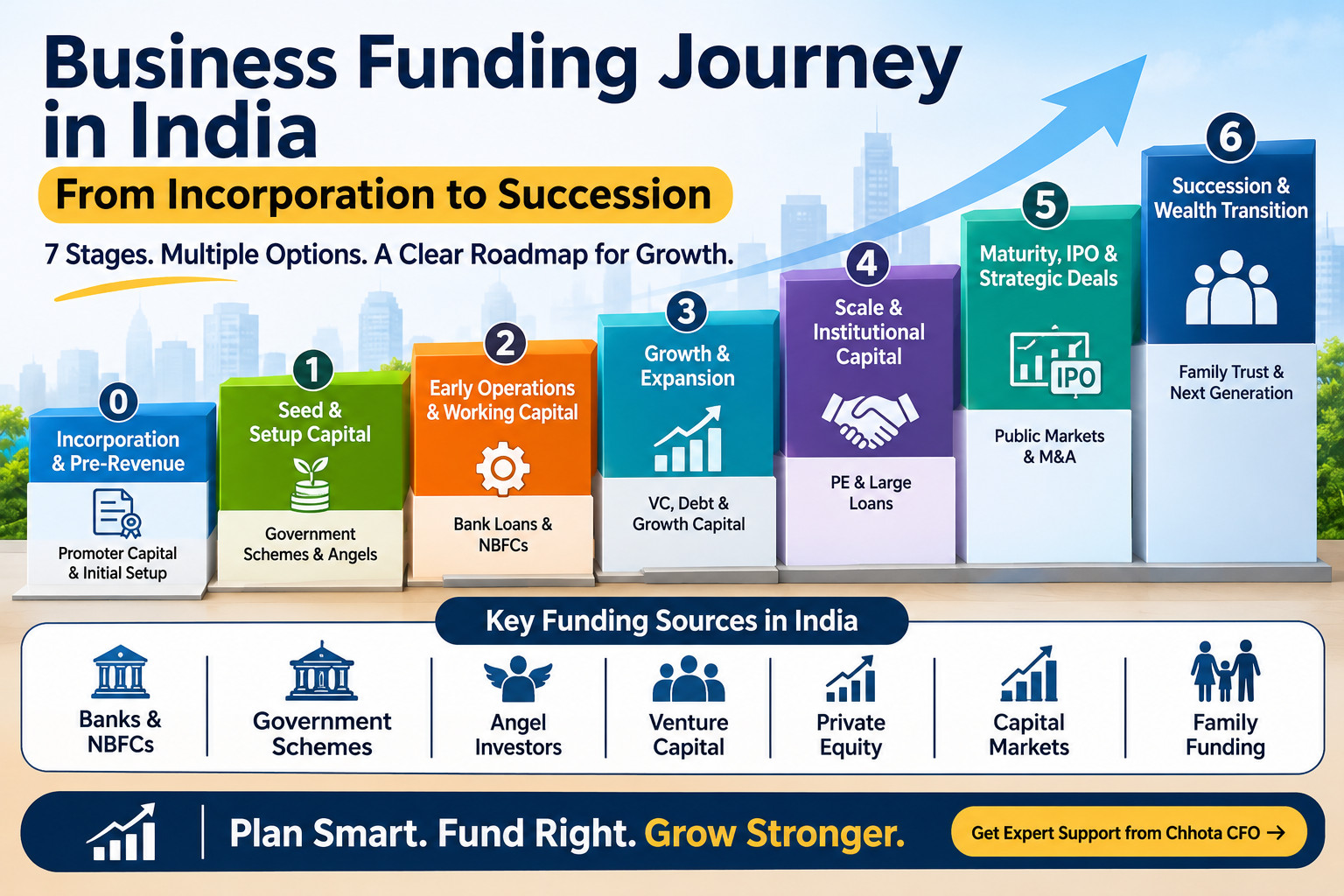
A business in India passes through seven funding stages, from incorporation to succession. Each stage has a different capital need, risk profile and set of lenders or investors willing to fund it. Matching the source to the stage is the single biggest lever on cost of capital and promoter control.
This journey covers private limited companies (and LLPs where noted) in three business models: manufacturing, trading and services. It maps every major source available in India: promoter capital, friends and family, angels, government schemes, chit funds, NBFCs, co-operative banks, commercial banks, domestic and foreign funds, capital markets and family structures.
How to read it:
Figures and scheme limits are current as of 20 November 2026. Scheme terms change with each Union Budget and RBI circular. Confirm limits with the lender or nodal agency before filing.
Need Help Choosing the Right Funding Strategy for Your Business?
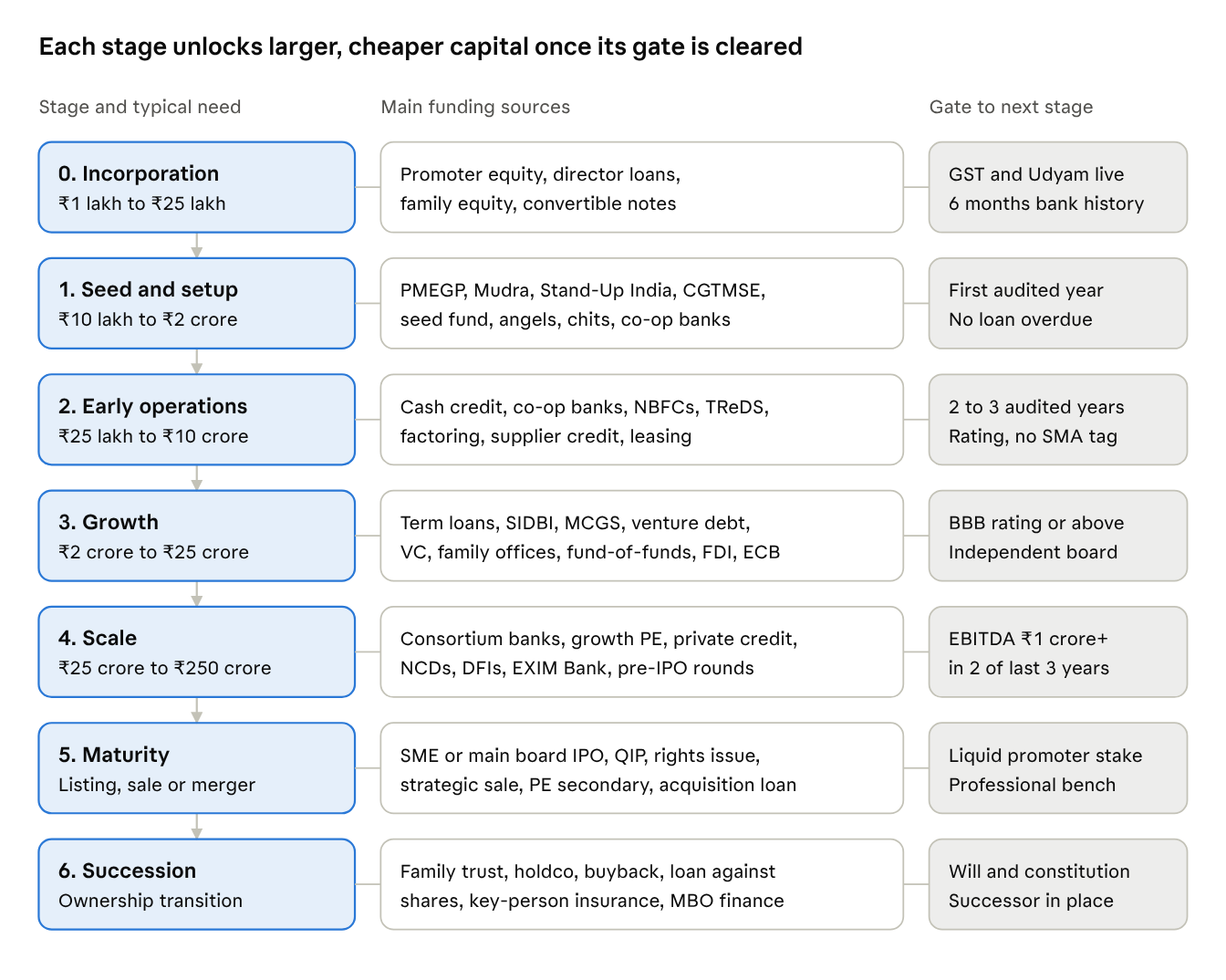
Funding journey · 7 stages, sources and gates
Read top to bottom. Each stage’s gate is the evidence lenders and investors need before they fund the next stage. Clearing a gate early lowers your cost of capital.
At this stage, funding comes almost entirely from the promoter’s own balance sheet and close circle. Typical need: ₹1 lakh to ₹25 lakh. No lender funds a business with no bank statements, no GST returns and no Udyam record.
Uses of funds:
Source | Typical ticket | Form | Key legal point |
Promoter savings | ₹1–25 lakh | Equity or director loan | No minimum paid-up capital. Keep proof of source of funds for KYC and tax scrutiny. |
Personal borrowing by promoter (gold loan, loan against FD, LIC policy, property or securities) | ₹2–50 lakh | Infused as equity or director loan | Debt sits on the promoter, not the company. Interest is not a company expense. |
Friends and family | ₹2–50 lakh | Equity shares, CCPS, or loan | A private company accepts loans only from directors, relatives of directors and members. A loan from a friend who is none of these is a deposit and is barred. |
Director loan | Any amount | Unsecured loan | Director gives a written declaration the funds are not borrowed. Report as exempt deposit in DPT-3 by 30 June. |
Convertible note (DPIIT startups) | ₹25 lakh or more per tranche | Note convertible within 10 years | Exempt from deposit rules when received in a single tranche of ₹25 lakh or more. |
Structure choice decides future funding options:
Two traps at this stage:
Milestone to exit Stage 0: current account opened, GST and Udyam in place, first invoices raised, and six months of clean bank statements.
Seed capital funds the first plant, store or delivery team, and government schemes carry most of the load here. Typical need: ₹10 lakh to ₹2 crore. Lenders look at promoter contribution (10% to 25%), project report quality and the promoter’s personal CIBIL score.
Source | Ticket | Cost or benefit | Best fit |
PMEGP (KVIC, DIC, KVIB) | Project cost up to ₹50 lakh manufacturing, ₹20 lakh services and trading | Subsidy 15% to 35% of project cost. Promoter puts in 5% to 10% | First-time micro units, rural and special-category promoters |
PM Mudra Yojana | Shishu up to ₹50,000. Kishore up to ₹5 lakh. Tarun up to ₹10 lakh. Tarun Plus up to ₹20 lakh for repeat borrowers who repaid Tarun | Collateral-free. Bank or NBFC rate | Micro traders, service providers, small workshops |
Stand-Up India | ₹10 lakh to ₹1 crore | Composite term loan and working capital. Greenfield only | SC, ST or women promoters holding 51% or more |
Bank term loan with CGTMSE cover | Up to ₹10 crore per borrower | 75% to 90% guarantee replaces collateral. Annual guarantee fee from 0.37% | Any Udyam-registered micro or small unit |
Startup India Seed Fund (through incubators) | Grant up to ₹20 lakh for proof of concept. Up to ₹50 lakh as debt or convertibles | Non-dilutive or low-dilution | DPIIT-recognised startups under two years old. Check the incubator’s open call |
State industrial policy incentives | Varies by state | Capital subsidy, interest subvention, stamp duty and electricity duty waivers | Manufacturing units in notified zones. Karnataka offers these through its Industrial Policy and Elevate grants for startups |
Angel investors and angel networks | ₹25 lakh to ₹5 crore | Equity, CCPS or convertible notes. 10% to 25% dilution | Tech, D2C and scalable services with a clear growth path |
Chit fund (registered foreman) | ₹5 lakh to ₹1 crore per chit | Effective cost depends on bid discount, often 12% to 20% or higher | Promoter-level bridge for traders and small manufacturers with steady monthly cash |
Co-operative bank term loan | ₹5 lakh to ₹2 crore | Close to commercial bank rates. Membership required | Local traders and manufacturers with ties to the bank |
What lenders and investors ask for:
Regulatory notes:
Milestone to exit Stage 1: unit operational, first full year of audited accounts, revenue visible in GST returns, and no overdue on any loan.
In years 1 to 3, the binding constraint shifts from capex to working capital: cash locked in inventory and receivables. Typical need: ₹25 lakh to ₹10 crore. Growth without a working capital line is the most common cause of early-stage failure.
Sizing the limit:
Source | Ticket | Indicative cost | Fit and caution |
Bank cash credit or overdraft (PSU, private, small finance banks) | ₹10 lakh to ₹10 crore | 9% to 12% | Cheapest line. Needs stock statements, annual renewal and often collateral. CGTMSE covers up to ₹10 crore |
Co-operative bank cash credit | ₹10 lakh to ₹5 crore | 10% to 14% | Faster local decisions. Urban co-operative banks are supervised by RBI. Per-borrower exposure caps limit large accounts |
NBFC working capital or business loan | ₹5 lakh to ₹5 crore | 14% to 26% unsecured | Quick and light on documents. Read foreclosure clauses and processing fees |
Fintech and cash-flow lending (GST, bank-statement or POS based) | ₹1 lakh to ₹50 lakh | 15% to 30% | Useful for traders and retail. Short tenor. Daily or weekly repayment strains cash |
TReDS invoice discounting (RXIL, M1xchange, Invoicemart) | Invoice value | Market-discovered, often near bank rates | MSME sellers to large corporates, PSUs and CPSEs. Without recourse to the MSME |
Factoring and supply chain finance | 70% to 90% of invoice | 10% to 15% | Banks and NBFC factors under the Factoring Regulation Act, 2011 |
Supplier credit and channel finance | 30 to 120 days | Built into price or 9% to 13% | Distributors and dealers funded by the brand’s bank. Core lever for traders |
Letter of credit and bank guarantee | Non-fund limit | 1% to 2.5% commission | Imports, tenders, advance-payment and performance guarantees |
Chit fund | ₹5 lakh to ₹1 crore | Effective 12% to 20%+ | Bridge for seasonal peaks. Prize money comes only after bidding. Monthly subscription runs for the full term |
Equipment lease or hire purchase | Asset value | 11% to 16% | Saves capex cash. Asset itself is the security |
Levers outside borrowing:
Milestone to exit Stage 2: two to three years of audited accounts, profitability or a clear path to it, a credit rating (even SME rating), and a utilisation history on the working capital line with no SMA classification.
Growth capital funds a second plant, new branches, new product lines or entry into new states and export markets. Typical need: ₹2 crore to ₹25 crore. This is the first stage where the choice between debt and equity shapes promoter control for decades.
Debt routes:
Source | Ticket | Indicative cost | Notes |
Bank term loan for capex (5 to 8 years, 6 to 12 month moratorium) | ₹50 lakh to ₹25 crore | 9% to 11.5% | Needs DSCR of 1.25+, debt-equity under 2:1 and asset cover of 1.25x |
SIDBI direct lending | ₹50 lakh to ₹25 crore | Competitive with banks | Machinery, energy efficiency, green and service-sector expansion |
Mutual Credit Guarantee Scheme for MSMEs (NCGTC) | Loans up to ₹100 crore | 60% guarantee | For plant and machinery where equipment is at least 75% of project cost. Confirm current terms with the lender |
Credit Guarantee Scheme for Startups (NCGTC) | Up to ₹20 crore per borrower | Guarantee to banks, NBFCs and venture debt funds | DPIIT-recognised startups |
Venture debt (Alteria, Trifecta, InnoVen, Stride and others) | ₹5 crore to ₹50 crore | 13% to 17% plus warrants | Taken alongside or after an equity round. Extends runway without full dilution |
NBFC and private credit term loans | ₹5 crore to ₹100 crore | 13% to 18% | Faster than banks. Cash-flow underwriting. Covenant-heavy |
External Commercial Borrowing | Higher of USD 1 billion or 300% of net worth (automatic route) | Market-determined | Revised framework effective 16 February 2026. Minimum average maturity of 3 years. Hedge currency risk |
Sale and leaseback, lease rental discounting | Up to 60% to 70% of property value | 9.5% to 12% | Releases cash locked in owned premises |
Source | Ticket | What they expect |
Domestic VC funds (Series A and B) | ₹15 crore to ₹150 crore | 20% to 30% dilution, board seat, affirmative rights, ESOP pool of 8% to 15% |
Family offices and HNIs | ₹2 crore to ₹50 crore | Flexible terms. Prefer profitable manufacturing and consumer businesses |
Government fund-of-funds (via SEBI-registered AIFs): Fund of Funds for Startups with a fresh ₹10,000 crore in Budget 2026-27, Self-Reliant India Fund with a ₹2,000 crore top-up, and the new ₹10,000 crore SME Growth Fund | Through daughter funds | Same as VC or growth funds. The SME Growth Fund targets manufacturing, services and technology SMEs, not only startups |
Foreign VC and growth funds (FDI or FVCI route) | USD 2 million to USD 50 million | Global governance standards, Big Four audit, FEMA-compliant pricing and exit rights |
Sector incentives at this stage:
Milestone to exit Stage 3: revenue above ₹50 crore or EBITDA above ₹5 crore, an external credit rating of BBB or above, independent board members, and audit by a firm investors accept.
At scale, the business funds itself through institutions: consortium banks, private equity, private credit and the debt market. Typical need: ₹25 crore to ₹250 crore. The price of entry is governance: audited quarterly MIS, independent directors and clean related-party dealings.
Source | Ticket | Indicative cost | Use case |
Consortium or multiple banking | ₹50 crore and above | 8.5% to 11% | Large working capital and term loans shared across banks. Lead bank runs common appraisal |
Growth private equity (domestic and foreign) | ₹50 crore to ₹500 crore | Equity. 15% to 35% stake | Capacity, acquisitions, pre-IPO. Expect board control rights, exit within 4 to 6 years, tag-along and drag-along |
Private credit funds (domestic AIFs and foreign funds) | ₹50 crore to ₹500 crore | 13% to 20% | Promoter funding, acquisition, refinancing, structured payouts. Secured by pledge and assets |
Non-convertible debentures (private placement) | ₹10 crore and above | 9.5% to 14% by rating | Issued under Section 42 and Section 71 to up to 200 persons a year. Listing optional. Needs a debenture trustee |
Development finance institutions (IFC, British International Investment, DEG, FMO, Proparco) | USD 10 million and above | Equity, debt or mezzanine | Climate, healthcare, financial inclusion, manufacturing with strong ESG standards |
EXIM Bank | Project-based | Competitive | Export capacity, overseas investment and buyer’s credit |
ECB from foreign lenders and parent | Higher of USD 1 billion or 300% of net worth | Market-determined | Capex, refinancing and acquisition under the 2026 framework. LRN from RBI before drawdown |
Pre-IPO placement | ₹25 crore to ₹200 crore | Equity at a discount to IPO price | Builds credibility and anchors IPO valuation |
Governance upgrades lenders and investors require:
Milestone to exit Stage 4: EBITDA of ₹1 crore or more in two of the last three years (the floor for an SME IPO), or ₹15 crore average operating profit (the profitability route for a main board IPO).
Connect with Chhota CFO to discuss the right funding strategy for your business.
A mature business raises capital from public markets or monetises value through a sale, merger or partial exit. The goal shifts from survival to valuation and liquidity for promoters and early investors.
Route | Eligibility (key points) | Fit |
SME IPO (BSE SME, NSE Emerge) | Post-issue paid-up capital up to ₹25 crore. EBITDA of ₹1 crore in at least two of the last three years. Offer for sale capped at 20% of issue size, and no seller offloads more than 50% of holding. Proceeds cannot repay promoter or related-party loans. Minimum application of two lots | Profitable MSMEs with ₹50 crore to ₹300 crore revenue |
Main board IPO (BSE, NSE) | Profitability route: net tangible assets of ₹3 crore, average operating profit of ₹15 crore over three years, net worth of ₹1 crore in each year. Otherwise 75% QIB allocation route | Larger companies seeking deep liquidity |
Migration from SME to main board | Track record on the SME platform plus main board criteria | Graduates from SME IPO |
Post-listing raises | Rights issue, preferential issue, QIP, warrants | Growth funding without a fresh IPO |
Direct listing at GIFT City IFSC | Permitted for unlisted public companies under 2024 rules. Confirm current operational status | Access to foreign investors in USD |
Strategic sale or merger | Valuation, due diligence, CCI approval above thresholds, NCLT for schemes | Full or partial exit, consolidation |
PE secondary sale | Negotiated buyer | Liquidity for promoters and early investors without listing |
Bank acquisition finance | Banks fund up to 75% of acquisition value for eligible Indian non-financial acquirers under RBI’s 2026 directions. Foreign-owned and controlled companies are excluded | Buying a competitor, supplier or distributor |
Preparation runs 18 to 36 months: restate three years of accounts, clean up related-party dealings, convert to a public company, build a full board and committees, and appoint a merchant banker. Main board listed entities then follow SEBI LODR in full, and SME-listed entities follow its lighter version plus main board related-party norms.
Milestone to exit Stage 5: a liquid market for the promoter’s stake, or a completed strategic transaction, and a professional management bench below the promoter.
Succession creates its own funding need: cash to buy out a sibling or co-founder, pay a non-family heir, settle estate claims or fund the next generation’s expansion. Plan it 5 to 10 years ahead. A succession forced by death or dispute destroys value and freezes bank lines.
The four decisions to settle first:
Ownership structures:
Structure | How it works | Points to watch |
Private family trust | Promoter settles shares on a trust under the Indian Trusts Act, 1882. Trustees vote. Beneficiaries receive income | Trust deed drafting, SBO and Section 89 beneficial-interest filings, tax treatment of the trust |
Promoter holding company | Family holds a holdco, which holds the operating company. Shares of the operating company stay intact | Tax-neutral share swap conditions, CIC rules if investments dominate the holdco balance sheet |
Will and family constitution | Will directs share transmission. Constitution sets employment, dividend and exit rules for family members | Probate where required, transmission under Section 56, articles must match the constitution |
Gift of shares to relatives | Transfer during the promoter’s lifetime | No income tax on gifts to relatives as defined. Stamp duty and SH-4 on transfer. Lender consent where shares are pledged |
LLP partner succession | LLP agreement provides for admission of heirs or payout of capital | Agreement must define valuation and payout schedule |
Funding the transition:
Need | Source | Notes |
Buy out a sibling or co-promoter | Company buyback, promoter loan against shares from NBFC or private credit, structured promoter financing | Buyback limits: 25% of paid-up capital plus free reserves, one buyback a year. From FY 2026-27 buyback proceeds are taxed as capital gains, with an additional tax on promoters (effective 22% for corporate promoters, 30% for others) |
Liquidity for exiting heirs | PE minority stake, PE secondary purchase, partial strategic sale | Sets a market valuation and brings governance discipline |
Management buyout by professionals or next generation | Bank acquisition finance (2026 framework), private credit, seller financing | Banks finance up to 75% of acquisition value for eligible acquirers |
Estate liquidity on sudden death | Key-person insurance, buy-sell agreement funded by insurance | Policy owned by the company or co-promoters. Payout funds the share purchase at a preset valuation formula |
Retain and reward successors | ESOPs, sweat equity, phantom stock | Ties professional managers to long-term value |
Lender-side actions:
Milestone to complete Stage 6: signed will and family constitution, ownership vehicle in place, successor running the business with banks’ consent, and exit paths funded for non-active heirs.
Each source below has a different regulator, legal limit and failure mode. Indicative costs are as of November 2026 and vary with credit profile, security and tenor.
Source | Regulator or law | Stages | Indicative cost | Key caution |
Promoter capital | Companies Act, 2013. Income-tax law on source of funds | 0 to 6 | Opportunity cost | Document source. Keep equity, not loans, as the base |
Friends and family | Companies (Acceptance of Deposits) Rules, 2014 | 0 to 1 | 0% to 12% | Private companies accept loans only from directors, their relatives and members. Equity is cleaner |
Angel investors and networks | Companies Act. FEMA for non-residents. SEBI for angel funds | 1 to 2 | Equity | Valuation, SHA terms, investor rights on future rounds |
Government schemes (PMEGP, Mudra, Stand-Up India, CGTMSE, CGSS, MCGS, state policies) | MSME Ministry, DFS, KVIC, SIDBI, NCGTC, state departments | 1 to 3 | Subsidy or bank rate | Subsidy locked until 3 years of operation. Delays in release. Strict end-use |
Chit funds | Chit Funds Act, 1982. State Registrar of Chits | 1 to 2 | 12% to 20%+ effective | Use only registered foremen (examples: Shriram Chits, Margadarsi, KSFE). Foreman commission capped at 7%, bid discount capped at 40% |
Microfinance institutions | RBI (NBFC-MFI) | 1 | 20% to 26% | Household income caps. Suits nano enterprises only |
NBFCs (business loans, LAP, equipment, invoice finance) | RBI scale-based regulation | 1 to 4 | 12% to 26% | Check fees, foreclosure terms and default interest. Verify RBI registration |
Fintech lenders and co-lending | RBI digital lending directions | 1 to 3 | 15% to 30% | Loan must flow from a regulated entity’s account. Key fact statement mandatory |
Urban co-operative banks | RBI (since the 2020 Banking Regulation amendment) and Registrar of Co-operative Societies | 1 to 3 | 10% to 14% | Membership required. Exposure caps per borrower. Deposits insured by DICGC up to ₹5 lakh |
Credit co-operative societies (state and multi-state) | State Co-operative Societies Act or MSCS Act, 2002. Not RBI-regulated | 1 | 12% to 18% | Not banks. No DICGC cover. Avoid placing company surplus here |
Commercial banks (PSU, private, small finance) | RBI, Banking Regulation Act, 1949 | 1 to 6 | 8.5% to 12% | Collateral, covenants, annual renewal. Cheapest source once eligible |
SIDBI, EXIM Bank, NABARD | RBI as all-India financial institutions | 2 to 5 | Competitive | Sector and purpose-specific windows |
TReDS and factoring | RBI. Factoring Regulation Act, 2011 | 2 to 4 | Near bank rates | Depends on buyer’s credit. Most effective when selling to large companies and CPSEs |
Domestic VC, PE and AIFs | SEBI (AIF) Regulations, 2012 | 2 to 5 | Equity | Dilution, board rights, exit pressure in 4 to 7 years |
Foreign fund houses (VC, PE, private credit) | FEMA NDI Rules, 2019. Press Note 3 (2020) for land-border countries | 2 to 6 | Equity or debt | Pricing floor at fair value. FC-GPR within 30 days of allotment. Government approval where the investor or beneficial owner is from a land-border country |
External Commercial Borrowing | FEMA (Borrowing and Lending) Regulations, revised February 2026 | 3 to 5 | Market-determined | Currency risk. LRN before drawdown. Monthly ECB-2 return |
Development finance institutions | Their own charters. FEMA on entry | 4 to 5 | Equity or debt | ESG action plans and impact reporting |
Venture debt | RBI for NBFCs. SEBI for debt AIFs | 2 to 4 | 13% to 17% plus warrants | Covenants tied to next equity round |
Private credit | SEBI (AIF). FEMA for offshore funds | 4 to 6 | 13% to 20% | Share pledge, cash sweeps, step-up interest |
Capital markets (SME IPO, main board, NCDs) | SEBI ICDR, LODR and NCS Regulations | 4 to 6 | Equity or coupon | Disclosure burden and continuous compliance |
Family trust and holdco structures | Indian Trusts Act, 1882. Companies Act. Income-tax law | 6 | Structuring cost | Drafting quality decides future disputes |
Registered and safe versus unregulated and risky: any scheme promising fixed high returns for deposits, a “chit” run by an individual without registration, or an investment society not shown on the state Registrar’s list falls outside regulation. The Banning of Unregulated Deposit Schemes Act, 2019 makes both running and promoting such schemes an offence.
The three business models need different capital at each stage: manufacturing needs long-term capex money, trading needs revolving working capital, and services need funding against people and receivables rather than assets.
Factor | Manufacturing | Trading | Services |
Main capital need | Land, building, plant and machinery, plus working capital | Inventory and receivables | Salaries, technology, receivables |
Collateral available | High (factory, machinery) | Medium (stock, debtors, premises) | Low (receivables, IP) |
Typical margin | 8% to 20% EBITDA | 2% to 8% gross on volume | 15% to 40% EBITDA |
Gestation | 12 to 36 months | 1 to 6 months | 3 to 12 months |
PMEGP project ceiling | ₹50 lakh | ₹20 lakh | ₹20 lakh |
Core debt products | Term loan, equipment finance, MCGS, cash credit, LC for imported machinery | Cash credit against stock and debtors, supplier credit, channel finance, LC for imports | Overdraft against receivables, CGTMSE-backed loans, invoice discounting, venture debt |
Government incentives | PLI, state capital subsidy, interest subvention, cluster schemes | Mudra, CGTMSE. Retail and wholesale traders count as MSMEs for priority-sector lending | Mudra, CGTMSE, Startup India, software and IT export benefits under STPI and SEZ |
Equity appetite | PE and family offices for scale. VC for deep-tech and EV | Limited unless brand-led or tech-enabled (D2C, B2B marketplaces) | Strong VC and PE appetite for tech, healthcare and education |
FDI position | 100% automatic in most sectors. Defence and some others capped | Wholesale cash and carry and single-brand retail 100% automatic. Multi-brand retail 51% with approval. Inventory-based e-commerce barred for FDI | 100% automatic in most sectors. Exceptions such as insurance, media and some financial services |
Biggest funding risk | Cost overruns, delayed commissioning | Thin margins, stock obsolescence, debtor defaults | Key-person dependence, client concentration |
Succession point | Plant ownership and family harmony | Supplier and customer relationships tied to the founder | Client relationships and talent retention |
Practical sequencing:
Every funding instrument triggers its own approvals and filings. Missing them leads to penalties, compounding, or an allotment declared void.
Instrument | Corporate approvals | Key filings and timelines | FEMA and tax points |
Equity or CCPS by preferential allotment | Board resolution, special resolution under Section 62(1)(c), valuation by registered valuer | MGT-14 within 30 days of special resolution. PAS-4 offer letter. PAS-3 within 15 days of allotment. Allot within 60 days of receipt | FC-GPR within 30 days for non-residents. Price at or above fair value for issue to non-residents |
Rights issue | Board resolution, letter of offer under Section 62(1)(a) | Offer open 7 to 30 days. PAS-3 within 15 days | Non-resident renunciation subject to FEMA pricing |
Director or relative loan | Board approval. Declaration of non-borrowed funds | Disclose in financial statements. DPT-3 by 30 June | No cash transactions of ₹20,000 or more |
Convertible note (startup) | Board approval, note agreement | Report as exempt in DPT-3 | Non-resident notes: report within 30 days of receipt |
Bank term loan or cash credit | Board resolution. Section 180(1)(c) special resolution for public companies above limit (private companies exempt) | CHG-1 within 30 days of charge creation. Satisfaction in CHG-4 | Stamp duty on loan documents. CERSAI registration by lender |
CGTMSE or government scheme loan | As for bank loan | Udyam updated. Annual stock and end-use certificates | Subsidy lock-in conditions |
Non-convertible debentures (private placement) | Special resolution under Section 42 (annual for NCDs), board resolution under Section 179 | PAS-4, PAS-5 record, PAS-3, debenture trustee agreement, CHG-9 for secured debentures | TDS on interest. Listed NCDs follow SEBI NCS Regulations |
ECB | Board resolution | Form ECB through AD bank for LRN before drawdown. ECB-2 monthly | Withholding tax on interest. Hedging policy |
FDI equity | As for preferential allotment | FC-GPR within 30 days. FLA return by 15 July annually | Press Note 3 approval where applicable. Downstream investment rules for foreign-owned companies |
Buyback | Board up to 10%. Special resolution up to 25% | SH-8 offer, SH-9 solvency declaration, SH-11 return within 30 days, SH-10 register | Capital gains for shareholders from FY 2026-27. Additional tax for promoters |
Gift or transfer of shares to trust or family | Board approval of transfer. Articles permit transfer | SH-4, stamp duty, BEN-1 and BEN-2 for significant beneficial owners, MGT-4 to MGT-6 declarations where nominee holding arises | Gift to relatives exempt from income tax. Trust taxation per deed |
LLP equivalents: partner contribution changes and admission or exit of partners need Form 3 (LLP agreement changes) and Form 4 (partner changes) within 30 days, and FDI in an LLP is reported in Form LLP(I).
Most funding failures in Indian MSMEs trace to a handful of avoidable errors. Review this list before every raise.
Risk | What goes wrong | Mitigation |
Illegal deposits | Loans from friends or outsiders who are not directors, relatives or members | Convert to equity or route through a director. File DPT-3 every year |
Short-term money for long-term assets | Cash credit or NBFC loans used to buy machinery. Liquidity crunch within 12 months | Match tenor to asset life. Term loans for capex, working capital lines for operations |
Over-leverage | DSCR falls below 1.25. Account slips into SMA-1 or SMA-2 | Keep total debt to EBITDA under 3x. Raise equity before debt crosses 2:1 |
Personal guarantees | Promoter assets exposed. Personal insolvency under Part III of the IBC | Negotiate guarantee caps. Use CGTMSE cover to reduce collateral and guarantee demands |
Unregulated chits and credit societies | Loss of money, no deposit insurance, criminal exposure under the BUDS Act | Verify registration with the Registrar. Keep company surplus in scheduled banks |
Equity dilution and control | Promoter falls below 51% (ordinary resolution) or 75% (special resolution) | Track post-money holding at each round. Use CCPS, ESOP pools and reserved-matter lists |
Foreign investor pricing and approvals | Allotment below fair value. Missed FC-GPR. Investor with a land-border beneficial owner | Valuation before term sheet. Beneficial-owner check under Press Note 3. Calendar every FEMA deadline |
Hidden NBFC and fintech costs | Processing fees, insurance bundles, high default interest | Demand the key fact statement and APR. RBI bars prepayment charges on floating-rate loans to individuals and micro and small enterprises from 1 January 2026 |
Delayed receivables | Buyers stretch payment beyond 45 days | Use Udyam status, MSME Samadhaan and TReDS. Write 45-day terms into every contract |
Succession left late | Bank lines frozen on a promoter’s death. Family dispute stalls the business | Will, family constitution, key-person insurance, and a named successor approved by lenders |
Advisory notes:
Every business requires the right funding strategy to support its growth, manage cash flow and maintain financial stability. Whether you are starting a business, expanding operations, raising investment or planning succession, choosing the right financing structure is essential.
At Chhota CFO, we help businesses navigate financial planning, funding strategy, business structuring, accounting, compliance and growth-related financial decisions.
Plan your business funding journey with the right financial and compliance support.
 GST Input Tax Credit (ITC) Guide for Startups & MSMEs (2026)
 Audit Red Flags in Due Diligence: Investor Guide (2026)
 IEM Registration Part A vs Part B under DPIIT | Complete Guide
 RBI Reporting After Foreign Investment in India | FEMA Guide 2026
 Sections 185, 186 & 188 of Companies Act, 2013: Complete Guide