A compliance obligation without a dedicated reporting window
Secretarial Audit has become an important pillar of corporate governance under the Companies Act, 2013. It is not merely a year-end exercise or a formality to be completed before filing the Board’s Report. It is an independent review of a company’s compliance framework, statutory records, governance processes and adherence to applicable laws.
Yet, an interesting question has emerged in 2026: while the law recognises the role and responsibility of the Secretarial Auditor, does the MCA-21 filing system provide an equally clear mechanism to record the auditor’s appointment, resignation or cessation?
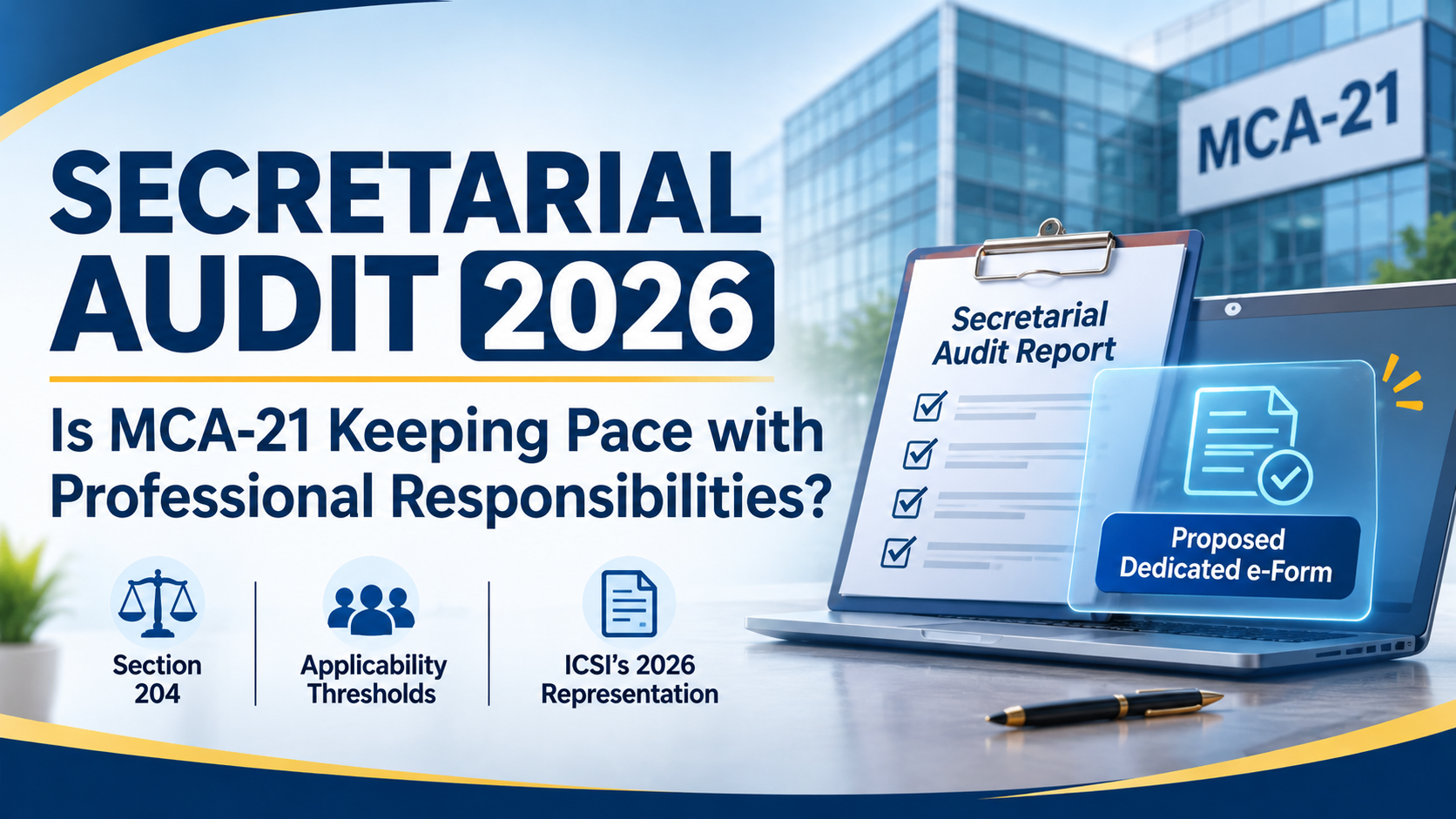
The Institute of Company Secretaries of India (ICSI) has brought this issue to the attention of the Ministry of Corporate Affairs (MCA), seeking the introduction of a separate e-Form for reporting the appointment and resignation/cessation of Secretarial Auditors under Section 204 of the Companies Act, 2013.
Need Support with Corporate Compliance?
At Chhota CFO, we help businesses navigate corporate compliance, statutory obligations and regulatory requirements under the Companies Act, 2013. Connect with our experts for professional compliance assistance.
Contact us for expert assistance with corporate compliance
Section 204 requires every listed company and such other prescribed classes of companies to annex a Secretarial Audit Report, issued by a Company Secretary in Practice, to its Board’s Report.
The prescribed report is issued in Form MR-3. Its objective is to provide shareholders and other stakeholders with an independent view of the company’s compliance with applicable corporate laws and governance requirements.
Section 204(4) provides for a penalty of ₹2 lakh where the company, an officer or the Company Secretary in Practice, as applicable, contravenes the provision.
The applicability is prescribed under Rule 9 of the Companies (Appointment and Remuneration of Managerial Personnel) Rules, 2014. Secretarial Audit is mandatory for:
Category of company | Applicability threshold |
Every listed company | Mandatory, irrespective of the thresholds below. |
Public company | Paid-up share capital of ₹50 crore or more; or turnover of ₹250 crore or more. |
Every company | Outstanding loans or borrowings from banks or public financial institutions of ₹100 crore or more. |
For these thresholds, the paid-up share capital, turnover or outstanding loans/borrowings, as applicable, are considered as at the last date of the latest audited financial statements. The applicability test should therefore form part of the annual compliance review. Companies should not restrict the assessment to paid-up capital alone; the borrowing threshold can independently trigger the requirement.
Through a representation dated 28 August 2026, ICSI requested the MCA to introduce a separate e-Form for filing the appointment and resignation/cessation of Secretarial Auditors appointed under Section 204.
ICSI highlighted that there is presently no dedicated e-Form under the MCA-21 system specifically designed for reporting these events. It compared this position with the reporting framework available for other auditors and professionals:
The Institute has suggested a dedicated form on similar lines for Secretarial Auditors. The proposed form could capture:
The representation was subsequently included among the matters on which ICSI sought follow-up consideration from the MCA in its communication dated 28 October 2026.
A dedicated filing mechanism could enable stakeholders and regulators to identify the Secretarial Auditor appointed by a company and the period for which the auditor has been engaged. In the absence of a centralised record, the relevant information may need to be traced through company records and other filings.
Where a Secretarial Auditor resigns or ceases to act before completion of the assignment, the reason and effective date are important governance information. A structured filing would create a consistent reporting trail and reduce ambiguity about the status of the engagement.
A prescribed form would create a uniform method of reporting across companies. It could reduce variations in the way appointment and cessation details are recorded, particularly where companies and professionals follow different internal practices.
A centralised database could help the MCA and other stakeholders monitor appointments, changes and reporting patterns. It could also support more effective analysis of compliance trends and professional accountability.
Secretarial Audit is an important governance mechanism. A clear appointment and cessation record would complement the annual MR-3 report and provide a more complete picture of the audit engagement over time.
Strengthen Your Corporate Compliance Framework
Proper documentation, regulatory reporting and corporate governance are essential for businesses. Chhota CFO provides professional support to companies in managing statutory compliance, corporate documentation and regulatory requirements.
Contact our team to simplify your corporate compliance processes.
A dedicated e-Form, if introduced, would improve reporting. However, the absence of such a form does not dilute the existing responsibilities under Section 204 or the applicable rules and professional standards.
Companies and Secretarial Auditors should continue to maintain a clear documentary trail, including:
The company should also ensure that the Board’s Report deals appropriately with qualifications, observations and remarks in the Secretarial Audit Report, as required by Section 204(3).
If the MCA accepts the representation, a well-designed form could provide a simple but meaningful reporting framework. The following are possible design considerations, rather than existing statutory requirements:
The form should be proportionate and easy to file. The objective should be to improve transparency without creating unnecessary procedural burden or duplicative disclosures.
Until the MCA issues a notification or prescribes a specific form, companies and professionals should not treat the ICSI representation as an amendment to the law.
Verify the latest MCA rules, form instructions and applicable ICSI guidance before making any filing or advising a client.
MCA-21 has significantly changed the way companies interact with the Registrar of Companies. E-forms, online approvals and digital records have made statutory reporting more structured and accessible. However, the effectiveness of a digital compliance system depends not only on the number of forms available, but also on whether the system captures the right information at the right stage.
The ICSI representation highlights a practical gap: the Secretarial Auditor has a defined statutory role, yet there is no dedicated MCA e-Form specifically designed to record appointment and resignation/cessation under Section 204.
A dedicated form could bring the reporting framework for Secretarial Auditors closer to that applicable to other audit professionals. More importantly, it could strengthen transparency and create a reliable record of the professional engagement.
Secretarial Audit is not simply an annual attachment to the Board’s Report. It is an important governance safeguard that supports regulatory discipline, transparency and informed decision-making.
ICSI’s 2026 representation for a separate e-Form for appointment and resignation/cessation of Secretarial Auditors is therefore a relevant step in the ongoing discussion on improving MCA-21 and the corporate compliance ecosystem.
Whether the proposal is accepted and how the MCA ultimately designs the reporting mechanism remain to be seen. Until then, companies and professionals must continue to comply with the existing provisions and maintain robust documentation.
The real objective should not be to add another form to the compliance calendar. It should be to ensure that professional responsibility, regulatory visibility and digital reporting move together.
At Chhota CFO, we assist companies with corporate compliance, Secretarial Audit, statutory documentation and regulatory requirements under the Companies Act, 2013. Our team supports businesses in maintaining proper compliance records, managing Board-related documentation and ensuring adherence to applicable statutory obligations. From Secretarial Audit coordination to ongoing corporate governance support, we help businesses streamline their compliance processes and stay updated with regulatory developments.
Looking for Corporate Compliance Assistance?
From Secretarial Audit coordination and Board documentation to ongoing corporate governance and statutory compliance, Chhota CFO helps businesses manage their compliance responsibilities efficiently.