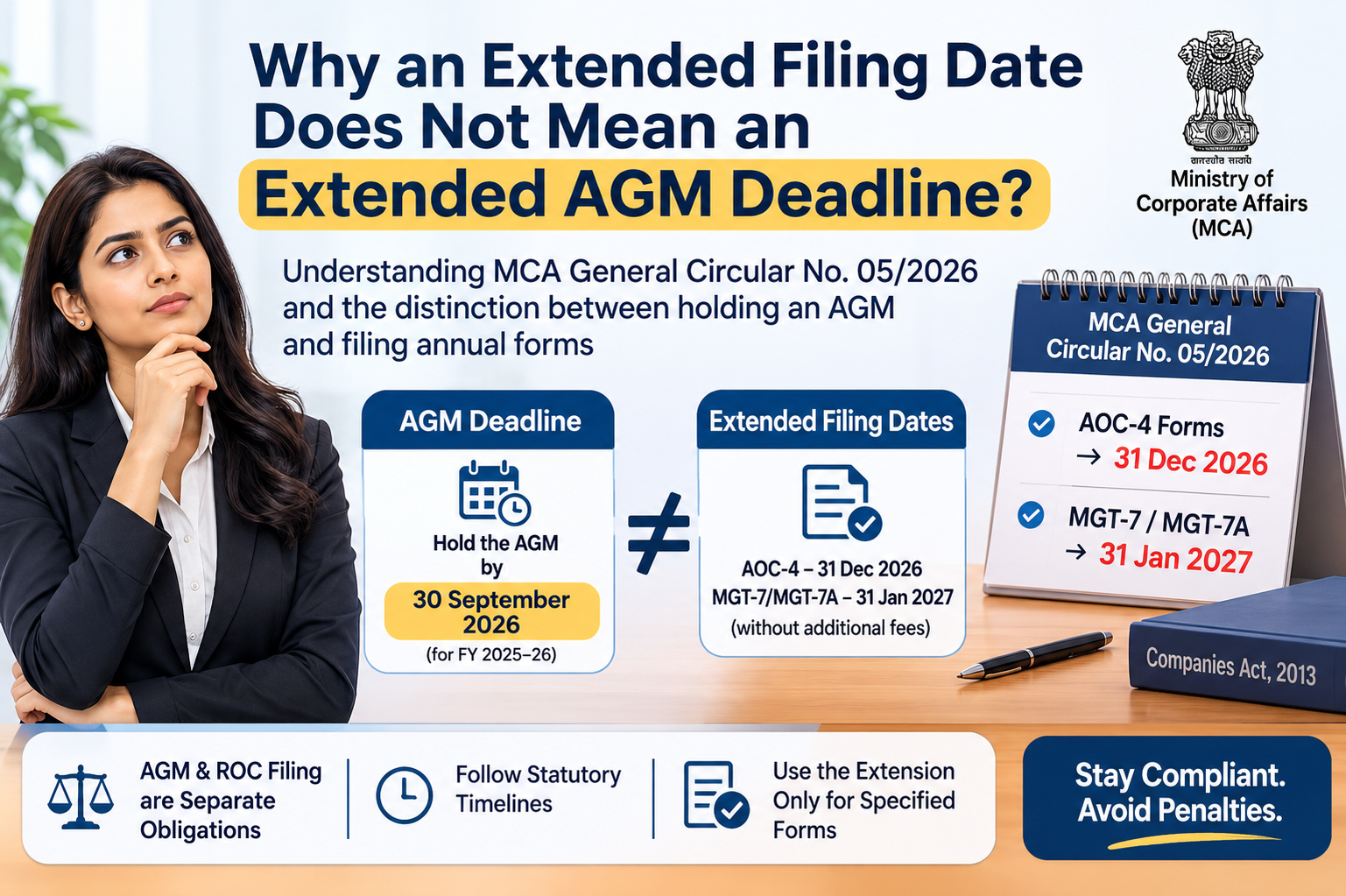
Why an Extended Filing Date Does Not Mean an Extended AGM Deadline ?
Understanding MCA General Circular No. 05/2026 and the distinction between holding an AGM and filing annual forms
The Ministry of Corporate Affairs (MCA), through General Circular No. 05/2026 dated 24 October 2026, has granted additional time for filing specified annual filing forms for FY 2025–26 without payment of additional fees.
The extended dates are:
Form | Extended date |
AOC-4, AOC-4 (CFS), AOC-4 (XBRL), AOC-4 NBFC (Ind AS) and AOC-4 CFS NBFC (Ind AS) | 31 December 2026 |
MGT-7 and MGT-7A | 31 January 2027 |
This is a relief for companies, professionals and compliance teams managing annual filings. However, the circular contains an important clarification: the relaxation does not extend the statutory time for holding an AGM.
In other words, MCA has relaxed the filing timeline for specified forms, not the underlying obligation to conduct the AGM within the prescribed period.
Need Assistance with AGM and Annual ROC Compliance?
The distinction becomes clear when we look at the relevant provisions of the Companies Act, 2013.
Every company, other than a One Person Company (OPC), is required to hold an AGM every year.
Accordingly, for FY 2025–26, the ordinary AGM deadline for companies whose financial year ended on 31 March 2026 was 30 September 2026, subject to any valid extension specifically granted under Section 96.
A company is required to file its adopted financial statements, along with the prescribed attachments, with the ROC within 30 days of the AGM.
The annual return in Form MGT-7 or MGT-7A is required to be filed within 60 days from the date of the AGM.
These are separate obligations. Conducting the AGM and filing the forms arising from that AGM are not interchangeable compliance activities.
Consider a company whose financial year ended on 31 March 2026 and which held its AGM on 30 September 2026. The position would be as follows:
Compliance | Relevant provision | Timeline |
Holding of AGM | Section 96 | 30 September 2026 |
Filing of financial statements – AOC-4 | Section 137 | Within 30 days of AGM |
Filing of annual return – MGT-7 / MGT-7A | Section 92 | Within 60 days of AGM |
Extended filing window for AOC-4 | MCA General Circular 05/2026 | 31 December 2026 |
Extended filing window for MGT-7 / MGT-7A | MCA General Circular 05/2026 | 31 January 2027 |
The practical takeaway is that the company may use the extended filing window for the specified forms, even though the ordinary statutory filing period calculated from the AGM has already elapsed.
However, if the company did not hold its AGM by 30 September 2026, the extension of the AOC-4 and MGT-7 filing dates does not cure that default.
A company that has not held its AGM within the prescribed period cannot treat the extended ROC filing dates as additional time to conduct the meeting.
The Act separately addresses the filing position where an AGM has not been held:
The MCA circular provides a filing relaxation for the specified forms. It does not regularise the failure to hold the AGM.
Therefore, companies that have missed their AGM deadline should examine the AGM default separately and take appropriate corrective steps. Merely filing AOC-4 or MGT-7 within the extended window does not resolve the AGM-related non-compliance.
Contact Chhota CFO to discuss your compliance requirements.
Not entirely. It is important to understand the scope of the relief.
The circular permits the specified forms to be filed up to the extended dates without payment of additional fees.
However, paragraph 4 of the circular clarifies that filings made after the extended dates will attract applicable fees, including additional fees, calculated from the date on which the forms were originally due under the Act.
Further, the circular expressly preserves liability for companies that have not complied with the statutory AGM timeline.
Thus, the relief is limited to the specified filing forms and the additional-fee relaxation. It should not be interpreted as a general waiver of all defaults or liabilities under the Companies Act, 2013.
Another important point is that the circular covers only the specified financial statement and annual return forms. Companies should not assume that the extension automatically applies to every annual or event-based ROC filing.
A form-specific review is therefore essential. The extension should not be applied indiscriminately to all ROC compliances.
Companies should use the additional time constructively rather than postpone the entire annual compliance exercise.
An extension of a filing date is a procedural relaxation. It does not automatically extend the underlying statutory event that triggers the filing obligation.
The AGM is a corporate governance requirement through which shareholders consider the company’s affairs, financial statements, auditor-related matters and other business. ROC filings are the subsequent statutory reporting obligations arising under the Act.
The safest approach is simple: hold the AGM within the statutory timeline, complete the related documentation and use the extended filing window only for the forms specifically covered by the MCA circular.
MCA General Circular No. 05/2026 is a useful compliance relief for FY 2025–26. It gives companies additional time to complete specified annual ROC filings without additional fees.
But it is not an extension of the AGM deadline.
Companies should distinguish between the obligation to hold the AGM and the obligation to file annual forms. Both need independent attention, and compliance with one does not automatically satisfy the other.
An extended ROC filing date should be treated as an opportunity to complete filings correctly — not as permission to defer statutory corporate governance requirements.
At Chhota CFO, we support startups and growing businesses with end-to-end corporate compliance, from incorporation to annual ROC filings and beyond.
Our support includes AGM and Board meeting compliances, preparation and review of statutory documents, annual filings, corporate governance, secretarial compliances and ongoing regulatory support.
For any queries or assistance with annual ROC filings, feel free to connect with us.