
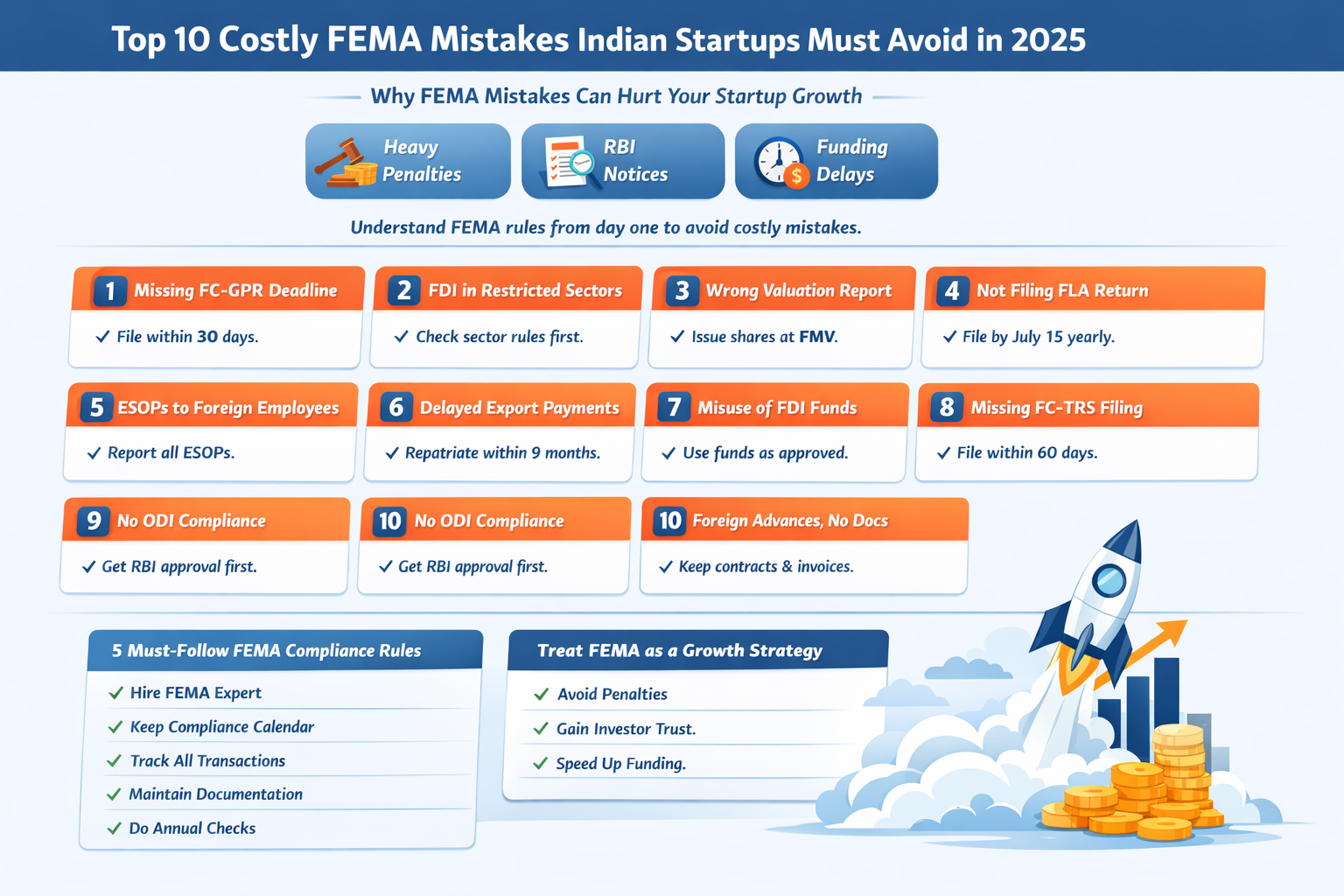
Many startups in cities like Bengaluru, Mumbai, Hyderabad, and Delhi raise funds from foreign investors. It feels like a big win. But the moment money hits your bank account, FEMA compliance begins.
If you miss key rules, you may face:
Even small mistakes can cost lakhs or crores. That’s why founders must understand FEMA basics from day one.
After issuing shares to a foreign investor, you must file FC-GPR (Foreign Currency — Gross Provisional Return) within 30 days.
Why this happens
Many founders think the process ends once funds are received.
What it costs
Late filing can lead to penalties from ₹50,000 to ₹10 lakh or more.
How to fix it
Not all sectors allow foreign investment freely.
Common risk areas
What it costs
How to avoid
You must issue shares at fair market value (FMV).
Common mistakes
Impact
You may face penalties equal to the pricing difference.
Fix
FLA return must be filed every year by July 15.
Who must file
Any company with foreign investment or overseas assets.
Penalty
₹7,500 per day of delay.
Solution
Giving ESOPs to foreign employees is treated as foreign investment.
Problem
HR teams often miss FEMA rules.
Impact
Fix
Export income must come back to India within 9 months.
Who is affected
Penalty
Can go up to the full unpaid amount.
Fix
FDI money must be used only for approved business activities.
Common misuse
Penalty
Up to 3 times the amount of misuse.
Fix
When shares are transferred between residents and non-residents, FC-TRS must be filed.
Common cases
Penalty
₹50,000 to ₹5 lakh.
Fix
Many startups open companies in Singapore, the UAE, or the US.
Mistake
Not filing ODI or getting RBI approval.
Impact
Fix
Advance payments from foreign clients need proper documentation.
Common issue
Impact
Can be treated as a FEMA violation.
Fix
To stay safe, every startup should follow these basics:
✔ Hire a FEMA expert early
✔ Maintain a compliance calendar
✔ Track all cross-border transactions
✔ Keep proper documentation
✔ Do yearly compliance checks
FEMA compliance is not just a legal rule. It protects your startup’s future.
If you follow the right steps:
Ignoring FEMA can block your growth. Managing it well can help you scale globally.
 GST Input Tax Credit (ITC) Guide for Startups & MSMEs (2026)
 Audit Red Flags in Due Diligence: Investor Guide (2026)
 IEM Registration Part A vs Part B under DPIIT | Complete Guide
 RBI Reporting After Foreign Investment in India | FEMA Guide 2026
 Sections 185, 186 & 188 of Companies Act, 2013: Complete Guide
 Regional Director Powers Under Companies Act, 2013
 PF Claim Rejected? 10 Steps to Get Full PF Faster in 2026
 New PF Rules 2026: EPF Wage Ceiling Hiked to ₹25,000
 Missed a FEMA Filing? Compounding vs Late Submission: What Should You Do?
 MCA Financial Year Flexibility Comes with a Tax Reporting Catch for Companies

