
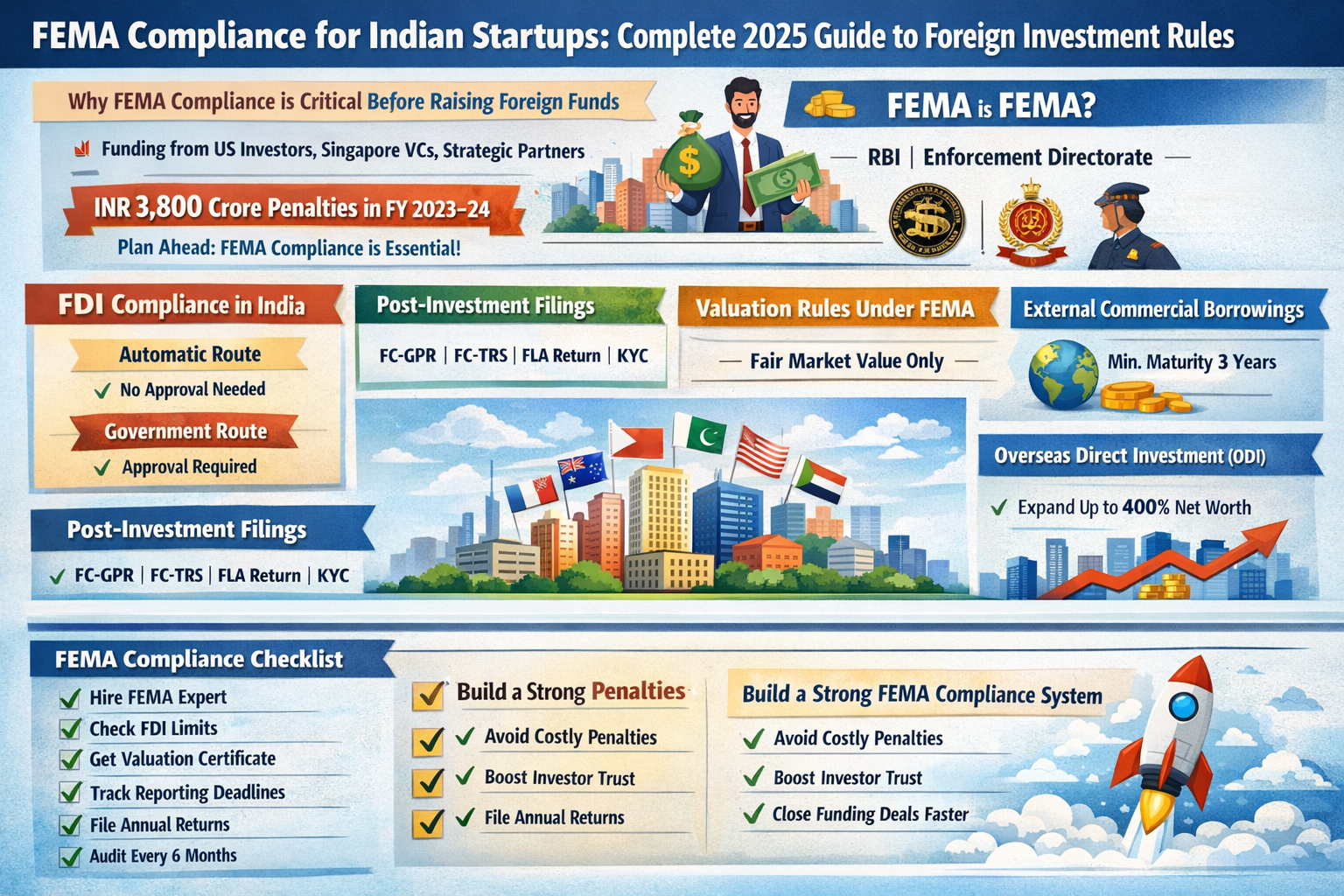
For startups in India—especially in cities like Bengaluru, Mumbai, Hyderabad, and Delhi NCR—raising international capital is a major growth milestone. Whether the funding comes from a US angel investor, a Singapore VC, or a global strategic partner, compliance begins the moment the funds hit your bank account.
Many founders ignore FEMA regulations until it’s too late. This can lead to heavy penalties, regulatory notices, and funding delays. In FY 2023–24 alone, enforcement actions exceeded INR 3,800 crore, impacting several startups and MSMEs.
Key takeaway: FEMA compliance is not optional. It must be planned before accepting foreign investment.
The Foreign Exchange Management Act, 1999 (FEMA), governs all cross-border financial transactions in India. It replaced the stricter FERA law and focuses on managing foreign exchange rather than restricting it.
FEMA is regulated by:
Reserve Bank of India (RBI)
Directorate of Enforcement (ED)
For startups, FEMA applies to:
Foreign Direct Investment (FDI)
Overseas Direct Investment (ODI)
Cross-border payments and remittances
Export and import transactions
Foreign investment in India happens through two main routes:
Automatic Route
Government Route
Pro Tip: Always verify your NIC code and sector classification before accepting foreign funds.
Once you receive foreign funds, compliance deadlines start immediately.
Missing deadlines can lead to penalties and compounding charges.
Shares issued to foreign investors must follow fair valuation norms.
Example: If FMV = ₹1,000/share, issuing at ₹800 is a violation.
If your startup plans to raise foreign debt, ECB rules apply.
Non-compliance can attract penalties up to ₹2 crore or 3x transaction value.
Indian startups setting up entities in Singapore, the UAE, the UK, or the USA must follow ODI rules.
FEMA violations can be expensive and disruptive.
Common Startup Mistakes:
Good news: FEMA violations are compoundable if addressed early.
Use this practical checklist to stay compliant:
✔ Hire a FEMA expert (CA or consultant)
✔ Check FDI limits and sector rules
✔ Obtain proper valuation certificate
✔ Track all filing deadlines
✔ Maintain FEMA transaction records
✔ File annual returns (FLA, APR)
✔ Conduct internal compliance audit every 6 months
FEMA compliance is not a one-time activity—it’s an ongoing process that evolves with your business.
Startups that proactively manage compliance:
 GST Input Tax Credit (ITC) Guide for Startups & MSMEs (2026)
 Audit Red Flags in Due Diligence: Investor Guide (2026)
 IEM Registration Part A vs Part B under DPIIT | Complete Guide
 RBI Reporting After Foreign Investment in India | FEMA Guide 2026
 Sections 185, 186 & 188 of Companies Act, 2013: Complete Guide
 Regional Director Powers Under Companies Act, 2013
 PF Claim Rejected? 10 Steps to Get Full PF Faster in 2026
 New PF Rules 2026: EPF Wage Ceiling Hiked to ₹25,000
 Missed a FEMA Filing? Compounding vs Late Submission: What Should You Do?
 MCA Financial Year Flexibility Comes with a Tax Reporting Catch for Companies

