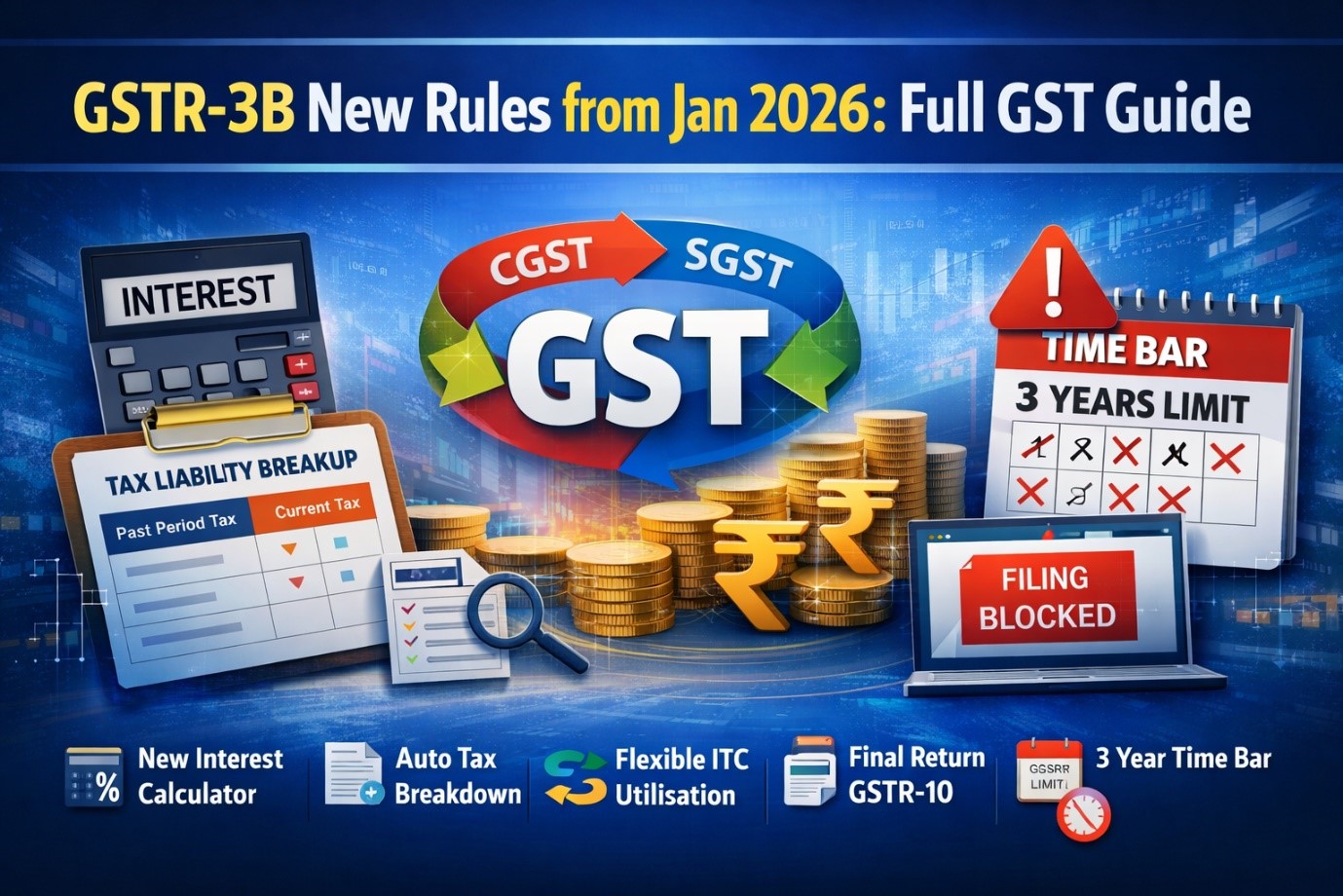
From the January 2026 tax period, the GST portal has rolled out important system-level enhancements in GSTR‑3B. These changes are not cosmetic; they directly impact how interest is calculated, how past period tax is reported, how ITC can be used, and even whether a taxpayer can file GSTR‑3B at all in certain situations.
In summary, the key changes are:
- Revamped interest calculator in GSTR‑3B with an automated, non-editable minimum interest figure.
- Auto-population of past-period tax liability breakup based on document dates reported in GSTR‑1 / GSTR‑1A / IFF.
- More flexible cross‑utilisation of ITC, allowing CGST and SGST credit to be used in any order to pay IGST once IGST ITC is exhausted.
- Interest recovery for cancelled registrations through the final return GSTR‑10 where the last GSTR‑3B is filed late.
- Portal-level ITC and ledger validations, including blocking of GSTR‑3B where certain negative balances or RCM mismatches exist.
- Time bar on old returns GSTR‑3B (and other returns) older than 3 years can no longer be filed after 1 January 2026.
For CFOs, accountants, and tax professionals, these changes mean more automation but also tighter controls. The portal will do more of the math, but the consequences of errors, delay, or poor ledger management will increase.
Quick Recap: Role of GSTR‑3B and Rationale for Changes
GSTR‑3B is the monthly/quarterly summary return in which taxpayers:
- Declare outward tax liability (IGST, CGST, SGST, Cess).
- Claim and utilise input tax credit (ITC).
- Pay net tax in cash through the Electronic Cash Ledger (ECL).
Over time, authorities observed issues such as fake billing, mismatches between GSTR‑1 and GSTR‑3B, and disputes over interest due on delayed payments. Several of the new changes aim to:
- Align GSTR‑3B more closely with data from GSTR‑1 / GSTR‑2B.
- Reduce manual editing of critical fields (like interest and tax payment).
- Make period‑wise tax reporting more transparent.
- Enforce discipline through portal level validations and time limits.
New Interest Calculator in GSTR‑3B
What Has Changed?
From the January 2026 tax period onwards, the interest calculator in GSTR‑3B has been enhanced. The key features are:
- Interest is now computed after considering the minimum cash balance in the Electronic Cash Ledger (ECL) available from the due date until the actual date of debit.
- The portal auto‑calculates interest and populates.
- The auto‑computed figure is non‑editable downward. Taxpayers can only increase the interest amount, not reduce it.
This effectively means the system shows the minimum interest payable. The legal responsibility to pay correct interest, however, still remains with the taxpayer.
Revised Interest Formula
As per the advisory and related explanations, the revised computation broadly follows this logic:
Interest = (Net Tax Liability – Minimum Cash Balance in ECL from due date to date of debit) × (Number of days delayed / 365) × Applicable interest rate
Where:
- Net Tax Liability is the amount payable in cash after ITC utilisation.
- Minimum Cash Balance in ECL is the lowest balance in that period, which is treated as if it was already available to pay tax.
- Days delayed are counted from the due date of the return till the date on which the tax is actually debited from the ECL.
Practical Example (in INR)
Assume:
- Net tax payable in cash for January 2026 = ₹1,50,000.
- Minimum balance in ECL between due date and payment date = ₹40,000.
- Delay = 15 days.
- Interest rate = 18% per annum.
Then:
- Adjusted base = ₹1,50,000 – ₹40,000 = ₹1,10,000.
- Interest = ₹1,10,000 × (15 / 365) × 18% ≈ ₹813 (rounded).
The portal will compute this minimum interest and auto fill it. If, based on your own working, you find that actual interest should be higher (e.g., due to additional delayed liabilities), you must increase the amount manually.
Action point: Tax teams should update their internal interest working templates to align with the new method and verify the auto‑calculated amount before filing.
Auto‑Population of Tax Liability Breakup for Past Periods
Many businesses report invoices for earlier months in a later GSTR‑1 and pay the resulting tax in the current GSTR‑3B. Tracking which month’s liability is being discharged becomes difficult during reconciliations and departmental audits.
From January 2026, the tax liability breakup table in GSTR‑3B is auto‑populated based on document dates of supplies reported in:
- GSTR‑1,
- GSTR‑1A,
- IFF (for QRMP taxpayers),
where the tax is actually being paid in the current GSTR‑3B.
Key implications:
- The portal shows how much of the current payment relates to earlier tax periods.
- This improves period‑wise transparency, aiding assessments, inquiries, and internal controls.
- Taxpayers may be allowed to increase these figures where their own records indicate a higher amount.
Action point: Ensure your ERP or accounting system captures original document dates correctly. Any misclassification at source will now flow into the breakup table and may cause questions during scrutiny.
Flexible Cross Utilisation of ITC for IGST Liability
Old vs New Utilisation Rule
Earlier, taxpayers often struggled with the rigid sequence for utilising ITC towards IGST, CGST and SGST liabilities, especially where IGST credit was insufficient or exhausted.
From January 2026 onwards, once ITC of IGST is fully utilised, the GST portal will allow taxpayers to use CGST and SGST ITC in any order to pay remaining IGST liability.
This means:
- You are no longer forced into a fixed order (e.g., CGST first, then SGST).
- You can optimise utilisation based on your overall credit structure.
Example (in INR)
Assume for February 2026 you have:
- IGST liability = ₹2,00,000.
- Available ITC:
- IGST ITC = ₹1,20,000,
- CGST ITC = ₹60,000,
- SGST ITC = ₹80,000.
Old situation (simplified):
- Use IGST ITC ₹1,20,000 → Remaining IGST liability = ₹80,000.
- Fixed sequence may not let you choose which pool (CGST/SGST) to deplete first.
New situation:
- After exhausting IGST ITC, you can decide to use:
- CGST ITC ₹40,000 + SGST ITC ₹40,000, or
- CGST ITC ₹60,000 + SGST ITC ₹20,000, etc.,
so long as the total of ₹80,000 is discharged.
Action point: Finance teams should revisit their ITC planning strategy. Better utilisation can reduce unnecessary cash payments (in ₹) and minimise accumulation of unusable credits in a particular head.
Interest Recovery for Cancelled Taxpayers via GSTR‑10
For taxpayers whose GST registration is cancelled, there is often a final GSTR‑3B to be filed for the last active period. If this last GSTR‑3B is filed late or tax is paid after due date, interest becomes payable.
From January 2026, the GST system has been configured so that such interest will be recovered through the final return GSTR‑10.
This ensures that:
- Interest dues are not left outstanding once a registration is cancelled.
- The closure process is more complete from the department’s perspective.
Action point: When advising on surrender or cancellation of GST registration, ensure:
- All pending GSTR‑3B returns are filed timely.
- Interest on any delayed payments is computed and paid along with GSTR‑10 to avoid notices later.
Portal‑Level Controls: ITC Blocking and Ledger Validations
Recent GST updates from 1 January 2026 have introduced stronger portal checks around ITC and return filing. These have a direct bearing on the ability to file GSTR‑3B.
Key highlights:
- Blocking of GSTR‑3B filing where certain conditions in ledgers are not met. For example, cases where:
- Reverse charge (RCM) liability reflected in specific tables is not properly discharged, or
- There is a negative balance in certain ITC or RCM‑related ledgers.
- The system may not permit filing of GSTR‑3B if these discrepancies exist, effectively forcing taxpayers to clear dues before proceeding.
This aligns with the broader push to:
- Prevent excessive or unsupported ITC claims.
- Ensure that RCM liabilities are fully paid in cash (in ₹) and not left lingering.
Action point:
- Reconcile RCM liabilities (such as on legal fees, GTA, import of services) with payments and ITC claims every tax period.
- Monitor all ledgers in the portal, and avoid negative balances that could trigger a block on GSTR‑3B filing.
Time Limit on Filing Old Returns (3‑Year Time Bar)
A significant change, often overlooked, is the time bar on filing old GST returns. From 1 January 2026, returns older than 3 years cannot be filed, and this includes GSTR‑3B along with other forms like GSTR‑1, GSTR‑4, GSTR‑5 etc.
Implications:
- If a taxpayer has not filed GSTR‑3B for a period more than 3 years old (e.g., FY 2019‑20 after the cut‑off), the system may block filing.
- Any unreported tax or ITC for those periods effectively becomes permanently locked with potential risk of demand, penalties, and loss of input tax credit (measured in ₹).
- This also tightens the window for voluntary corrections and late compliance.
Action point:
- Immediately review all pending GST returns and ensure there is no backlog approaching the 3‑year limit.
- For older gaps, consider voluntary disclosure and payment before the time bar kicks in to mitigate future litigation.
Compliance Checklist for January 2026 Onwards
To adapt smoothly to the new GSTR‑3B environment, businesses can follow this practical checklist:
- Update internal interest working sheets to the new formula, including minimum ECL balance and automatic calculation logic.
- Reconcile cash ledger (ECL) regularly, and plan timely funding so that minimum balances are maintained where needed.
- Align ERP invoice dates and GSTR‑1 data with the new tax liability breakup table to avoid mismatched periods.
- Review ITC strategy in light of the flexible IGST payment rules using CGST/SGST ITC; optimise to reduce cash outgo (in ₹).
- Clean up RCM accounting – ensure all RCM liabilities are fully paid and ITC is claimed only thereafter, avoiding negative or inconsistent ledgers.
- Monitor ledger status before filing – check for blocks or warnings on the GST portal that could prevent GSTR‑3B submission.
- Track the 3‑year limitation for all pending returns and prioritise filing by oldest period.
- For cancelled or soon‑to‑be‑cancelled registrations, prepare a closure pack: last GSTR‑3B, interest computation, and final GSTR‑10 with all dues cleared.
- Document every significant reconciliation, especially regarding past‑period invoices and tax liability breakup, to handle future audits and notices confidently.
Conclusion
The GSTR‑3B changes effective from January 2026 mark a clear shift towards system driven compliance. Automated interest calculation, period‑wise tax breakup, and flexible ITC utilisation on one side, and portal level blocking and time barred returns on the other, together push taxpayers towards timely, accurate, and well reconciled filings.
For Indian businesses, the practical takeaway is unmistakable:
- Invest in robust GST reconciliations,
- Maintain healthy cash and credit planning (in ₹ terms), and
- Track due dates and time limits closely.
Those who adapt early will not only avoid interest and penalties but also unlock smoother scrutiny and fewer compliance surprises in the GST regime going forward.

 GST Input Tax Credit (ITC) Guide for Startups & MSMEs (2026)
 Audit Red Flags in Due Diligence: Investor Guide (2026)
 IEM Registration Part A vs Part B under DPIIT | Complete Guide
 RBI Reporting After Foreign Investment in India | FEMA Guide 2026
 Sections 185, 186 & 188 of Companies Act, 2013: Complete Guide