
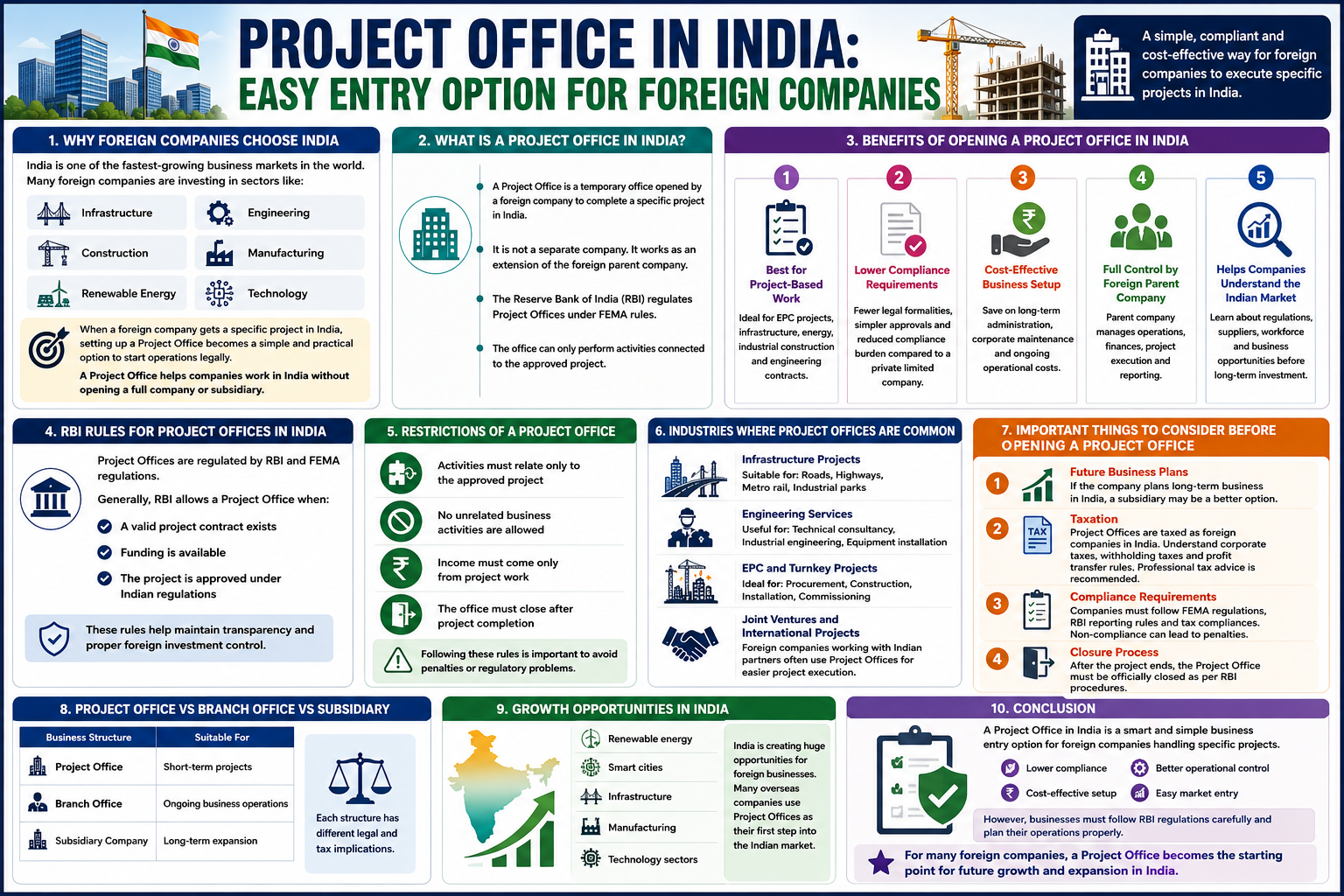
India is one of the fastest-growing business markets in the world. Many foreign companies are investing in sectors like:
When a foreign company gets a specific project in India, setting up a Project Office becomes a simple and practical option to start operations legally.
A Project Office helps companies work in India without opening a full company or subsidiary.
A Project Office is a temporary office opened by a foreign company to complete a specific project in India.
It is not a separate company. It works as an extension of the foreign parent company.
The Reserve Bank of India (RBI) regulates Project Offices under FEMA rules.
The office can only perform activities connected to the approved project.
Foreign companies prefer Project Offices because they are simple, cost-effective, and suitable for project-based work.
A Project Office is ideal for industries like:
It allows companies to execute projects smoothly in India.
Compared to setting up a private limited company, a Project Office has:
This makes it easier for short-term projects.
Since the office is temporary, businesses can save money on:
This helps reduce overall business expenses.
The parent company manages:
This ensures better control and quality management.
A Project Office also helps businesses learn about:
This is useful before making long-term investments in India.
Project Offices are regulated by RBI and FEMA regulations.
Generally, RBI allows a Project Office when:
These rules help maintain transparency and proper foreign investment control.
A Project Office has certain limitations.
Important Restrictions
Following these rules is important to avoid penalties or regulatory problems.
Infrastructure Projects
Suitable for:
Engineering Services
Useful for:
EPC and Turnkey Projects
Ideal for:
Joint Ventures and International Projects
Foreign companies working with Indian partners often use Project Offices for easier project execution.
If the company plans long-term business in India, a subsidiary may be a better option.
Project Offices are taxed as foreign companies in India.
Businesses should understand:
Professional tax advice is recommended.
Companies must follow:
Non-compliance can lead to penalties.
After the project ends, the Project Office must be officially closed as per RBI procedures.
Business Structure | Suitable For |
Project Office | Short-term projects |
Branch Office | Ongoing business operations |
Subsidiary Company | Long-term expansion |
Each structure has different legal and tax implications.
India is creating huge opportunities for foreign businesses in:
Many overseas companies use Project Offices as their first step into the Indian market.
A Project Office in India is a smart and simple business entry option for foreign companies handling specific projects.
It offers:
However, businesses must follow RBI regulations carefully and plan their operations properly.
For many foreign companies, a Project Office becomes the starting point for future growth and expansion in India.
 GST Input Tax Credit (ITC) Guide for Startups & MSMEs (2026)
 Audit Red Flags in Due Diligence: Investor Guide (2026)
 IEM Registration Part A vs Part B under DPIIT | Complete Guide
 RBI Reporting After Foreign Investment in India | FEMA Guide 2026
 Sections 185, 186 & 188 of Companies Act, 2013: Complete Guide
 Missed a FEMA Filing? Compounding vs Late Submission: What Should You Do?
 MCA Financial Year Flexibility Comes with a Tax Reporting Catch for Companies
 Fast Track Merger without NCLT approval
 Trademark Registration Bangalore: Fees, Eligibility & Steps
 Section 185 vs Section 186: Company Loan Rules Explained

