
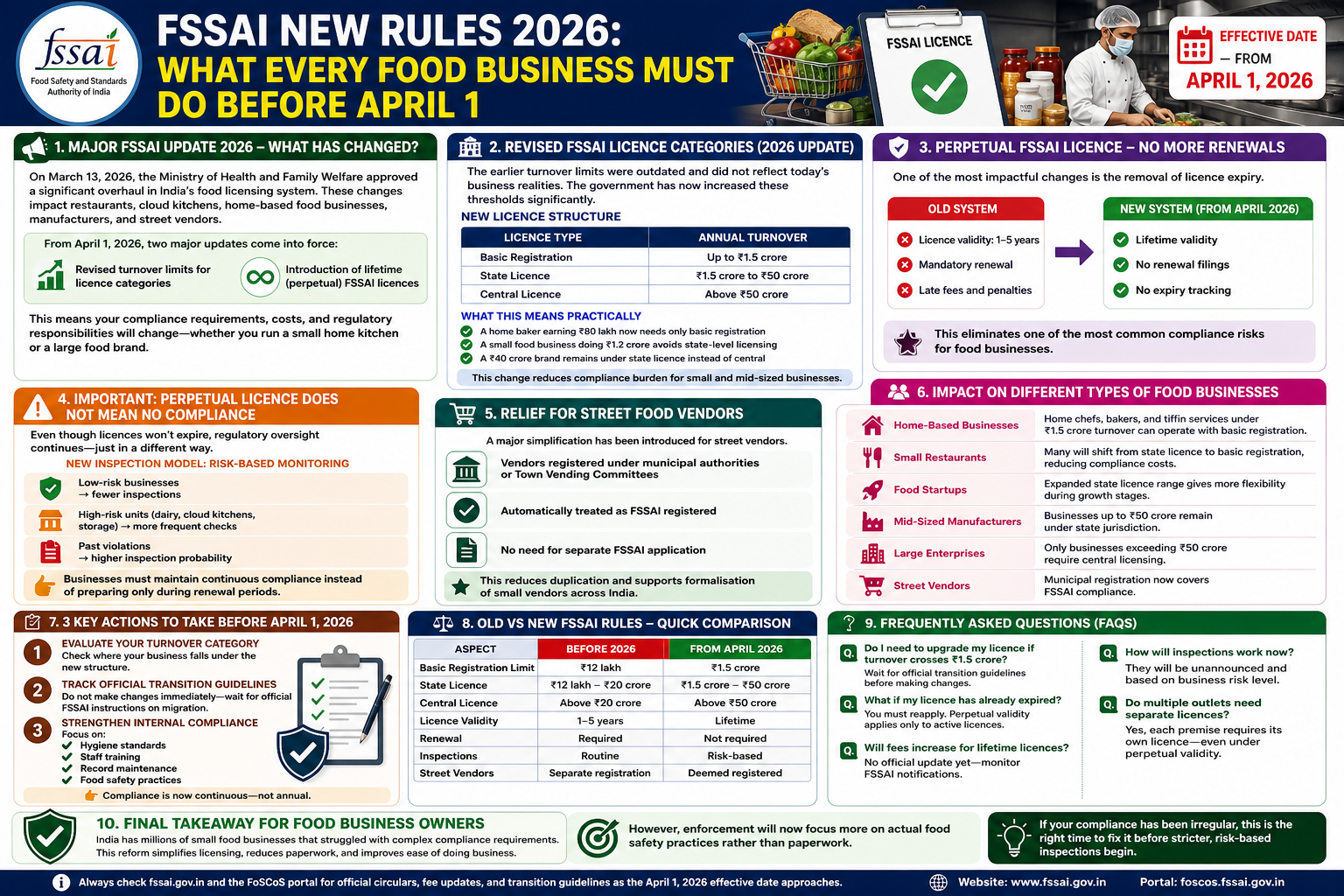
On March 13, 2026, the Ministry of Health and Family Welfare approved a significant overhaul in India’s food licensing system. These changes directly impact restaurants, cloud kitchens, home-based food businesses, manufacturers, and street vendors.
From April 1, 2026, two major updates come into force:
This means your compliance requirements, costs, and regulatory responsibilities will change—whether you run a small home kitchen or a large food brand.
The earlier turnover limits were outdated and did not reflect today’s business realities. The government has now significantly increased these thresholds.
New License Structure
License Type | Annual Turnover |
Basic Registration | Up to ₹1.5 crore |
State License | ₹1.5 crore to ₹50 crore |
Central License | Above ₹50 crore |
What This Means Practically
This change reduces the compliance burden for small and mid-sized businesses.
One of the most impactful changes is the removal of license expiry.
Old System
New System (From April 2026)
This eliminates one of the most common compliance risks for food businesses.
Even though licences won’t expire, regulatory oversight continues—just in a different way.
New Inspection Model: Risk-Based Monitoring
👉 Businesses must maintain continuous compliance instead of preparing only during renewal periods.
A major simplification has been introduced for street vendors.
This reduces duplication and supports the formalization of small vendors across India.
Home-Based Businesses
Home chefs, bakers, and tiffin services under ₹1.5 crore turnover can operate with basic registration.
Small Restaurants
Many will shift from state licence to basic registration, reducing compliance costs.
Food Startups
Expanded state licence range gives more flexibility during growth stages.
Mid-Sized Manufacturers
Businesses up to ₹50 crore remain under state jurisdiction.
Large Enterprises
Only businesses exceeding ₹50 crore require central licensing.
Street Vendors
Municipal registration now covers FSSAI compliance.
Check where your business falls under the new structure.
Do not make changes immediately—wait for official FSSAI instructions on migration.
Focus on:
👉 Compliance is now continuous—not annual.
Aspect | Before 2026 | From April 2026 |
Basic Registration Limit | ₹12 lakh | ₹1.5 crore |
State License | ₹12 lakh – ₹20 crore | ₹1.5 crore – ₹50 crore |
Central License | Above ₹20 crore | Above ₹50 crore |
License Validity | 1–5 years | Lifetime |
Renewal | Required | Not required |
Inspections | Routine | Risk-based |
Street Vendors | Separate registration | Deemed registered |
India has millions of small food businesses that struggle with complex compliance requirements. This reform simplifies licensing, reduces paperwork, and improves ease of doing business.
However, enforcement will now focus more on actual food safety practices rather than paperwork.
👉 If your compliance has been irregular, this is the right time to fix it before stricter, risk-based inspections begin.
Always check fssai.gov.in and the FoSCoS portal for official circulars, fee updates, and transition guidelines as the April 1, 2026 effective date approaches.
 GST Input Tax Credit (ITC) Guide for Startups & MSMEs (2026)
 Audit Red Flags in Due Diligence: Investor Guide (2026)
 IEM Registration Part A vs Part B under DPIIT | Complete Guide
 RBI Reporting After Foreign Investment in India | FEMA Guide 2026
 Sections 185, 186 & 188 of Companies Act, 2013: Complete Guide
 Missed a FEMA Filing? Compounding vs Late Submission: What Should You Do?
 MCA Financial Year Flexibility Comes with a Tax Reporting Catch for Companies
 Fast Track Merger without NCLT approval
 Trademark Registration Bangalore: Fees, Eligibility & Steps
 Section 185 vs Section 186: Company Loan Rules Explained

