When startups prepare for a Series A fundraising round, founders usually focus on valuation, investor interest, and growth projections. However, one critical factor that often receives less attention is the Employee Stock Option Plan (ESOP) Pool.
The structure and timing of an ESOP pool can significantly influence founder ownership, investor negotiations, and the company’s ability to attract top talent after funding. Many investors require startups to establish an ESOP pool before investing, which can result in significant founder dilution if not properly planned.
Understanding how ESOP pools work before a Series A round can help founders make informed decisions and negotiate from a stronger position.
Talk to our startup fundraising experts today and build an investor-ready ESOP strategy.
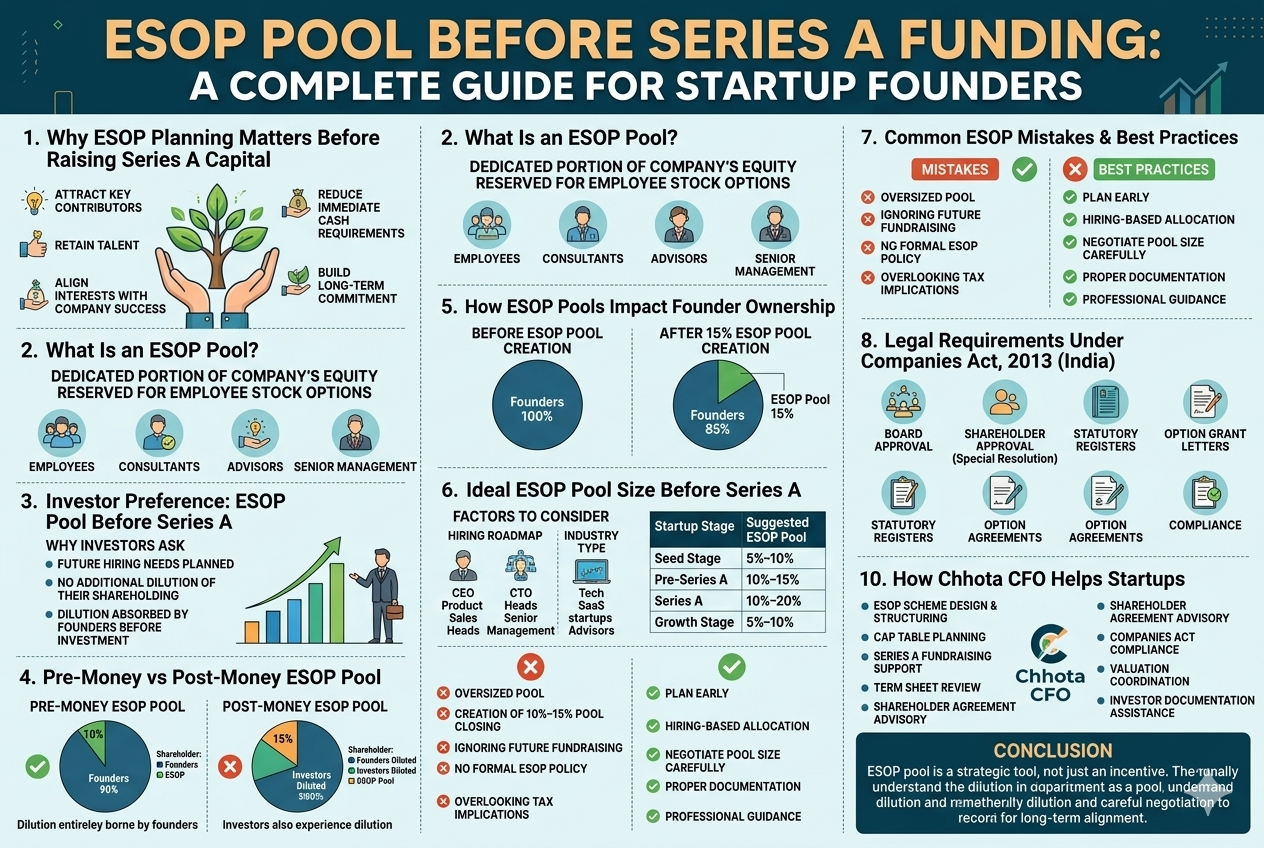
An Employee Stock Option Plan (ESOP) Pool is a dedicated portion of a company’s equity reserved for granting stock options to employees, consultants, advisors, and senior management.
The goal of creating an ESOP pool is to reward and retain key contributors by giving them an opportunity to participate in the company’s future growth.
Key Benefits of an ESOP Pool
For early-stage startups, ESOPs often serve as an effective alternative to higher salaries.
Most venture capital investors expect startups to hire experienced leadership and specialized talent after raising capital.
To support future recruitment, investors usually ask companies to create an ESOP pool before the investment closes.
Investor Perspective
Investors want assurance that:
As a result, founders often bear the dilution impact when the ESOP pool is created before the funding round.
The timing of ESOP pool creation directly affects ownership percentages.
ESOP Pool Created Before Investment (Common Investor Preference)
Example
Shareholder | Holding |
Founders | 100% |
ESOP Pool Created | 10% |
Founders After ESOP Creation | 90% |
In this structure, the dilution is entirely borne by the founders before the investor enters.
ESOP Pool Created After Investment
Example
Shareholder | Impact |
Founders | Diluted |
Investors | Diluted |
ESOP Pool | Created Post-Investment |
Because investors also experience dilution in this scenario, most prefer that the ESOP pool be established before the funding round closes.
Many startup founders negotiate valuation aggressively but underestimate the impact of ESOP dilution.
Before ESOP Pool Creation
Shareholder | Ownership |
Founders | 100% |
After 15% ESOP Pool Creation
Shareholder | Ownership |
Founders | 85% |
ESOP Pool | 15% |
If investors subsequently get a stake in the company, founder ownership decreases further.
This makes ESOP negotiations just as important as valuation discussions.
Schedule a consultation and ensure your fundraising strategy works in your favour.
There is no universal percentage that works for every startup.
The right ESOP pool size depends on future hiring requirements, industry dynamics, growth plans, and investor expectations.
Factors to Consider
Hiring Roadmap
Estimate future recruitment requirements,, such as
Industry Type
Technology and SaaS startups often must have larger ESOP pools due to intense competition for skilled talent.
Typical ESOP Pool Benchmarks
Startup Stage | Suggested ESOP Pool |
Seed Stage | 5% – 10% |
Pre-Series A | 10% – 15% |
Series A | 10% – 20% |
Growth Stage | 5% – 10% |
Creating an Oversized Pool
Establishing a larger-than-required ESOP pool can lead to unnecessary dilution.
Ignoring Future Fundraising
Additional funding rounds may be required for further ESOP expansion, leading to greater dilution later.
Lack of a Formal ESOP Policy
A professionally drafted ESOP scheme should define:
Overlooking Tax Implications
ESOP taxation affects both employees and employers. Proper planning helps avoid compliance issues and future disputes.
In India, ESOPs are primarily regulated under:
Compliance Requirements
Companies implementing ESOPs must:
✔ Get Board approval.
✔ Secure shareholder approval through a Special Resolution.
✔ Maintain statutory registers and records.
✔ Issue option grant letters.
✔ Execute option agreements.
✔ Ensure proper compliance during exercise and allotment.
Failure to comply may result in regulatory and governance challenges.
Most Series A investors include ESOP-related clauses in investment documents.
Typical provisions include the following:
These provisions directly influence cap table structure and founder ownership.
Plan ESOPs Before Fundraising
Creating an ESOP strategy early prevents last-minute negotiations.
Build a Hiring-Based Allocation Model
Reserve equity based on actual hiring requirements rather than arbitrary percentages.
Negotiate the Pool Size Carefully
Ensure the ESOP pool reflects realistic talent acquisition plans.
Maintain Proper Documentation
Keep board resolutions, shareholder approvals, grant letters, and statutory records up to date.
Seek Professional Guidance
Legal, tax, valuation, and secretarial advice can significantly improve ESOP design and implementation.
At Chhota CFO, we support startups throughout their fundraising and equity planning journey.
Our services include:
Our aim is to help founders attract talent, remain investor-ready, and preserve ownership wherever possible.
Conclusion
An ESOP pool is far more than an employee incentive program. It is a strategic tool that impacts recruitment, fundraising, governance, and founder ownership.
Since most investors require ESOP pools to be created before a Series A round, founders must understand the dilution implications and negotiate the structure carefully.
A thoughtfully designed ESOP pool helps startups attract exceptional talent, scale efficiently, and remain attractive to future investors while maintaining a healthy cap table.
Before signing a Series A term sheet, founders should test the size, timing, and legal structure of their ESOP pool to ensure long-term alignment between employees, founders, and investors.
 GST Input Tax Credit (ITC) Guide for Startups & MSMEs (2026)
 Audit Red Flags in Due Diligence: Investor Guide (2026)
 IEM Registration Part A vs Part B under DPIIT | Complete Guide
 RBI Reporting After Foreign Investment in India | FEMA Guide 2026
 Sections 185, 186 & 188 of Companies Act, 2013: Complete Guide