
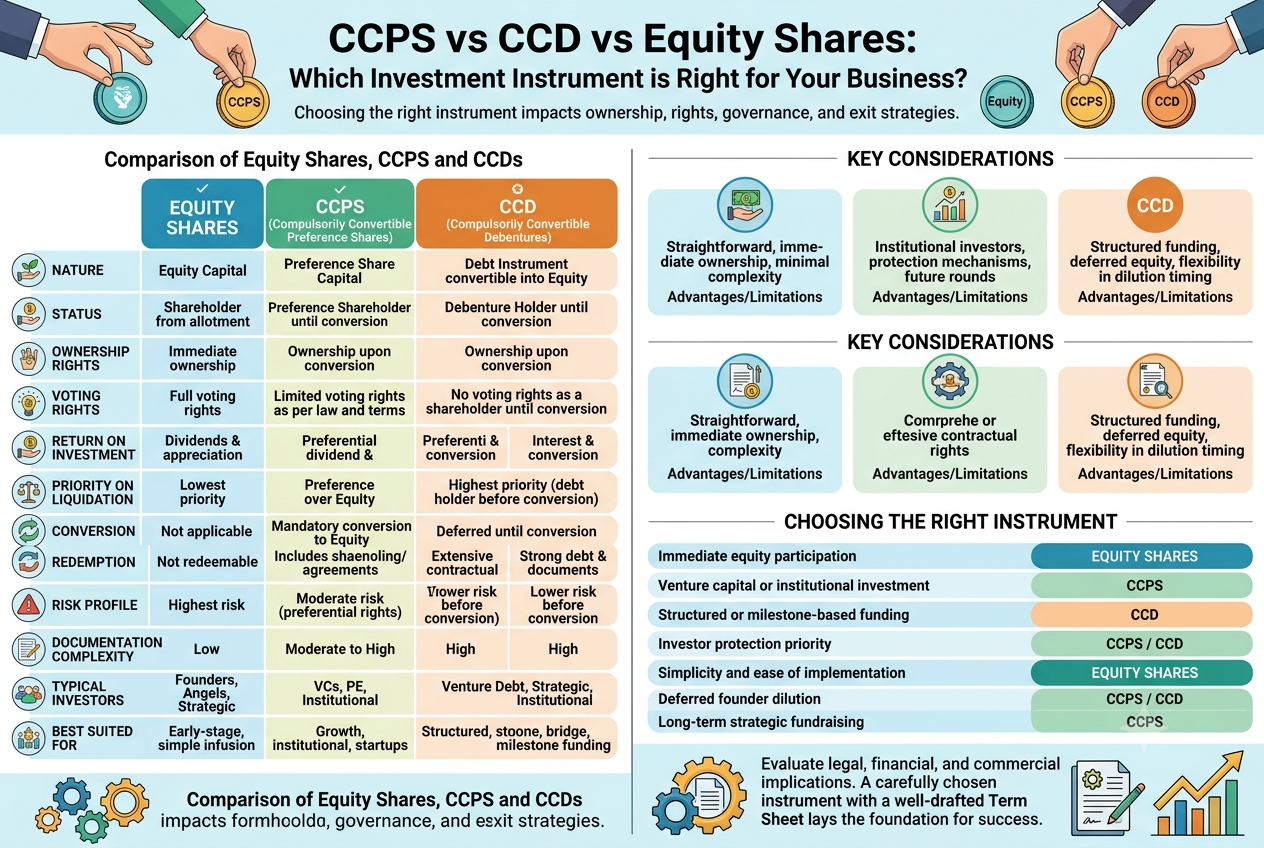
Choosing the right investment instrument is one of the most important decisions when raising capital. The instrument selected not only determines how funds are infused into the company but also influences ownership, investor rights, governance, future fundraising, and exit strategies.
Among the most commonly used instruments for private companies and startups are equity shares, compulsorily convertible preference shares (CCPS), and compulsorily convertible debentures (CCDs). Each serves a distinct commercial purpose and offers a different balance between founder flexibility and investor protection.
This comparison provides business owners with a clear understanding of these investment instruments, helping them make informed fundraising decisions.
Planning to Raise Capital? Structure Your Investment the Right Way
Particulars | Equity Shares | CCPS (Compulsorily Convertible Preference Shares) | CCD (Compulsorily Convertible Debentures) |
Nature of Instrument | Equity Capital | Preference Share Capital | Debt Instrument convertible into Equity |
Status of Investor | Shareholder from the date of allotment | Preference Shareholder until conversion | Debenture Holder until conversion |
Ownership Rights | Immediate ownership | Ownership upon conversion | Ownership upon conversion |
Voting Rights | Full voting rights on shareholder matters | Limited voting rights as per law and agreed terms | No voting rights as a shareholder until conversion |
Return on Investment | Dividends (if declared) and capital appreciation | Preferential dividend (if declared) and conversion into equity | Interest (if applicable) and conversion into equity |
Priority on Liquidation | Lowest priority | Preference over Equity Shareholders | Highest priority as a debt holder before conversion |
Conversion | Not applicable | Mandatory conversion into Equity Shares | Mandatory conversion into Equity Shares |
Dilution of Founders | Immediate | Deferred until conversion | Deferred until conversion |
Investor Protection | Limited unless contractually agreed | Extensive protection through contractual rights | Strong protection through debt and contractual rights |
Governance Rights | Through shareholding and agreements | Generally includes enhanced governance rights | Usually governed by the investment documents |
Redemption | Not redeemable | Not redeemable due to compulsory conversion | Not redeemable; compulsorily converts into equity |
Risk Profile | Highest investment risk | Moderate risk with preferential rights | Lower risk before conversion due to debt characteristics |
Documentation Complexity | Low | Moderate to High | High |
Typical Investors | Founders, Angel Investors, Strategic Investors | Venture Capital Funds, Private Equity Investors, Institutional Investors | Venture Debt Funds, Strategic Investors, Institutional Investors |
Best Suited For | Early-stage investments and simple capital infusion | Growth capital, institutional investments and startup funding | Structured funding, bridge financing and milestone-based investments |
Suitable when:
Advantages
Limitations
Suitable when:
Advantages
Limitations
Suitable when:
Advantages
Limitations
Business Requirement | Recommended Instrument |
Immediate equity participation | Equity Shares |
Venture capital or institutional investment | CCPS |
Structured or milestone-based funding | CCD |
Investor protection is a priority | CCPS / CCD |
Simplicity and ease of implementation | Equity Shares |
Deferred founder dilution | CCPS / CCD |
Long-term strategic fundraising | CCPS |
There is no universally preferred investment instrument. The appropriate choice depends on the company’s stage of growth, commercial objectives, investor expectations, governance framework, and future fundraising plans.
While equity shares offer simplicity and immediate ownership, CCPS provide a balanced structure with enhanced investor protection, making them the preferred instrument for most venture capital investments. CCDs, on the other hand, are ideal for structured financing transactions where deferred equity participation and debt-like characteristics are commercially desirable.
Business owners should evaluate the legal, financial, and commercial implications of each instrument before finalizing the investment structure. A carefully chosen instrument, supported by a well-drafted Term Sheet and definitive agreements, lays the foundation for a successful and sustainable fundraising transaction.
Looking to raise your next funding round? Contact Chhota CFO today for expert guidance on selecting the right investment instrument and structuring a legally compliant, investor-friendly transaction.
 GST Input Tax Credit (ITC) Guide for Startups & MSMEs (2026)
 Audit Red Flags in Due Diligence: Investor Guide (2026)
 IEM Registration Part A vs Part B under DPIIT | Complete Guide
 RBI Reporting After Foreign Investment in India | FEMA Guide 2026
 Sections 185, 186 & 188 of Companies Act, 2013: Complete Guide
 Missed a FEMA Filing? Compounding vs Late Submission: What Should You Do?
 MCA Financial Year Flexibility Comes with a Tax Reporting Catch for Companies
 Fast Track Merger without NCLT approval
 Trademark Registration Bangalore: Fees, Eligibility & Steps
 Section 185 vs Section 186: Company Loan Rules Explained

