A Term Sheet is one of the most important documents used during fundraising, mergers, acquisitions, private equity investments, venture capital transactions, and strategic business partnerships. It outlines the key commercial, legal, and financial terms the parties intend to follow during negotiations for a proposed investment or business transaction.
A term sheet acts as a roadmap for discussions between investors and companies before executing detailed legal agreements. It helps both parties align on valuation, investment structure, governance rights, investor protections, and transaction timelines.
Depending on the nature of the transaction, the investment may be structured through:
While a term sheet records the preliminary understanding between parties, not every provision is legally enforceable. This is where the distinction between a Binding Term Sheet and a Non-Binding Term Sheet becomes critical.
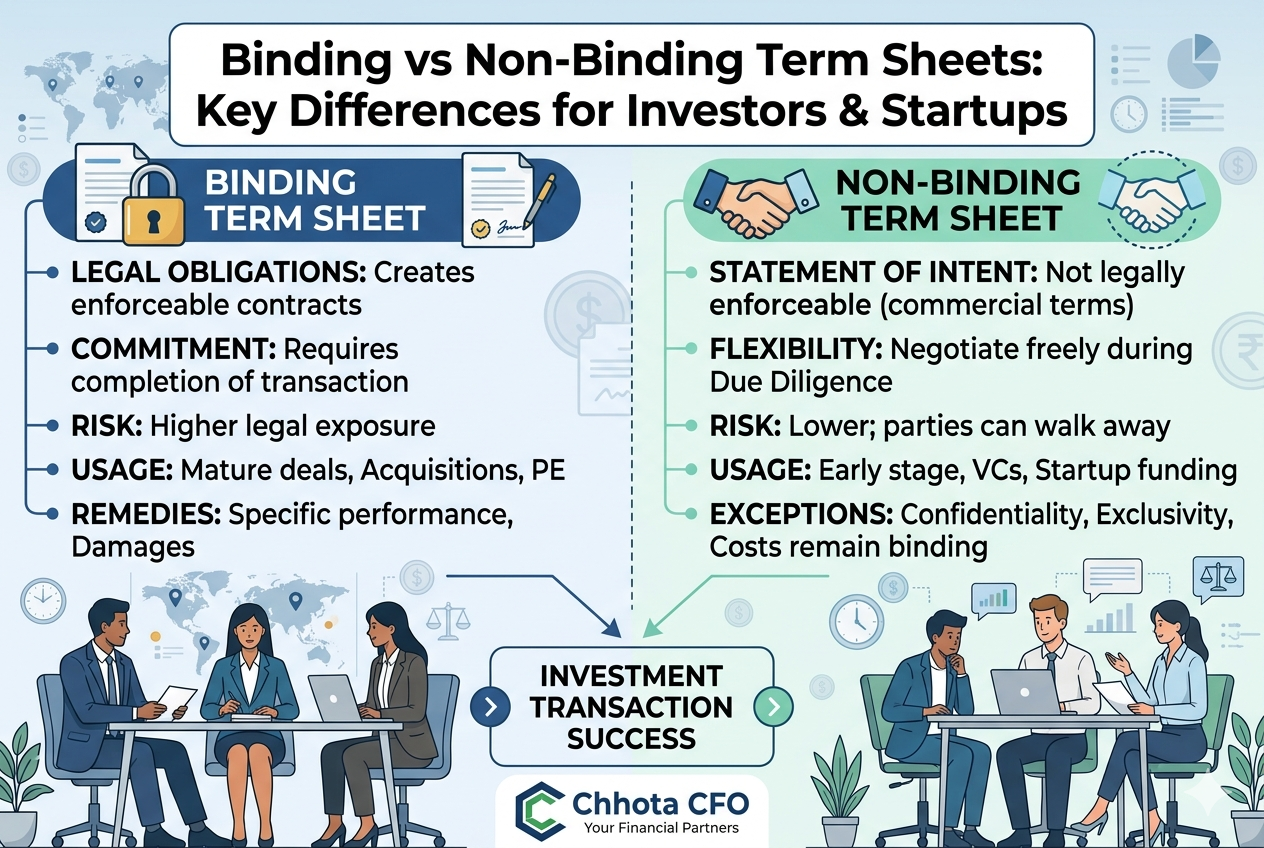
A Binding Term Sheet creates legally enforceable obligations between the parties for the provisions specifically mentioned as binding.
Once executed, the parties may be legally required to proceed with the transaction if the agreed conditions are satisfied. Failure to comply can expose the defaulting party to legal action, damages, injunctions, or claims for specific performance.
Binding term sheets are generally used when:
Key Features of a Binding Term Sheet
A Non-Binding Term Sheet serves as a statement of intent rather than a legally enforceable agreement.
It outlines the commercial understanding between the parties while preserving flexibility during negotiations and due diligence. The parties remain free to drop discussions if they are unable to agree on final terms.
Most startup funding rounds, venture capital investments, and preliminary acquisition discussions begin with a non-binding term sheet.
Key Features of a Non-Binding Term Sheet
Particulars | Binding Term Sheet | Non-Binding Term Sheet |
Legal Status | Legally enforceable | Primarily indicative |
Purpose | Creates contractual commitments | Facilitates negotiations |
Transaction Obligation | Parties may be required to complete the transaction | No obligation to close |
Risk Exposure | Higher | Lower |
Flexibility | Limited | High |
Due Diligence | Usually follows execution | Conducted during the negotiation phase |
Remedies for Breach | Damages, injunctions, specific performance | Limited to binding clauses only |
Typical Usage | Acquisitions, joint ventures, PE deals | Startup funding, VC rounds, early-stage negotiations |
Although the commercial terms may be non-binding, certain provisions are commonly drafted as legally enforceable.
Protects sensitive financial, commercial, and operational information exchanged during discussions.
Prevents the company from negotiating with competing investors or buyers for a specified period.
Determines which party bears legal, financial, and due diligence expenses.
Specifies the jurisdiction and applicable legal framework.
Provides mechanisms such as arbitration, mediation, or court proceedings.
Restricts parties from poaching employees, consultants, or customers.
Provides investors access to information required for legal, financial, tax, and commercial review.
A typical nonbinding clause may state the following:
Except for the provisions relating to Confidentiality, Exclusivity, Costs and Expenses, Governing Law, and Dispute Resolution, this Term Sheet is intended solely to record the current intentions of the parties and must not create any legally binding obligation to complete the proposed transaction.
A typical binding provision may state:
The parties agree that this Term Sheet must constitute a legally binding agreement, and each party must negotiate and execute definitive agreements in good faith and complete the transaction subject to the conditions expressly stated herein.
Scenario 1: Non-Binding Investment Term Sheet
An investor proposes to invest ₹5 Crore in a startup at a pre-money valuation of ₹20 Crore.
Key points:
Scenario 2: Binding Investment Term Sheet
The investor and startup agree on:
Upon satisfying the agreed conditions, both parties become legally obligated to complete the transaction.
A non-binding term sheet is generally recommended for:
This approach protects both parties while allowing adequate time for due diligence and commercial negotiations.
A binding term sheet may be appropriate when:
At Chhota CFO, we assist founders, investors, startups, and growing businesses throughout the investment lifecycle.
Our services include:
From the initial term sheet stage to the final investment closure, our team helps ensure that every transaction is legally compliant, commercially efficient, and structured to protect stakeholder interests.
A term sheet serves as the foundation of any investment transaction. Understanding the difference between a binding and non-binding term sheet is essential for startups, investors, private equity funds, and business owners.
While non-binding term sheets offer flexibility and ease negotiations, binding term sheets provide legal certainty and stronger transactional commitment. Selecting the right approach depends on the stage of the transaction, the level of due diligence completed, and the commercial objectives of the parties involved.
Professional legal, financial, and compliance guidance can significantly reduce transaction risks and help ensure a smooth investment process from negotiation to closing.
 GST Input Tax Credit (ITC) Guide for Startups & MSMEs (2026)
 Audit Red Flags in Due Diligence: Investor Guide (2026)
 IEM Registration Part A vs Part B under DPIIT | Complete Guide
 RBI Reporting After Foreign Investment in India | FEMA Guide 2026
 Sections 185, 186 & 188 of Companies Act, 2013: Complete Guide