
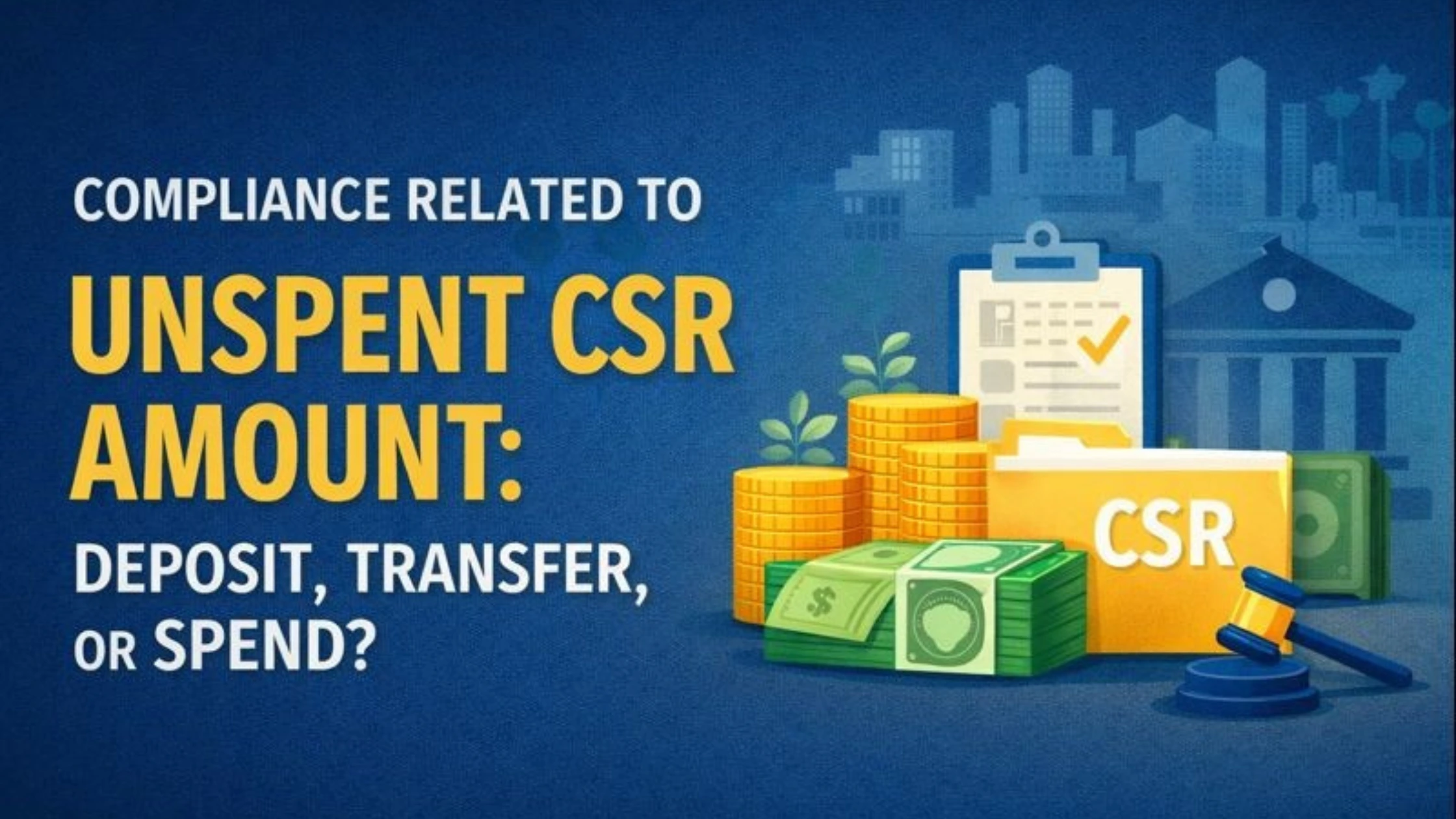
For years, many companies treated Corporate Social Responsibility (CSR) spending as a “best-effort activity”, something to be explained in the Board’s Report if not entirely spent. That approach no longer works.
After the 2021 amendments to the Companies Act, 2013, unspent CSR amounts are no longer a disclosure issue; they are a transfer and timing issue. If companies fail to act within statutory deadlines, penalties are automatic, and directors can be held personally liable.
Yet, despite explicit legal provisions, CSR defaults remain common, primarily due to a misunderstanding of one fundamental question:
Should the unspent amount be spent later, transferred to a government fund, or parked in a separate CSR account?
This blog explains the actual legal framework, not assumptions, so companies can stay compliant and avoid MCA scrutiny.
Section 135(5) of the Companies Act, 2013 requires eligible companies to spend at least 2% of the average net profits of the preceding three financial years on CSR activities.
The first proviso to Section 135(5) requires companies to explain unspent amounts in the Board’s Report.
However, this explanation alone does not satisfy compliance.
Earlier, companies believed that if CSR was not spent, giving reasons in the annual report was sufficient. This interpretation is now incorrect.
Post-amendment:
Failure to do so results in statutory default, even if the company later pays the amount.
The Companies Act creates two distinct compliance tracks for unspent CSR amounts. Failure to correctly classify the unspent amount is the root cause of most CSR defaults.
The two categories are:
Each category has different statutory requirements and timelines.
If the unspent CSR amount does not relate to any ongoing project, the second proviso to Section 135(5) applies.
Legal Requirement
The company must transfer the unspent amount to a Schedule VII fund within six months from the end of the financial year.
Common Schedule VII Funds
Important: MCA adjudication orders clearly state that a late transfer remains a violation, even if the money is eventually paid.
Example :
ABC Ltd earned profits calculated as per Section 198 as follows:
The average of the three preceding financial years is Rs 10 crore. The CSR obligation for FY 2025–26 is 2% of Rs 10 crore, i.e., Rs 20 lakh.
As of 31 March 2026:
The unspent amount of Rs 7 lakh must be transferred to a Schedule VII fund on or before 30 September 2026, which is six months from the end of the financial year.
When the unspent amount relates to an ongoing project, Section 135(6) applies.
What Qualifies as an Ongoing Project?
As per CSR Rules, 2014, the project must:
Mere continuation of activities without Board approval or a timeline does not qualify
What Companies Must Do for Ongoing Projects
Example :
ABC Ltd has an unspent CSR amount of Rs 5 lakh at the end of FY 2025–26, which relates to an approved ongoing project.
Despite explicit statutory provisions, CSR defaults commonly occur due to the following reasons:
Failure to comply with Sections 135(5) or 135(6) attracts penalties under Section 135(7) of the Companies Act.
Penalty provisions are as follows.
Twice the amount required to be transferred or one crore rupees, whichever is less
One-tenth of the amount required to be transferred or two lakh rupees, whichever is less.
MCA adjudication orders clearly show that directors and compliance officers are routinely penalised, reinforcing that CSR compliance is not a soft governance area.
Compliance with CSR rules is no longer just about explaining unspent funds in the Board’s Report. Companies must act promptly to either spend the funds on approved projects or transfer them to government-designated funds within the prescribed timelines.
Correct classification of unspent amounts, proper documentation, and timely action are essential to avoid penalties for both the company and its directors. Following these rules ensures that CSR obligations are met effectively and legally, while contributing to social development.
 GST Input Tax Credit (ITC) Guide for Startups & MSMEs (2026)
 Audit Red Flags in Due Diligence: Investor Guide (2026)
 IEM Registration Part A vs Part B under DPIIT | Complete Guide
 RBI Reporting After Foreign Investment in India | FEMA Guide 2026
 Sections 185, 186 & 188 of Companies Act, 2013: Complete Guide
 Missed a FEMA Filing? Compounding vs Late Submission: What Should You Do?
 MCA Financial Year Flexibility Comes with a Tax Reporting Catch for Companies
 Fast Track Merger without NCLT approval
 Trademark Registration Bangalore: Fees, Eligibility & Steps
 Section 185 vs Section 186: Company Loan Rules Explained

