
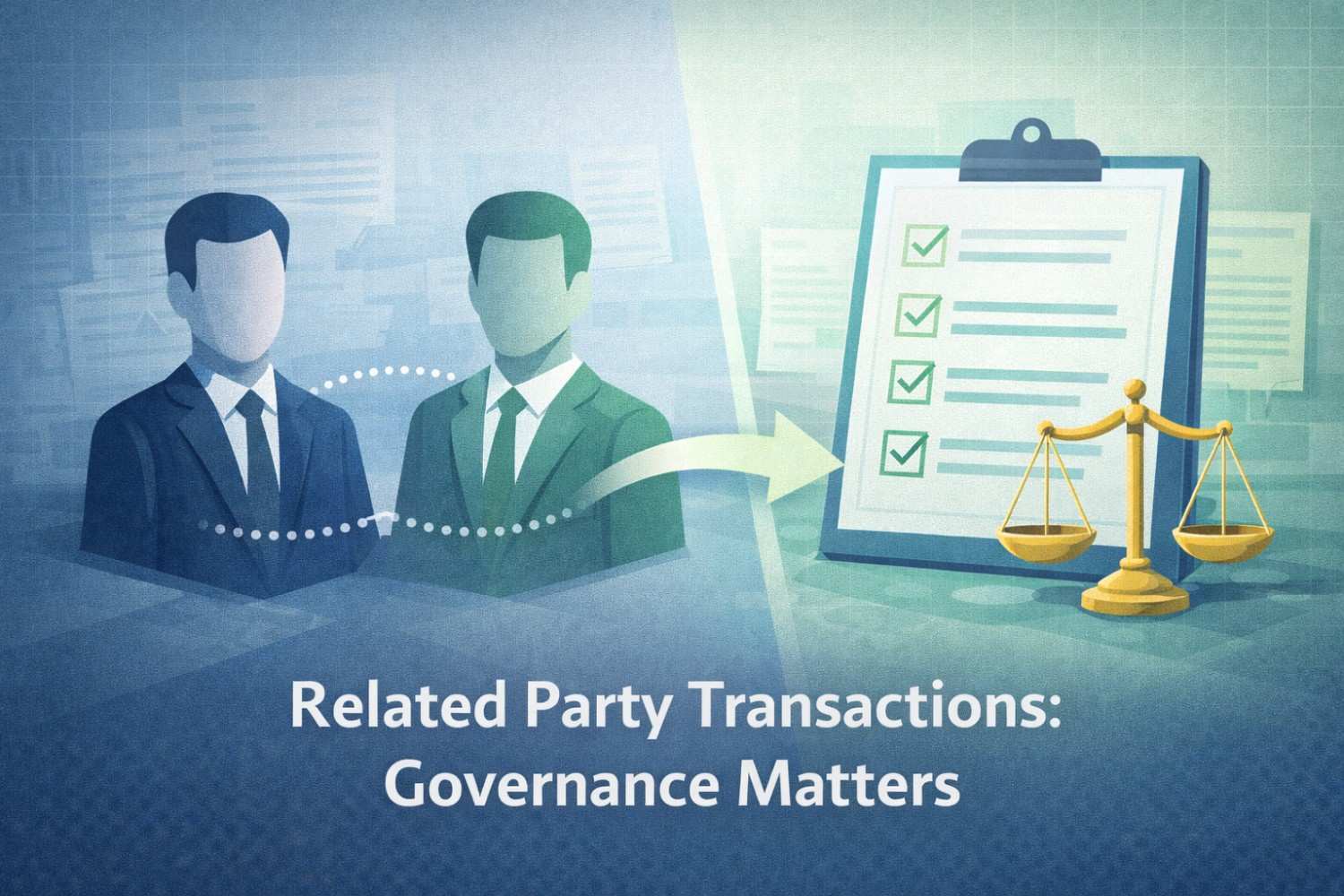
Related Party Transactions (RPTs) occur when a company does business with parties connected to it. These transactions are common in private limited companies because owners and managers are often the same. RPTs can include paying rent to a promoter company, making loans, or sharing services.
Even if they seem normal, RPTs can cause problems if they are not approved properly, priced fairly, or documented clearly. Good RPT governance keeps the company safe, protects directors, and builds trust with investors and lenders.
A Related Party Transaction is any arrangement between a company and its related parties, such as directors, key managerial personnel, relatives, holding or subsidiary companies, or entities under their influence. Common examples in private companies include rent, loans, service agreements, cost sharing, and guarantees.
Regulators focus on how RPTs are executed, not whether they exist. Directors must understand legal responsibilities to ensure compliance.
Private companies are not always under public scrutiny, but weak RPT governance can harm minority shareholders, raise audit concerns, and expose directors to personal liability. Strong RPT governance reduces disputes, strengthens credibility, and ensures smooth audits or funding rounds.
The arm’s length principle ensures that RPTs are conducted as if the parties were unrelated. Pricing, tenure, payment terms, and risk allocation must reflect market reality. Companies can use market benchmarks, quotations, industry standards, or independent valuations to justify the fairness of their transactions.
Compliance starts before signing the deal. Directors and key personnel must disclose their interests in other entities. Maintaining an updated internal register helps identify related parties and plan approvals in advance.
Section 188 governs which RPTs need board or shareholder approval. The approval level depends on whether the transaction is ordinary and at arm’s length, and its value. Directors with an interest must abstain from discussion and voting.
Private companies often engage in recurring RPTs, such as rentals, shared services, or group support arrangements. Approving each transaction separately can be inefficient. Using consolidated agreements with predefined limits and commercial terms streamlines the process.
Transactions done without approval create immediate governance risks. Under Section 188, they may be voidable, and directors or related parties may need to compensate the company. Prompt ratification, supported by proper documentation, reduces regulatory and reputational risk.
Actions to Take:
Not every RPT requires special approval. Exemptions include transactions with wholly-owned subsidiaries, uniform employee benefits, and corporate actions that apply equally to all shareholders. These exemptions focus governance on material risk.
Failure to comply with Section 188 can result in penalties from ₹25,000 to ₹5,00,000. Unapproved transactions may be invalid, and directors may face personal liability. Poorly documented RPTs can also attract scrutiny from tax authorities. Correcting compliance failures is more costly than following rules from the start.
All RPTs must be disclosed in the Board’s Report with proper justification. Approved limits must be monitored continuously. Continuous oversight ensures compliance and audit readiness and demonstrates strong governance.
Key Practices:
RPT governance is not just a legal requirement, it is a strategic advantage. Companies with clear RPT frameworks face fewer issues during audits, funding, or exits. Strong governance signals maturity, reduces friction, and supports long-term scalability.
Related Party Transactions (RPTs) are everyday in private limited companies because owners and managers are often the same people. They are allowed, but must be done carefully with proper approvals, fair pricing, and clear records.
Good RPT governance protects the company and its directors, prevents legal or financial problems, and builds trust with investors and lenders. It also makes the company ready for audits, funding, and future growth.
 GST Input Tax Credit (ITC) Guide for Startups & MSMEs (2026)
 Audit Red Flags in Due Diligence: Investor Guide (2026)
 IEM Registration Part A vs Part B under DPIIT | Complete Guide
 RBI Reporting After Foreign Investment in India | FEMA Guide 2026
 Sections 185, 186 & 188 of Companies Act, 2013: Complete Guide
 Missed a FEMA Filing? Compounding vs Late Submission: What Should You Do?
 MCA Financial Year Flexibility Comes with a Tax Reporting Catch for Companies
 Fast Track Merger without NCLT approval
 Trademark Registration Bangalore: Fees, Eligibility & Steps
 Section 185 vs Section 186: Company Loan Rules Explained

