
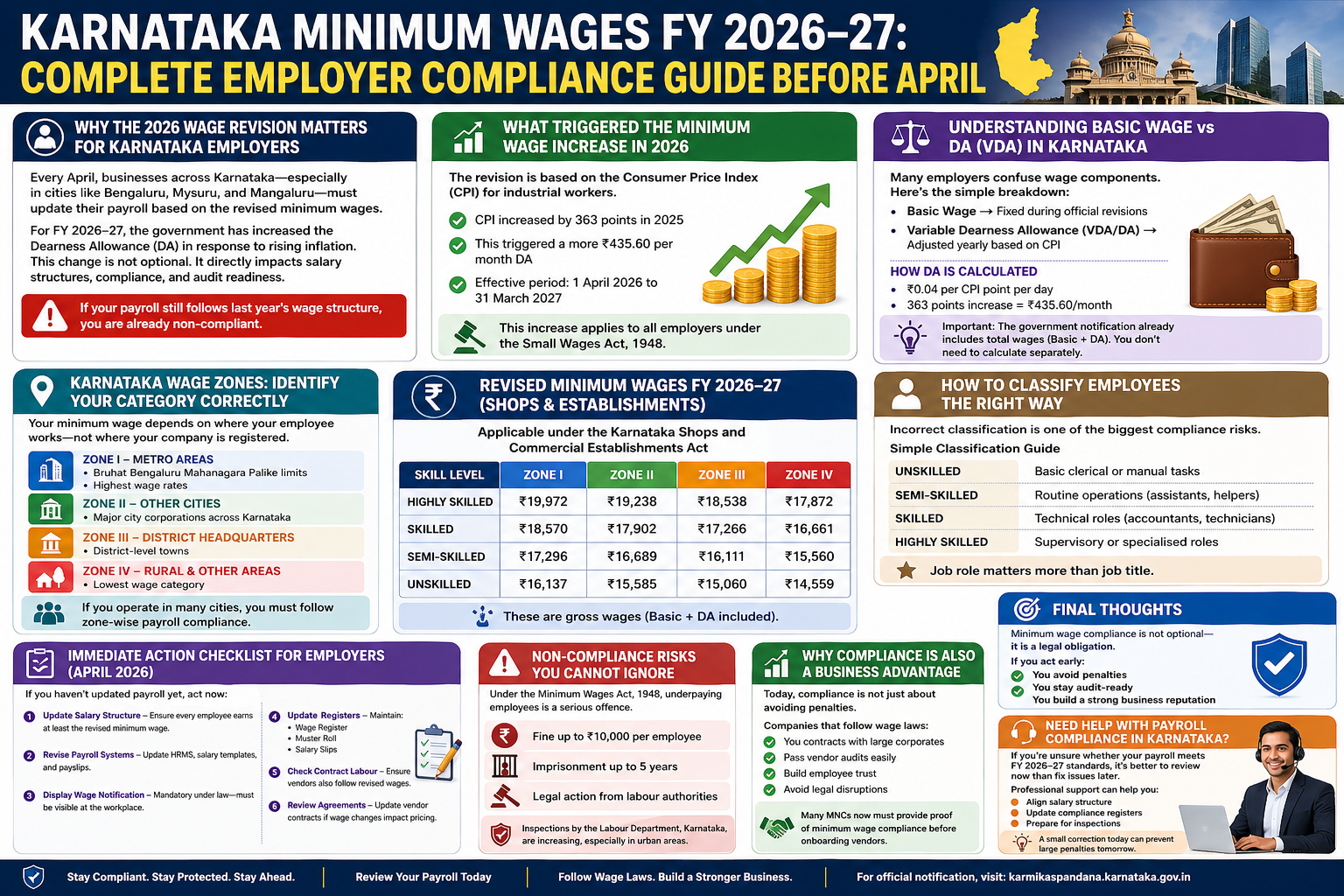
Every April, businesses across Karnataka —especially in cities like Bengaluru, Mysuru, and Mangaluru—must update their payroll based on the revised minimum wages.
For FY 2026–27, the government has increased the Dearness Allowance (DA) in response to rising inflation. This change is not optional. It directly impacts salary structures, compliance, and audit readiness.
If your payroll still follows last year’s wage structure, you are already non-compliant.
The revision is based on the Consumer Price Index (CPI) for industrial workers.
This increase applies to all employers under the Small Wages Act, 1948.
Many employers confuse wage components. Here’s the simple breakdown:
👉 Important: The government notification already includes total wages (Basic + DA). You don’t need to calculate separately.
Your minimum wage depends on where your employee works—not where your company is registered.
👉 If you operate in many cities, you must follow zone-wise payroll compliance.
Applicable under the Karnataka Shops and Commercial Establishments Act
Skill Level | Zone I | Zone II | Zone III
| Zone IV |
Highly Skilled | ₹19,972 | ₹19,238 | ₹18,538 | ₹17,872 |
Skilled | ₹18,570 | ₹17,902 | ₹17,266 | ₹16,661 |
Semi-Skilled | ₹17,296 | ₹16,689 | ₹16,111 | ₹15,560 |
Unskilled | │ ₹16,137 | ₹15,585 | ₹15,060 | ₹14,559 |
👉 These are gross wages (Basic + DA included).
Incorrect classification is one of the biggest compliance risks.
👉 Job role matters more than job title.
If you haven’t updated payroll yet, act now:
Ensure every employee earns at least the revised minimum Wage.
Update HRMS, salary templates, and payslips.
Mandatory under law—must be visible at the workplace.
Maintain:
Ensure vendors also follow revised wages.
Update vendor contracts if wage changes impact pricing.
Under the Minimum Wages Act, 1948, underpaying employees is a serious offense.
👉 Inspections by the labour department, Karnataka, are increasing, especially in urban areas.
Today, compliance is not just about avoiding penalties.
Companies that follow wage laws:
👉 Many MNCs now must provide proof of minimum wage compliance before onboarding vendors.
Minimum wage compliance is not optional—it is a legal obligation.
If you act early:
Delays only increase cost and risk.
If you’re unsure whether your payroll meets FY 2026–27 standards, it’s better to review now than fix issues later.
Professional support can help you:
👉 A small correction today can prevent large penalties tomorrow.
 GST Input Tax Credit (ITC) Guide for Startups & MSMEs (2026)
 Audit Red Flags in Due Diligence: Investor Guide (2026)
 IEM Registration Part A vs Part B under DPIIT | Complete Guide
 RBI Reporting After Foreign Investment in India | FEMA Guide 2026
 Sections 185, 186 & 188 of Companies Act, 2013: Complete Guide
 Missed a FEMA Filing? Compounding vs Late Submission: What Should You Do?
 MCA Financial Year Flexibility Comes with a Tax Reporting Catch for Companies
 Fast Track Merger without NCLT approval
 Trademark Registration Bangalore: Fees, Eligibility & Steps
 Section 185 vs Section 186: Company Loan Rules Explained

