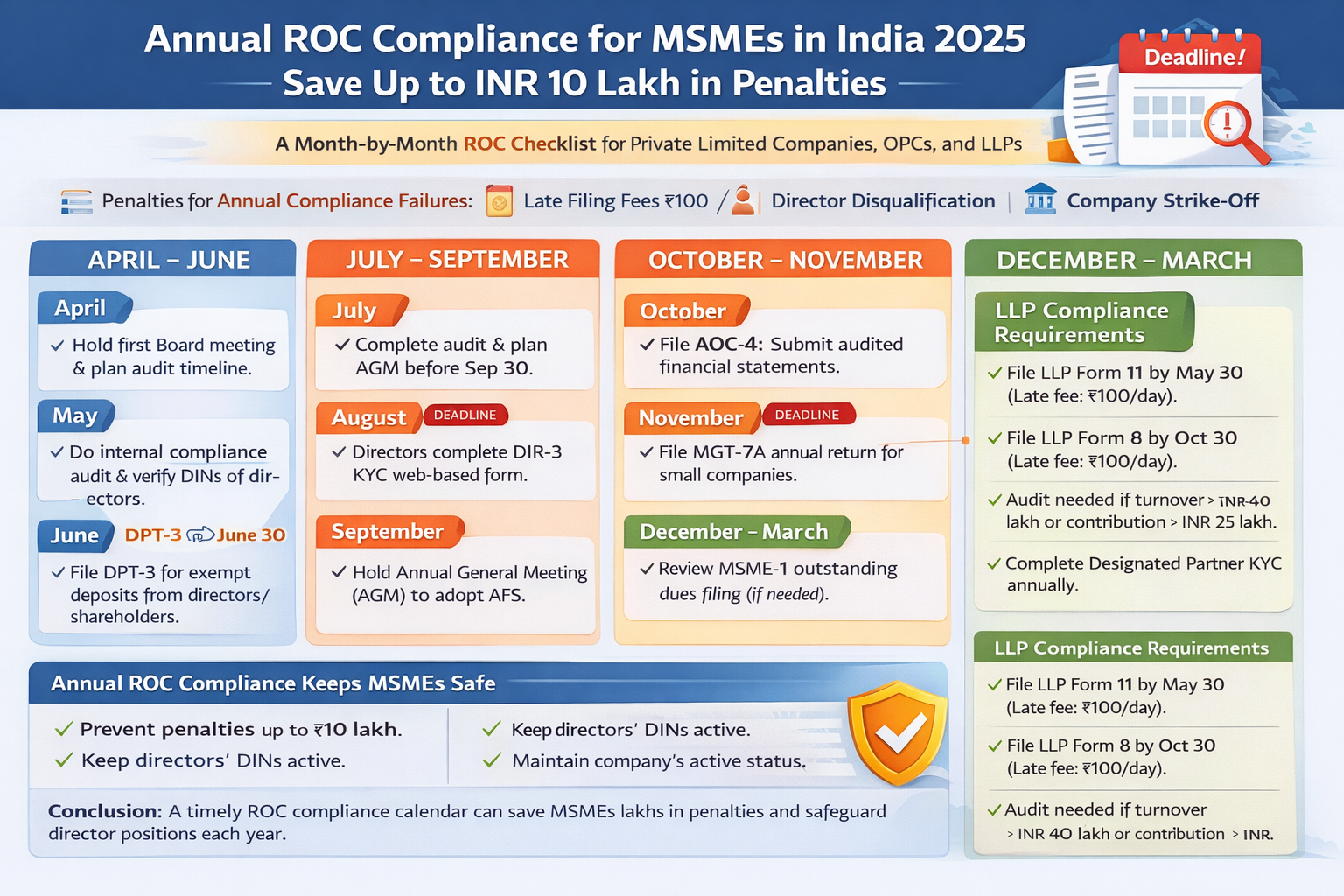
Every year between September and October, thousands of MSME directors across India receive an unpleasant notification from the MCA portal — their company has been marked as a ‘defaulter’ for non-filing of annual returns. The cascading effect is brutal: penalty notices from the ROC, DIN deactivation, bank account complications, and in extreme cases, company strike-off.
The irony? Most of these penalties are entirely preventable. A well-maintained compliance calendar and a competent compliance professional can save an MSME anywhere from INR 50,000 to over INR 10 lakh annually in late fees, compounding penalties, and reinstatement costs.
This guide gives you a month-by-month compliance roadmap for the April-to-March financial year, applicable to private limited companies, one-person companies (OPCs), and LLPs operating as MSMEs in India.
The new financial year begins with the Board’s first meeting of the year. For companies with a March 31 year-end, April is when preliminary accounts are prepared and the audit process begins. Key actions:
Use May to conduct an internal compliance review. Check whether all previous years’ filings are complete, DINs of all directors are active, and there are no pending ROC notices. A 2-3 hour review with your CS in May can prevent a crisis in October.
Form DPT-3 (Return of Deposits) must be filed by June 30 for all companies that have accepted loans from directors or shareholders that qualify as ‘exempt deposits.’ This is one of the most commonly missed MSME filings.
Penalty for non-filing of DPT-3: INR 1 crore or twice the amount of deposit, whichever is lower, plus INR 10 lakh on every officer in default. This is one of the most severe MCA penalties per filing.
The statutory audit must be completed so that financial statements are ready before the Annual General Meeting (AGM). For companies whose financial year ends March 31, the AGM must be held within 6 months — i.e., by September 30.
The Board must approve the audited financial statements and Directors’ Report before the AGM notice is issued. The AGM notice must be sent to shareholders at least 21 clear days in advance (or a shorter period with shareholder consent).
All directors holding a DIN as of March 31 must complete their annual DIR-3 KYC by September 30. This is a web-based form filed directly on the MCA portal. Directors who have filed DIR-3 KYC previously and whose details have not changed file the simpler DIR-3 KYC-Web form.
Fee for Late DIR-3 KYC: INR 5,000 flat reactivation fee if missed. No daily penalty — but your DIN gets deactivated until the fee is paid and the form is filed.
The AGM is the central event that triggers most annual compliance filings. At the AGM:
The AGM date determines the due dates for AOC-4 and MGT-7/7A filings. Missing the AGM itself attracts a penalty of INR 1 lakh on the company and INR 5,000 per day of default.
Form AOC-4 is used to file audited financial statements with the ROC. For companies whose AGM is held on September 30, AOC-4 is due by October 29.
Standard ROC Filing Fee for AOC-4: INR 200 to INR 600 depending on share capital
Late Filing Penalty: INR 100 per day of default — with no maximum cap. A company that files AOC-4 60 days late pays INR 6,000 in late fees on top of the filing fee.
For small companies and OPCs, Form AOC-4 XBRL is not mandatory. They can file the non-XBRL form, significantly simplifying the process.
Small companies (paid-up capital below INR 4 crore and turnover below INR 40 crore) file the simplified Form MGT-7A instead of the comprehensive MGT-7. For an AGM held on September 30, MGT-7A is due by November 28.
Late Filing Penalty for MGT-7A: INR 100 per day of default with no cap
Form ADT-1 must be filed within 15 days of the AGM to notify the ROC of the statutory auditor’s appointment. For an AGM on September 30, ADT-1 is due by October 14.
Important: The auditor’s term must follow rotation norms. For a private limited company, an audit firm can serve for up to 2 consecutive terms of 5 years each (10 years total). Non-rotation is a violation under Section 139.
If your company (not being an MSME itself) has outstanding dues to MSME vendors exceeding 45 days as of September 30, Form MSME-1 was due by October 31. Review whether this was filed. For the half-year ending March 31, MSME-1 is due by April 30.
Hold the third and fourth quarterly board meetings. Discuss and pass resolutions for any new investments, changes in authorized capital, new bank mandates, or related party transactions before the year-end to ensure timely ROC filings in the new year.
Before March 31, conduct a final compliance review:
Limited Liability Partnerships (LLPs) registered under the LLP Act, 2008, have their own compliance framework, but are also administered through the MCA portal:
For MSMEs operating in a competitive market, regulatory compliance is increasingly a business advantage. Banks, institutional investors, large corporates, and government procurement agencies increasingly check MCA compliance status before entering into contracts or providing credit. A clean MCA track record is an asset worth protecting.
The total cost of staying compliant — CS fees, ROC filing fees, auditor fees — for a small private limited company is typically between INR 30,000 and INR 1.5 lakh per year. The potential penalties for non-compliance can be 10 to 100 times that amount. The math is simple.
 GST Input Tax Credit (ITC) Guide for Startups & MSMEs (2026)
 Audit Red Flags in Due Diligence: Investor Guide (2026)
 IEM Registration Part A vs Part B under DPIIT | Complete Guide
 RBI Reporting After Foreign Investment in India | FEMA Guide 2026
 Sections 185, 186 & 188 of Companies Act, 2013: Complete Guide