
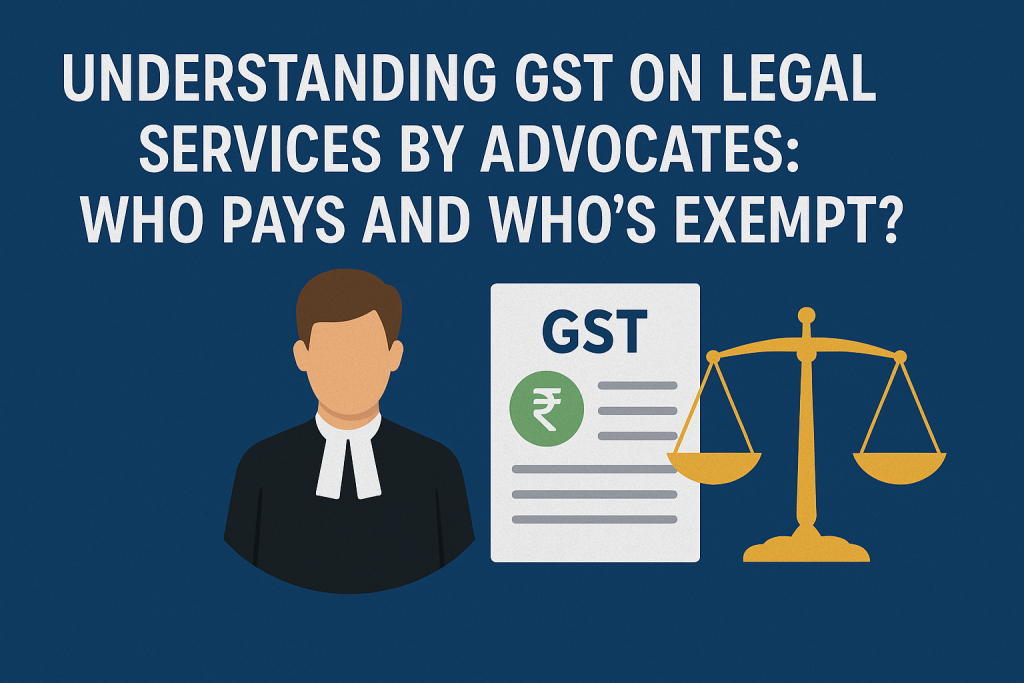
Legal services form an essential part of both personal and professional life, but when it comes to taxation, many are unsure about whether GST (Goods and Services Tax) applies to legal services provided by advocates. The Central Goods and Services Tax (CGST) Act, 2017, along with Notification No. 12/2017-Central Tax (Rate), clearly outlines the situations where GST is applicable and where it is not.
Let’s break it down simply.
If you’re an individual seeking legal help for personal reasons—say, a family dispute or a property issue—you don’t need to worry about GST. The law specifically exempts legal services provided to non-business entities.
This exemption covers a wide range of recipients. For instance:
In all the above cases, legal services are not considered a part of business transactions, and hence, GST does not apply.
On the flip side, when legal services are provided to entities involved in business or commercial activities, GST kicks in—and at a rate of 18%.
Here’s who needs to be aware:
If you’re availing legal services, it’s important to identify your status—whether you’re an individual or represent a business entity—because that determines your GST liability. For non-business clients, the legal service is GST-free. But for business operations, be prepared to add 18% GST to your legal bills.
Knowing where you stand helps avoid unexpected tax liabilities and ensures better financial planning.
 GST Input Tax Credit (ITC) Guide for Startups & MSMEs (2026)
 Audit Red Flags in Due Diligence: Investor Guide (2026)
 IEM Registration Part A vs Part B under DPIIT | Complete Guide
 RBI Reporting After Foreign Investment in India | FEMA Guide 2026
 Sections 185, 186 & 188 of Companies Act, 2013: Complete Guide
 Missed a FEMA Filing? Compounding vs Late Submission: What Should You Do?
 MCA Financial Year Flexibility Comes with a Tax Reporting Catch for Companies
 Fast Track Merger without NCLT approval
 Trademark Registration Bangalore: Fees, Eligibility & Steps
 Section 185 vs Section 186: Company Loan Rules Explained

