For decades, Indian labour law was spread across dozens of separate Acts. Each had its own definitions, registers, returns, and inspectors. Clients found it confusing, and honestly, so did many professionals.
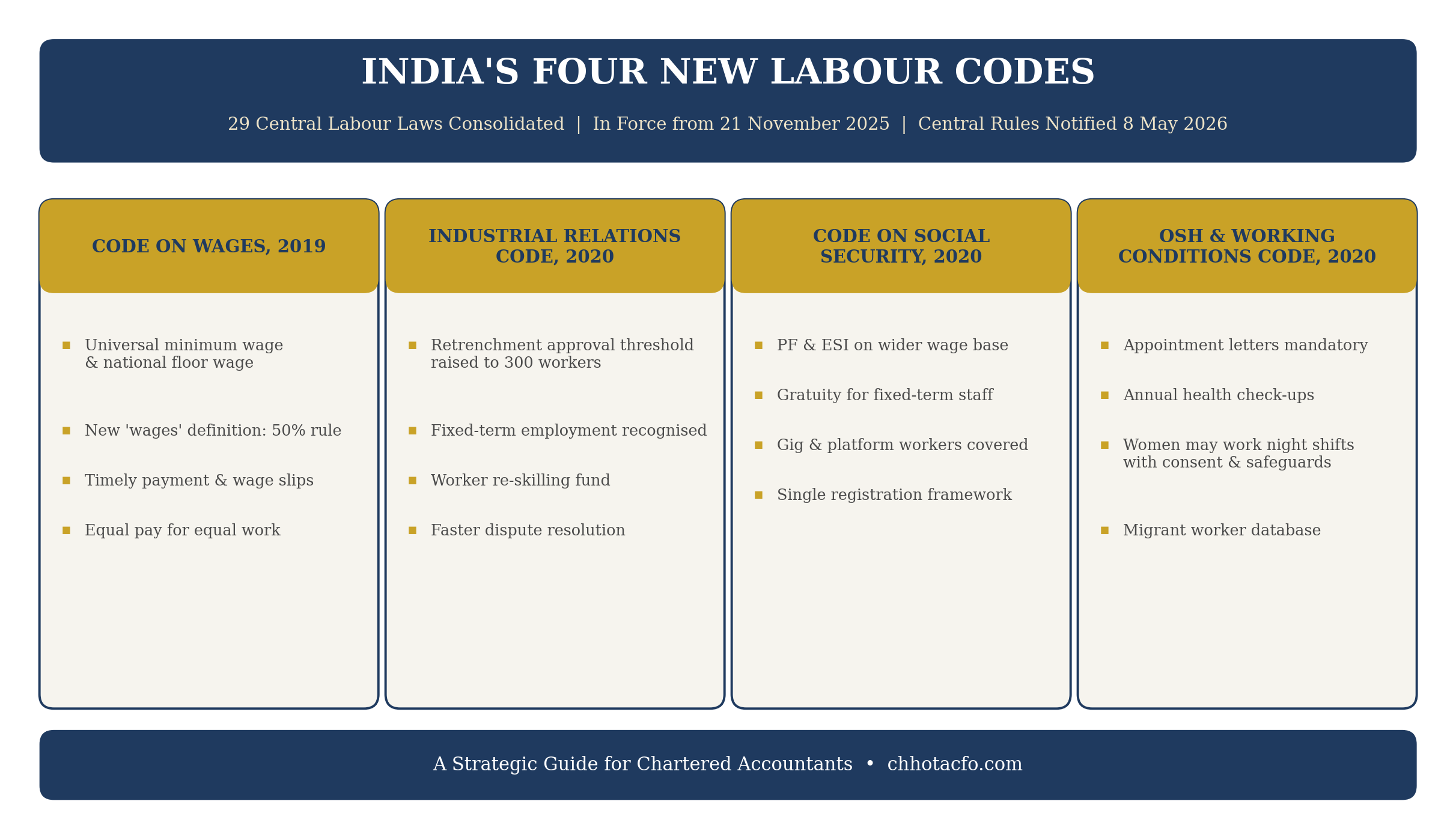
That era is ending. The Government of India has merged 29 central labour laws into four consolidated Codes. The Codes became effective on 21 November 2025, and the final Central Rules were notified on 8 May 2026. Old laws such as the Payment of Wages Act, the Minimum Wages Act, the Factories Act, and the Industrial Disputes Act now stand repealed at the central level, with transition provisions applying until the new framework is fully operational in each state.
Here is the simple truth: labour law has now become as much a payroll and finance subject as an HR subject. The new wage definition changes the arithmetic of PF, gratuity, and bonus. That arithmetic sits squarely on the CA’s desk. Clients will not call their lawyer first. They will call you.
👉 Talk to Our Compliance Experts
Think of the four Codes as four buckets. Every labour law question your client asks will now fall into one of them.
Code | What It Covers | Laws It Replaces (Examples) |
Code on Wages, 2019 | Minimum wages, payment of wages, bonuses, and equal pay | Minimum Wages Act, Payment of Wages Act, Payment of Bonus Act |
Industrial Relations Code, 2020 | Trade unions, standing orders, layoffs, retrenchment, disputes | Industrial Disputes Act, Trade Unions Act, Standing Orders Act |
Code on Social Security, 2020 | PF, ESI, gratuity, maternity benefit, gig and platform workers | EPF Act, ESI Act, Payment of Gratuity Act, Maternity Benefit Act |
OSH & Working Conditions Code, 2020 | Safety, health, working hours, leave, contract labour, migrant workers | Factories Act, Contract Labour Act, Inter-State Migrant Workmen Act |
This is the part clients find most confusing, so keep the explanation simple. The Codes themselves are in force from 21 November 2025. The Central Rules, which give the operating procedures for establishments where the Central Government is the appropriate authority, were notified on 8 May 2026. These central rules govern sectors such as banking, insurance, mines, railways, major ports, and central public sector undertakings.
However, labour is a concurrent subject under the Constitution. For most private companies, the State Government is the appropriate authority, and each state must notify its own rules. States are at different stages. Some have finalised rules under all four Codes; others have finalised rules under only some of the Codes; and several are still at the draft stage. Karnataka-based clients should closely track the state labour department’s notifications before making any state-level filings.
Practical position for advisors: the direction is final, the destination is certain, and only the state-level timing differs. Clients who wait for “full clarity” will end up restructuring payroll in a panic. Clients who prepare now will transition smoothly.
If you remember only one thing from this guide, remember this. The Codes introduce one common definition of “wages” across all four laws. In simple terms, wages mean basic pay plus dearness allowance plus retaining allowance. Certain items, such as HRA, conveyance, overtime, commission, and statutory bonus, are excluded. But there is a catch: if the excluded items cross 50% of total remuneration, the excess is pulled back into wages.
In effect, the wage base for statutory calculations must generally be at least half of the total pay. Many Indian salary structures were deliberately built the other way, with a small basic and a large basket of allowances, to keep PF and gratuity outgo low. That model no longer works.
For CAs, this is a modeling exercise. Every client needs a before-and-after comparison: current structure versus compliant structure, with the impact on employer cost, employee take-home, gratuity provisioning, and deferred tax clearly quantified.
Most coverage of the Labour Codes is written for HR teams. That misses the point for our profession. The Codes create at least six billable, high-value service lines that sit naturally inside a CA or Virtual CFO practice:
Days 1–30 – Diagnose: Pull every client’s current salary structures. Test each against the 50% wage definition. Identify employees and fixed-term staff who become newly eligible for benefits. List missing appointment letters and registrations.
Days 31–60 – Design: Prepare compliant salary structures with a clear cost-impact sheet for management. Recompute gratuity provisions. Update employment contracts, HR policies, and contractor agreements. Brief the board or partners formally.
Days 61–90 – Deploy: Update payroll software settings, issue revised appointment letters, switch to electronic wage slips and registers, and set up a tracker for your state’s rule notifications so the final cut-over is a switch, not a scramble.
The Labour Codes are the biggest rewrite of Indian employment law since Independence. They simplify the rulebook, widen worker protection, and quietly reshape the cost structure of every business with employees. For Chartered Accountants, the message is straightforward: the firms that build labour-code capability now will own this advisory space for the next decade, exactly as early movers did with GST.
Need help assessing the impact on your organisation or your clients? The team at CLAAT Corporate Advisors LLP (Chhota CFO) assists businesses with salary restructuring, compliance health checks, gratuity provisioning, and end-to-end Labour Code transition support. Write to us through chhotacfo.com for a structured impact assessment.
Need Expert Labour Code Compliance and Payroll Advisory Support?
 GST Input Tax Credit (ITC) Guide for Startups & MSMEs (2026)
 Audit Red Flags in Due Diligence: Investor Guide (2026)
 IEM Registration Part A vs Part B under DPIIT | Complete Guide
 RBI Reporting After Foreign Investment in India | FEMA Guide 2026
 Sections 185, 186 & 188 of Companies Act, 2013: Complete Guide