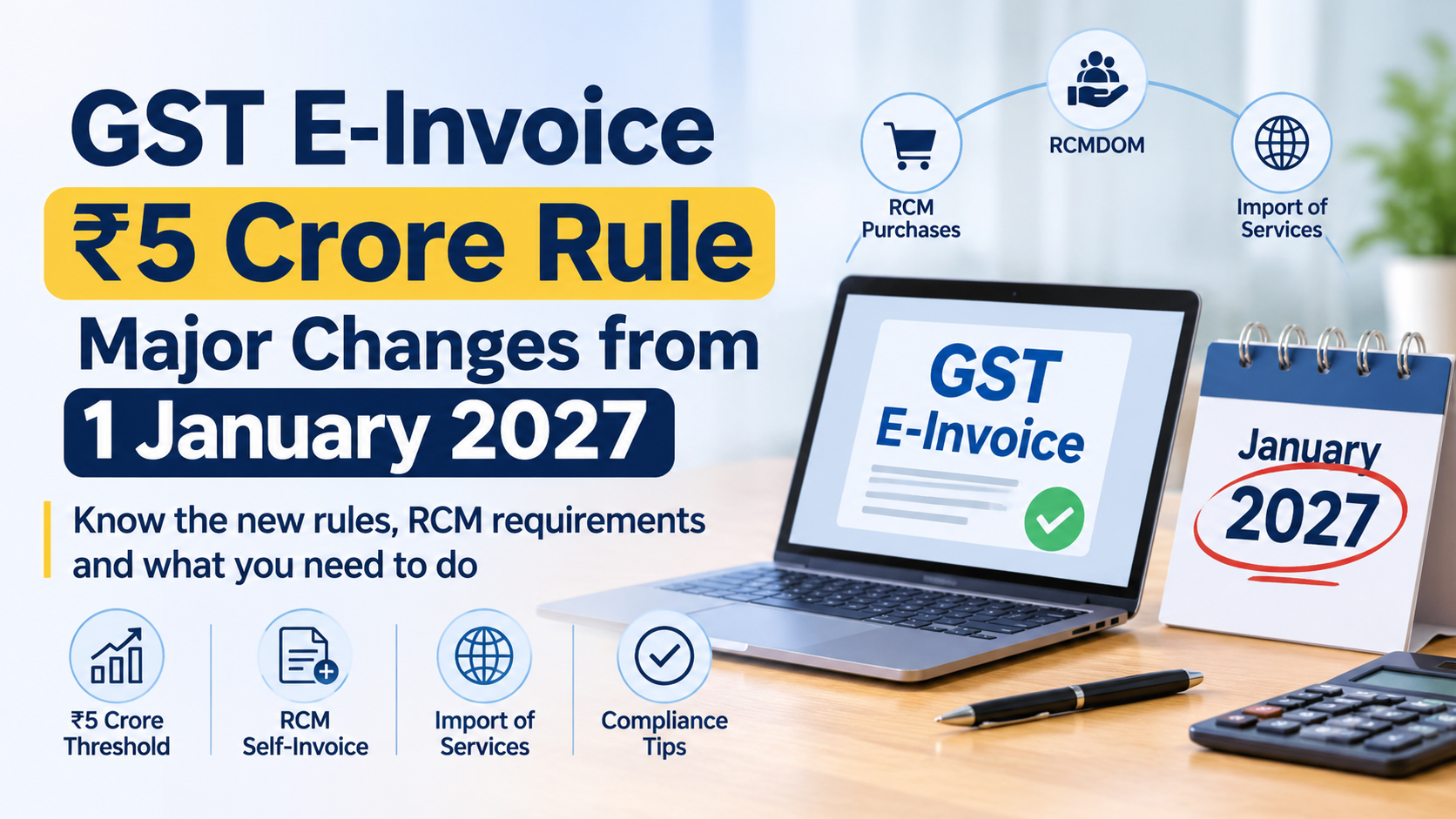
The ₹5 crore e-invoice threshold has not changed. The scope has.
From 1 January 2027, if your aggregate turnover crossed ₹5 crore in any year since FY 2017-18, you must generate an IRN for two more documents:
The legal basis is Notification No. 04/2026–Central Tax, dated 26 October 2026, effective 1 January 2027.
Your finance team already runs e-invoicing on sales. Your purchase side, the RCM register, probably still sits in Excel. You have under 60 days to move it into the IRP system. This guide shows you who is covered, what to fix, and how to avoid losing input tax credit.
Need help preparing for the new GST e-invoice rules?
Chhota CFO helps businesses manage GST compliance, review RCM transactions and prepare for changing e-invoicing requirements.
E-invoicing applies to you if your aggregate turnover exceeded ₹5 crore in any financial year from FY 2017-18 onwards. This test comes from Notification No. 10/2023–Central Tax, in force since 1 August 2023.
Three points decide applicability:
How the threshold came down:
Effective from | E-invoice threshold (aggregate turnover) |
1 August 2023 | Above ₹5 crore |
1 October 2022 | Above ₹10 crore |
1 April 2022 | Above ₹20 crore |
1 April 2021 | Above ₹50 crore |
1 January 2021 | Above ₹100 crore |
1 October 2020 | Above ₹500 crore |
The January 2027 change does not touch this table. It widens the list of documents a covered business must register on the IRP.
Three official steps built this change:
Before and after, at a glance:
Transaction | Till 31 Dec 2026 | From 1 Jan 2027 | IRP supply type |
Sale to a registered buyer (B2B) | IRN required | IRN required | B2B |
Export of goods or services | IRN required | IRN required | EXPWP / EXPWOP |
Purchase from unregistered person under RCM (your self-invoice) | No IRN | IRN required | RCMDOM |
Import of services (your self-invoice) | No IRN | IRN required | RCMIMP |
Purchase from registered supplier under RCM | Supplier issues invoice | No change | Not applicable |
Import of goods | Bill of entry | No change | Not applicable |
How the new flow works:
Production status as of 3 November 2026: GSTN has not yet announced the live production date. The advisory says the date and technical guidelines will follow. The legal effective date of 1 January 2027 stands.
You are covered if both of these are true:
For domestic purchases, two conditions must meet together. The supplier is unregistered. And you pay tax under reverse charge, under Section 9(3) or 9(4) of the CGST Act, or Section 5(3) or 5(4) of the IGST Act. A purchase from an unregistered supplier with no RCM liability needs no self-invoice and no IRN.
Not covered, based on the existing exclusions in Notification No. 13/2020–Central Tax:
Below ₹5 crore? Nothing changes for you. You still raise the self-invoice within 30 days under Rule 47A. You do not need an IRN for it.
Stay Ahead of GST Compliance Changes
Not sure whether your business is ready for the new e-invoicing requirements? Get professional support with RCM reconciliation, GST records and compliance planning.
Get GST Compliance Support from Chhota CFO
Take a private limited company in Bengaluru with aggregate turnover of ₹12 crore. Here is how its regular RCM bills change from January 2027.
Scenario | Bill value | GST under RCM | IRN from Jan 2027? | Code |
Legal fees to an individual advocate (unregistered) | ₹1,50,000 | ₹27,000 (18%) | Yes | RCMDOM |
Sitting fees to an independent director | ₹50,000 | ₹9,000 (18%) | Yes | RCMDOM |
Office rent to an unregistered landlord (monthly) | ₹2,00,000 | ₹36,000 (18%) | Yes, 12 IRNs a year | RCMDOM |
Cloud software from a US provider (monthly, USD 2,000) | ₹1,76,000 | ₹31,680 (18% IGST) | Yes | RCMIMP |
Consulting fees to a UK firm | ₹5,00,000 | ₹90,000 (18% IGST) | Yes | RCMIMP |
Legal fees to a registered law firm | ₹1,50,000 | ₹27,000 (18%) | No, the firm issues the invoice | Not applicable |
Raw material imported from China | ₹10,00,000 | Customs duty and IGST at port | No, bill of entry applies | Not applicable |
USD converted at an assumed ₹88 per USD.
This one company would generate around 30 extra IRNs a year on rent, cloud software and director fees alone. Count your recurring RCM vendors now.
Many teams mix these up. They are separate rules.
Clock | What it controls | Who it applies to | Starts from |
Rule 47A | Issue the self-invoice within 30 days | Every registered recipient under RCM, any turnover (since 1 November 2024) | Date you receive the goods or services |
IRP reporting window | IRP rejects documents older than 30 days | Taxpayers with turnover of ₹10 crore and above (since 1 April 2025) | Date on the invoice |
Worked timeline:
GSTN has not yet confirmed whether the IRP window applies to RCMDOM and RCMIMP. Plan as if it does. Do not treat the two clocks as a 60-day buffer. Set an internal rule: self-invoice and IRN within 7 days of receipt.
Transition point: a service received on 20 December 2026 and self-invoiced on 5 January 2027 falls inside the new rule on the safer reading. The invoice date drives the e-invoice requirement. Clear December RCM bills before 31 December 2026 where you can.
The tax stays payable whether you generate an IRN or not. The real damage sits elsewhere.
The cost in rupees, using the rent example above:
Item | Monthly | Yearly |
RCM GST paid in cash on rent | ₹36,000 | ₹4,32,000 |
ITC at risk if self-invoices lack IRN | ₹36,000 | ₹4,32,000 |
Total cash hit if credit is denied | ₹36,000 | ₹4,32,000 plus interest and penalty |
One vendor, one compliance gap, ₹4.32 lakh of blocked credit a year.
You have under 60 days. Chhota CFO helps MSMEs and startups map RCM vendors, test e-invoice flows with your ERP, and reconcile GSTR-3B before the deadline.
Book a 30-minute e-invoice readiness call. Email mgmt@chhotacfo.com or call +91 97397 36999 | Contact Us or visit: www.chhotacfo.com