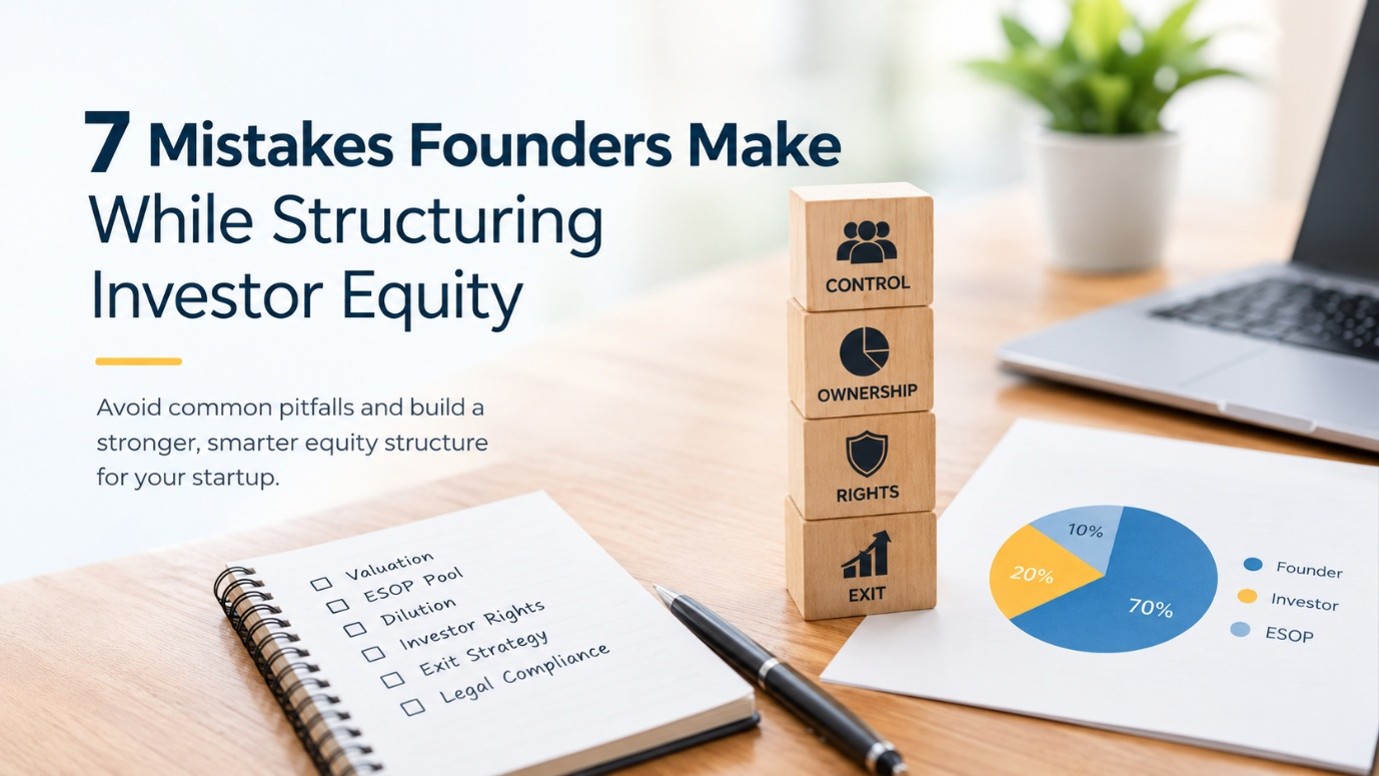
7 Mistakes Founders Make While Structuring Investor Equity

7 mistakes founders make while structuring investor equity

Raising funding is exciting. But many founders focus so much on “How much money are we raising?” that they overlook a more important question:

“What exactly are we giving away in return?”

Planning to Raise Funds for Your Startup?

Before accepting an investment, understand how equity allocation, valuation and investor rights can affect your business. Chhota CFO can help you assess your financial structure and prepare for your next funding round.

Talk to Chhota CFO

Here are 7 common mistakes founders should watch out for:

1. Looking Only at the Equity Percentage

An investor holding 20% may have significant rights relating to:

  • Board representation
  • Reserved matters
  • Information rights
  • Anti-dilution
  • Tag-along / drag-along
  • Exit rights
  • Liquidation preference

20% ownership does not necessarily mean 20% of the entire commercial bargain.

2. Not Understanding Pre-Money vs Post-Money Valuation

A ₹10 crore valuation can mean very different things depending on whether it is:

₹10 crore pre-money or ₹10 crore post-money.

Always calculate the ownership percentage before signing the term sheet.

3. Ignoring the ESOP Pool

Founders sometimes agree to create an ESOP pool without understanding whether the pool is being created:

before or after the investment.

That difference can materially affect founder dilution.

ESOP structuring and compliance

4. Not Modelling Future Dilution

A founder may own 70% today.

But what happens after:

Seed → Series A → Series B → ESOP expansion → Further fundraising?

A current cap table is not enough.

Founders should model the fully diluted cap table and future funding scenarios.

Understand Your Startup’s Equity Before the Next Funding Round

Future investments, ESOP allocations and changes in ownership can affect your shareholding over time. Review your cap table and model potential dilution scenarios before finalising your next investment.

Get Startup Financial Guidance

5. Treating Control and Ownership as the Same Thing

Ownership percentage and control are not always identical.

Board rights, voting rights, reserved matters and investor consent rights can materially influence governance.

6. Agreeing to Investor Rights Without Understanding the Exit Economics

Founders should carefully understand provisions such as:

  • Liquidation preference
  • Anti-dilution
  • Tag-along
  • Drag-along
  • Exit rights
  • Transfer restrictions

The question is not only:

“Who owns what?”

It is also: “Who gets what, when and under what circumstances?”

7. Structuring the Transaction Before Checking the Legal Route

Equity transactions can involve:

Companies Act + Valuation + Tax + Stamp Duty + FEMA + Accounting + AOA + SHA

The correct legal mechanism should be identified before the transaction is implemented.

The Founder Rule

Before agreeing to an investment, don’t look at the cap table only as:

Founder: 70%
Investor: 20%
ESOP: 10%

Look deeper.

Ask:

Who owns?
Who controls?
Who gets diluted?
Who gets paid first on exit?
What happens in the next funding round?

A well-structured equity deal should work not only for today’s funding round, but also for the company’s next stage of growth.

Structure the equity before the money comes in — not after.

Why Choose Chhota CFO for Startup Financial Guidance?

Structuring investor equity involves more than deciding how much ownership to offer an investor. Founders also need to understand valuation, future dilution, financial projections and the impact of fundraising on their business.

Chhota CFO supports businesses with financial planning and advisory services to help them make informed financial decisions as they grow.

  • Financial Planning: Understand your startup’s financial position and plan for future funding requirements.
  • Valuation Support: Coordinate valuation requirements and understand how valuation affects equity allocation.
  • Fundraising Preparation: Organise financial information and prepare for discussions with potential investors.
  • Growth Planning: Evaluate future funding needs, projected expenses and financial scenarios.
  • Compliance Coordination: Identify relevant financial and regulatory requirements and coordinate with appropriate legal and tax professionals where necessary.

With the right financial planning, founders can approach investment discussions with a clearer understanding of their company’s ownership structure and future funding needs.

Structure Your Startup’s Equity with Confidence

A well-planned equity structure can help founders understand ownership, investor rights, dilution and future funding requirements. Chhota CFO can support your business with financial planning, valuation coordination and funding-related financial guidance.

Connect with our team to discuss your startup’s financial requirements.

Contact Chhota CFO

FAQ

What is investor equity in a startup?

Investor equity is the ownership stake a startup gives an investor in exchange for capital. The percentage allocated depends on factors such as the company's valuation, investment amount and agreed transaction terms.

How do founders calculate equity for investors?

Founders generally calculate investor equity using the investment amount and the company's agreed valuation. They should clarify whether the valuation is pre-money or post-money and account for any applicable share-pool arrangements.

What is the difference between pre-money and post-money valuation?

Pre-money valuation refers to a company's agreed value before a new investment. Post-money valuation includes the new investment. The difference affects the investor's ownership percentage.

How does an ESOP pool affect founder equity?

An Employee Stock Option Plan (ESOP) pool reserves shares or options for employees. Creating or expanding the pool can dilute existing shareholders, depending on the agreed structure and timing.

What is founder dilution during fundraising?

Founder dilution occurs when a founder's percentage ownership decreases as a company issues additional shares or securities. It commonly happens during new funding rounds or when an ESOP pool is expanded.

Why is a cap table important for startups?

A capitalisation table, or cap table, records a company's ownership structure. It helps founders track shareholdings, investor ownership, employee equity and the potential impact of future fundraising.

Does owning more equity always mean having more control?

No. Ownership percentage and control are not always the same. Board representation, voting rights, reserved matters and investor consent provisions can influence how important business decisions are made.

What are liquidation preferences in an investor agreement?

A liquidation preference determines the order or priority in which certain investors receive proceeds in specified events, such as a sale or liquidation. Its effect depends on the terms of the investment agreement.

Which legal and compliance requirements should founders consider when issuing equity in India?

Depending on the transaction, founders may need to consider the Companies Act, applicable valuation requirements, tax implications, stamp duty, FEMA requirements for relevant cross-border investments, accounting treatment and company documents such as the Articles of Association and Shareholders' Agreement.

How can founders prepare their equity structure before raising funds?

Founders should review their current cap table, calculate pre-money and post-money ownership, assess ESOP requirements, model future dilution and understand investor rights and exit provisions. They should also obtain appropriate financial, tax and legal advice before finalising the transaction.
Book a Call with an expert absolutely FREE for 15 minutes