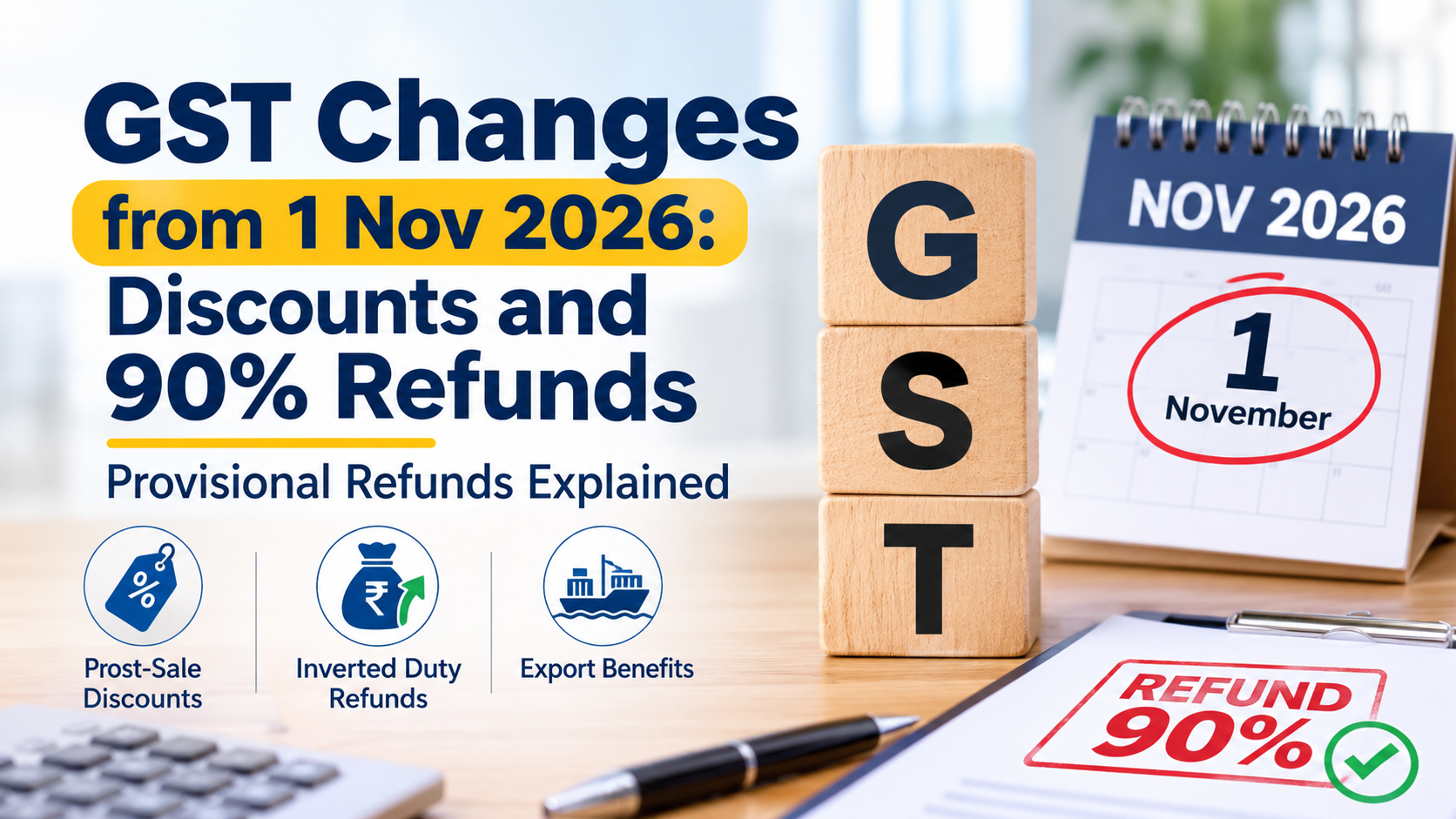
From 1 November 2026, three GST rules change in your favour. Year-end and volume discounts get easier. Refunds for inverted duty businesses get faster. Small exporters get relief.
Chhota CFO helps MSMEs, startups and growing businesses stay updated with GST regulations and manage their tax compliance efficiently.
The Finance Ministry notified these changes through Notification No. 03/2026 Central Tax, dated 26 October 2026. It brings Sections 153, 154 and 155 of the Finance Act, 2026 into force. These sections amend Sections 15, 34 and 54 of the CGST Act, 2017. The GST Council first recommended them at its 56th meeting in September 2025, and the Budget 2026-27 carried them into law.
Here is what changes for you, in short:
A companion notification, Notification No. 05/2026 Central Tax (also dated 26 October 2026), amends the CGST Rules. It adds ITC on input services to inverted duty refunds from 1 November 2026, and ITC on capital goods from 1 April 2027.
Need Help Understanding the Latest GST Changes?
Stay ahead of the November 2026 GST amendments. Chhota CFO helps businesses understand new GST provisions, manage credit notes and identify eligible refund benefits.
Provision | Until 31 October 2026 | From 1 November 2026 |
Section 15(3)(b): post-sale discount | Discount had to be agreed before or at the time of supply and linked to specific invoices | No prior agreement needed. No invoice linking needed. Supplier issues a GST credit note and recipient reverses the Input Tax Credit |
Section 34(1): credit notes | Covered excess value, excess tax, goods returned, deficient supply. Discounts sat in a grey area | Discounts under Section 15(3)(b) now expressly covered |
Section 54(6): provisional refund | 90% provisional refund for zero-rated supplies (exports, SEZ) | Also covers unutilized ITC from inverted duty structure |
Rule 89(5): inverted duty Net ITC | ITC on inputs only. Input services and capital goods excluded | Input services included for ITC availed on or after 1 November 2026. Capital goods from 1 April 2027 |
Rule 89(4)(C): export refund | Turnover of zero-rated goods capped at 1.5 times the value of like domestic goods | 1.5 times cap removed |
Section 54(14): minimum refund | No refund below Rs 1,000 | Rs 1,000 limit removed for goods exported with payment of tax |
You now pay GST only on the price your customer pays after discount, even if you decide the discount after the sale.
Most businesses fix year-end or target discounts after the sales happen. A distributor hits a target in March. A brand clears old stock with a retailer in Q4. Under the old Section 15(3)(b), these discounts reduced GST value only if two tests were met:
Most real-world discounts failed both tests. Suppliers issued “financial” credit notes without GST. They paid GST on money they never received. Tax officers also raised disputes, treating some dealer discounts as payment for promotion services.
From 1 November 2026, a post-sale discount reduces taxable value when two conditions are met:
The law now links the supplier’s tax reduction to the buyer’s ITC reversal. The government gets its tax either way. You get a cleaner, dispute-free route.
Your company sells electronics worth Rs 1,00,00,000 to Dealer A during FY 2026-27 at 18% GST. In March 2027, you give Dealer A a 5% target discount of Rs 5,00,000. No agreement existed at the time of sale.
Item | Old rule (financial credit note) | New rule (GST credit note) |
Discount (before tax) | Rs 5,00,000 | Rs 5,00,000 |
GST on discount at 18% | Not adjusted | Rs 90,000 |
Credit note value | Rs 5,00,000 | Rs 5,90,000 |
Your output GST reduced by | Rs 0 | Rs 90,000 |
Dealer A reverses ITC of | Rs 0 | Rs 90,000 |
Extra GST cost borne by you | Rs 90,000 | Rs 0 |
On a Rs 10 crore annual dealer network with 5% post-sale discounts, that is Rs 9,00,000 of GST you stop overpaying each year.
Section 34(2) still applies. You must declare the credit note in your return by 30 November after the end of the financial year, or the date you file the annual return, whichever comes first. For FY 2026-27 sales, that means 30 November 2027 at the latest. Miss it and the discount stays outside GST.
If your input GST is higher than your output GST, you now get 90% of your refund within days, not months.
You buy inputs at a higher GST rate and sell at a lower rate. ITC piles up in your electronic credit ledger. You cannot use it, so your working capital stays locked.
Common examples after GST 2.0 rate cuts:
The amended Section 54(6) extends the 90% provisional refund to unutilized ITC under clause (ii) of the first proviso to Section 54(3). Until now, only exporters and SEZ suppliers had this facility in the law. An interim administrative arrangement existed for inverted duty claims. It now has a statutory footing.
The amended Rule 91(2) adds speed. The GST portal generates the provisional refund order in Form GST RFD-04, based on system risk checks, within three working days of the acknowledgement.
A garment unit in Tiruppur buys dyes, chemicals and trims at 18% GST and sells garments at 5%. Its monthly refund claim of accumulated ITC is Rs 8,00,000.
Stage | Amount | Timeline |
Refund claimed | Rs 8,00,000 | Month-end filing in RFD-01 |
Provisional refund (90%) | Rs 7,20,000 | Order within 3 working days of acknowledgement |
Balance after scrutiny (10%) | Rs 80,000 | Final order under Section 54(7) |
Over 12 months, this unit frees up Rs 86,40,000 in cash much earlier than before.
Notification No. 05/2026 Central Tax substitutes Rule 89(5). The refund formula is now:
\text{Maximum Refund} = \frac{\text{Turnover of inverted rated supply} \times \text{Net ITC}}{\text{Adjusted Total Turnover}} – \text{Tax payable on inverted rated supply}
“Net ITC” now covers:
This reverses the position the Supreme Court upheld in the VKC Footsteps case, where input services stayed outside the refund formula. Note one limit: input services increase your refund amount. They do not by themselves create an inverted duty structure. The input vs output rate test still decides eligibility.
Notification No. 14/2025 Central Tax already bars certain persons from provisional refunds under Section 54(6). These include taxpayers who have not completed Aadhaar authentication and suppliers of pan masala, tobacco and areca nuts. Check your status before you rely on the 90% cash flow.
Unlock Your Eligible GST Refunds
Is accumulated input tax credit affecting your business cash flow? Get professional assistance with inverted duty refund calculations, ITC reconciliation and GST refund filing.
Exporters of goods who pay IGST on exports now get refunds of any size, even below Rs 1,000.
Section 54(14) earlier blocked any refund below Rs 1,000. For a small exporter sending samples or low-value parcels with IGST paid, that meant lost money. The amendment removes this limit for refunds of tax paid on goods exported out of India with payment of tax.
The Rs 1,000 limit still applies to:
A separate rule change also helps exporters under LUT. From 1 November 2026, Rule 89(4)(C) no longer caps the turnover of zero-rated goods at 1.5 times the value of similar goods sold in India. Exporters with premium export pricing get their full refund.
Businesses dealing with multiple taxable products and services can refer to this GST rate and HSN code guide for classification information.
Act this month. The benefits apply only if your paperwork and systems match the new rules.
For suppliers giving discounts
For buyers receiving discounts
For inverted duty and export businesses
Chhota CFO supports MSMEs, startups and growing businesses with practical GST and financial compliance solutions.
With Chhota CFO, businesses can navigate changing GST requirements with greater confidence.
Need help implementing the latest GST amendments? Connect with Chhota CFO for GST compliance, credit note management and refund filing support.
Write to mgmt@chhotacfo.com or call +91 97397 36999. Visit www.chhotacfo.com