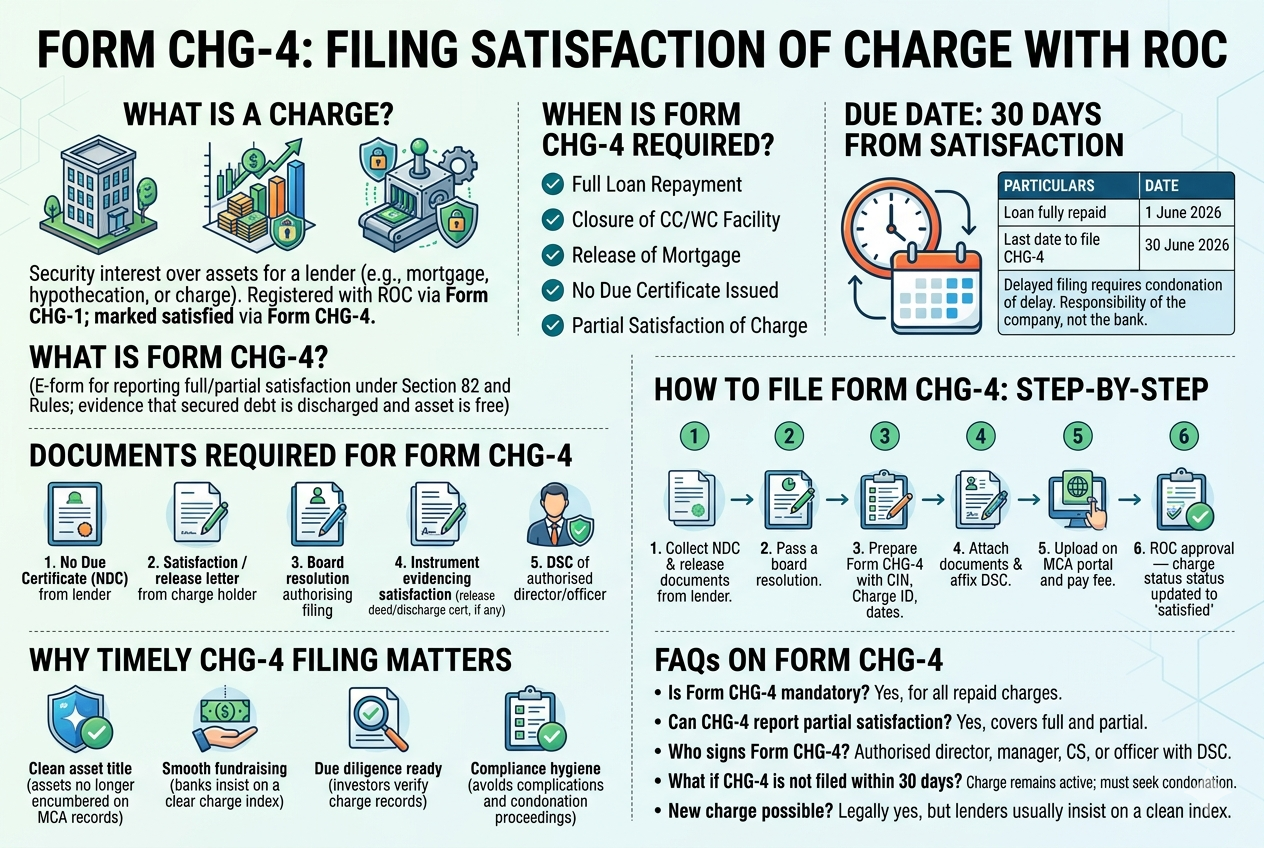
A charge is a security interest created by a company over its assets in favour of a lender—for example, a mortgage on property, hypothecation of stock and receivables, or a charge on plant and machinery. Every charge is registered with the ROC through Form CHG-1 at the time of creation and must be marked as satisfied through Form CHG-4 once the loan is repaid.
Form CHG-4 is the e-form prescribed under Section 82 of the Companies Act, 2013, read with the Companies (Registration of Charges) Rules, 2014, for reporting full or partial satisfaction of a registered charge to the ROC. It serves as official evidence that the secured debt has been discharged and the asset is free from encumbrance.
File CHG-4 whenever:
Need Help Filing Form CHG-4 with ROC?
Form CHG-4 must be filed within 30 days from the date of satisfaction of the charge.
Particulars | Date |
Loan fully repaid | 1 June 2026 |
Last date to file CHG-4 | 30 June 2026 |
Delayed filing requires condonation of the delay, adding cost and time. The responsibility to file rests with the company — not the bank.
Loan repayment completes the financial obligation; Form CHG-4 completes the compliance. Filing within 30 days keeps your charge index clean, your assets unencumbered on record, and your company due diligence ready.
Contact Chhota CFO today for Form CHG-4 filing and ROC charge satisfaction support.
 GST Input Tax Credit (ITC) Guide for Startups & MSMEs (2026)
 Audit Red Flags in Due Diligence: Investor Guide (2026)
 IEM Registration Part A vs Part B under DPIIT | Complete Guide
 RBI Reporting After Foreign Investment in India | FEMA Guide 2026
 Sections 185, 186 & 188 of Companies Act, 2013: Complete Guide