RBI Restores Export Proceeds Realisation Period to 9 Months: What Every Exporter Must Know (June 2026)

RBI restores export proceeds realisation period to 9 months from June 2026 under FEMA export compliance regulations for Indian exporters

Quick Answer

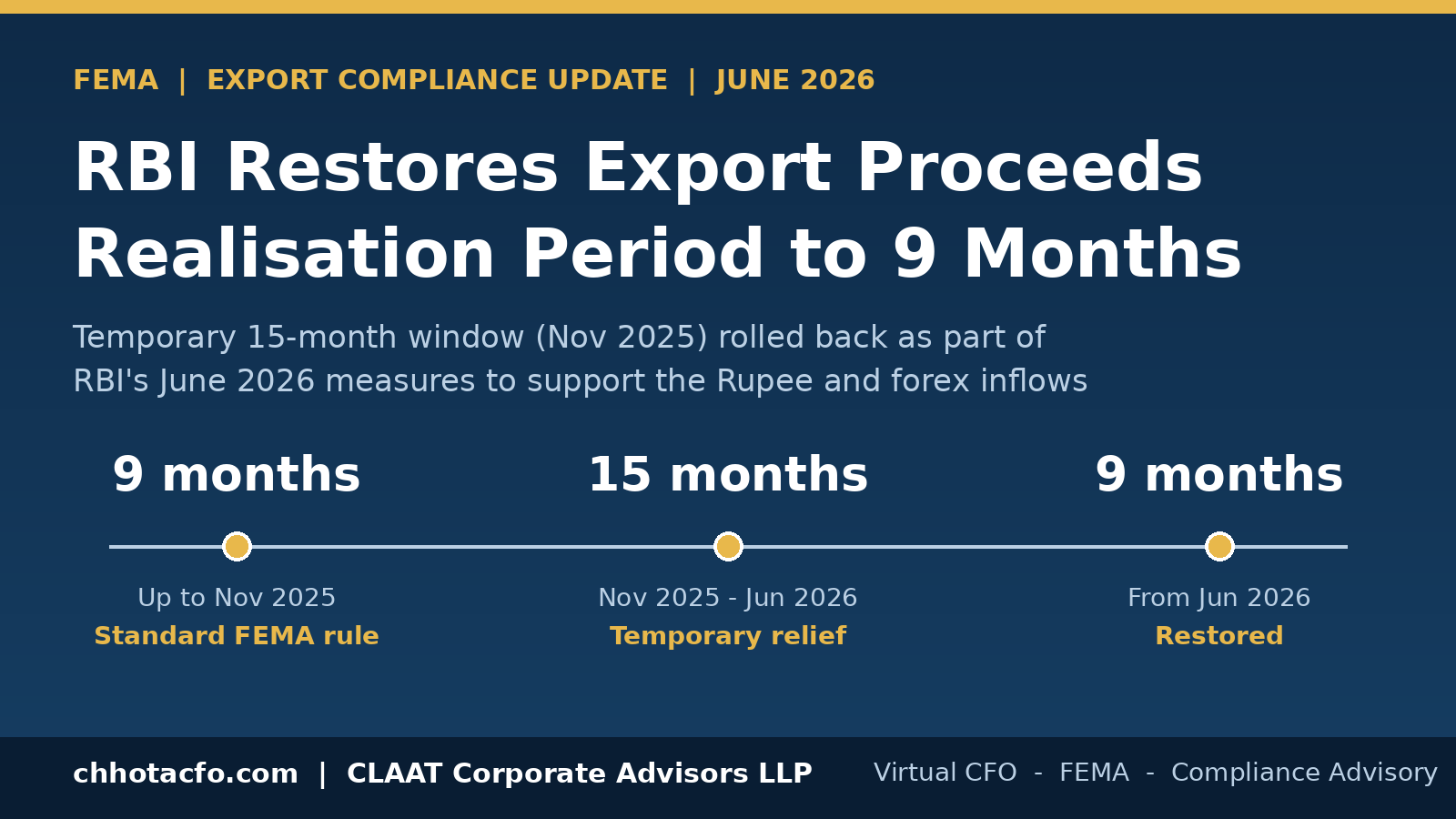
The Reserve Bank of India (RBI) has restored the time limit for realizing and repatriating export proceeds to 9 months from the date of export. This rolls back the temporary 15-month window granted in November 2025. The change was announced as part of the RBI’s package of measures on 5 June 2026 to support the Indian Rupee and improve foreign exchange inflows. In simple words: if you export goods, software, or services from India, you must now bring the payment into India within 9 months, not 15.

Speak to Our FEMA Experts Today

What Has Changed?

Until November 2025, the standard rule under the Foreign Exchange Management (Export of Goods and Services) Regulations was simple: an exporter had to receive the full export payment and bring it into India within 9 months from the date of export.

In November 2025, the RBI relaxed this rule. Through Notification No. FEMA 23(R)/(7)/2025-RB dated 13 November 2025, the period was extended from 9 months to 15 months. This was a relief measure. Indian exporters were facing payment delays because of steep US tariffs and disturbed global trade. The longer window gave them breathing room and helped them offer longer credit periods to overseas buyers.

Now, in June 2026, the RBI has reversed that relaxation. The realisation period stands restored to 9 months. The rollback was announced alongside the Monetary Policy on 5 June 2026, as one of several steps taken to strengthen India’s external sector.

👉 Contact Chhota CFO for a Compliance Review

The Timeline at a Glance

Period

Realisation Limit

Basis

Up to 13 November 2025

9 months

Standard rule under FEMA Export Regulations, 2015 (Regulation 9)

14 November 2025 to early June 2026

15 months

Temporary relief via Notification FEMA 23(R)/(7)/2025-RB amid US tariff pressure; carried into the FEMA Export-Import Regulations, 2026

From June 2026 onwards

9 months (restored)

Announced with RBI’s 5 June 2026 measures to support the Rupee and forex inflows

Why Did the RBI Roll It Back?

The answer is the Rupee. When exporters take longer to bring dollars home, the supply of foreign currency in India slows down. This puts pressure on the exchange rate. By restoring the 9-month deadline, the RBI wants export earnings to flow back into the country faster.

The rollback did not come alone. It is part of a larger set of June 2026 measures aimed at attracting foreign capital and supporting the balance of payments. These include easier access for foreign investors to government securities, support for foreign currency (FCNR-B) deposits, and incentives for overseas borrowings by public sector enterprises. Faster export realisation fits the same goal: more foreign exchange, sooner.

What the 9-Month Rule Means in Simple Words

  • The clock starts on the date of export. For goods, this is generally the shipment date. For services and software, it is linked to the invoice.
  • The full value must come in. You must receive the entire invoice value through proper banking channels, not just a part of it.
  • The money must come to India. Realisation means receiving the payment; repatriation means bringing it into India. Both must happen within the time limit.
  • Your bank tracks every shipment. Each shipping bill sits as an open entry in the RBI’s EDPMS system until your AD bank matches it with the inward payment.
  • Delays are not automatically forgiven. If a buyer is slow to pay, you must apply to your AD bank for an extension before the deadline with genuine reasons.

Who Does This Apply To?

The realisation timeline applies to exporters of goods, services, and software. Historically, the RBI has kept the rule uniform for all categories, including units in Special Economic Zones (SEZs), Export Oriented Units (EOUs), Status Holder exporters, and units in Software Technology Parks (STPs), Electronics Hardware Technology Parks (EHTPs), and Biotechnology Parks (BTPs). MSME exporters, merchant exporters, and service exporters, such as IT and consulting firms, are all covered.

Two practical points need confirmation with your AD bank under the operative circular: first, the exact effective date and whether shipments already made under the 15-month window get transition protection; and second, whether any special timelines (for example, for goods sold from overseas warehouses or for Rupee-settled exports) apply to your case. Until confirmed, the safest planning assumption is 9 months for every open shipment.

Action Plan: 7 Steps Exporters Should Take Now

  1. Pull your EDPMS open-entry report from your AD bank and list every shipping bill that is still unpaid.
  2. Re-calculate the due date for each open shipment on a 9-month basis and flag anything that crosses or nears the limit.
  3. Follow up with overseas buyers immediately for shipments where the longer credit period was agreed upon, assuming a 15-month window.
  4. Revisit payment terms in new export contracts; align buyer credit periods with the 9-month outer limit, keeping a buffer for banking delays.
  5. Apply to your AD bank in advance for extensions on genuinely delayed receivables, with correspondence and documents that prove your recovery efforts.
  6. Review forward covers and hedging, since collection timelines may now compress and forwards may need realignment.
  7. Set a monthly compliance calendar entry to review export outstandings, so no shipment silently crosses the FEMA deadline.

What If You Miss the Deadline?

Non-realization of export proceeds within the permitted period, without an approved extension, is a contravention under FEMA. The consequences can be serious:

  • Monetary penalty: Under Section 13 of FEMA, the penalty can go up to three times the amount involved in the contravention, or up to two lakh rupees where the amount is not quantifiable, with further daily penalties for continuing default.
  • Caution listing: Exporters with long-pending EDPMS entries can be placed on the RBI caution list, after which banks handle their documents only on a restricted basis.
  • Restricted trade terms: Future exports may be permitted only against advance payment or an irrevocable letter of credit.
  • Practical friction: Open entries delay bank processing of fresh export documents, export incentive claims, and write-off requests.

The good news: AD banks have powers to grant extensions and, in genuine cases, to permit reduction in realisation or write-off of unrecoverable dues, subject to conditions. The key is to act before the deadline, not after.

How Chhota CFO Can Help

CLAAT Corporate Advisors LLP works with MSMEs, startups, and exporters across India on FEMA and RBI compliance. Our team can map your EDPMS outstandings, build a collection tracker aligned to the restored 9-month deadline, draft extension and write-off applications to your AD bank, and handle the supporting documentation end-to-end. If you export goods, software, or services and want a clear compliance picture before the new deadline starts to bite, reach out to us through chhotacfo.com.

Disclaimer

This article is for general information only and is based on RBI announcements and reports available as on the date of publication. It does not constitute legal, tax or financial advice. The operative RBI notification or A.P. (DIR Series) circular governs the exact effective date, transition provisions and category-wise applicability; exporters should verify their specific position with their Authorised Dealer bank or a professional advisor before acting. For tailored FEMA and export compliance support, contact CLAAT Corporate Advisors LLP at chhotacfo.com.

FAQ

What is the export proceeds realisation period?

It is the maximum time an Indian exporter gets to receive payment from a foreign buyer and bring that money into India through banking channels. The clock starts from the date of export. This rule comes from the Foreign Exchange Management Act, 1999 (FEMA) and the export regulations issued under it by the RBI.

What has the RBI changed now?

At its Monetary Policy announcements on 5 June 2026, the RBI restored the realisation period to 9 months. The temporary 15-month window, which had been allowed since November 2025, has been rolled back. Exporters must once again realise and repatriate export proceeds within 9 months from the date of export.

Why was the period 15 months earlier?

In November 2025, through Notification No. FEMA 23(R)/(7)/2025-RB, the RBI had extended the period from 9 months to 15 months. This was a relief measure for exporters facing payment delays due to steep US tariffs and global trade disruption. It was always intended as a temporary relaxation.

Why has the RBI brought back the 9-month rule?

The rollback is part of a wider package of measures announced in June 2026 to support the Indian Rupee and strengthen foreign exchange inflows. A shorter realisation period means export dollars come back to India faster, which improves the supply of foreign currency and supports the balance of payments.

Does the 9-month rule apply to SEZ units, EOUs and Status Holders?

Yes. The realisation timeline has historically applied uniformly to all exporter categories, including units in Special Economic Zones (SEZs), Export Oriented Units (EOUs), Status Holder exporters, and units in Software Technology Parks (STPs), Electronics Hardware Technology Parks (EHTPs) and Bio-Technology Parks (BTPs). Exporters in these categories should confirm the position under the operative circular with their AD bank.

What about exports already made under the 15-month window?

Exporters should check the effective date and transition language of the operative RBI circular or notification with their Authorised Dealer (AD) bank. As a conservative practice, exporters should plan collections for all open shipments on a 9-month basis unless the bank confirms that the longer window is protected for past exports.

What happens if I cannot realise the money within 9 months?

Apply to your AD bank for an extension before the deadline expires, with proper reasons and supporting documents. If proceeds remain unrealised without an approved extension, it becomes a contravention under FEMA. Penalties under Section 13 of FEMA can go up to three times the amount involved, and future exports may be restricted to advance payment or letter of credit terms.

How is the unrealised amount tracked?

Every shipping bill is tracked in the Export Data Processing and Monitoring System (EDPMS) maintained by the RBI through AD banks. Entries stay open until the bank receives and matches the inward remittance. Long-pending open entries can lead to the exporter being placed on the caution list.

Does this change affect advance payments for exports?

The June 2026 announcement specifically concerns the realisation timeline for export proceeds. The separate relaxation allowing shipment against export advances within an extended window was introduced through the November 2025 amendment. Exporters should verify the current position on advances with their AD bank under the operative circular.

Where can I get help with FEMA and export compliance?

A Virtual CFO or FEMA compliance advisor can help you track EDPMS entries, plan collections within the 9-month window, prepare extension or write-off applications, and respond to bank or RBI queries. CLAAT Corporate Advisors LLP (chhotacfo.com) supports MSMEs and startups with end-to-end FEMA, RBI and export documentation compliance.
Book a Call with an expert absolutely FREE for 15 minutes