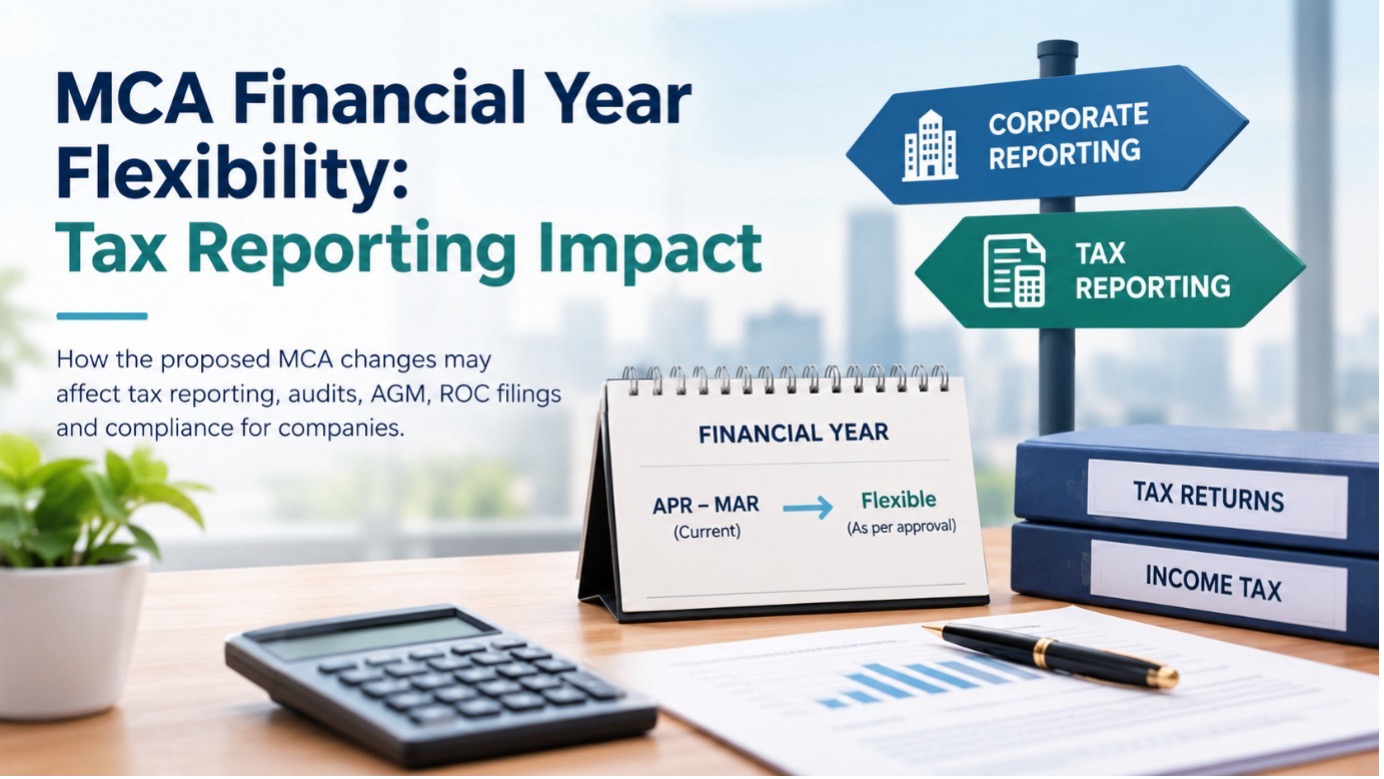
Corporate Laws (Amendment) Bill, 2026 proposes greater flexibility for companies to align their financial year with overseas parent companies or commercial requirements — but this flexibility does not mean that companies can move away from India’s tax reporting framework.
For multinational groups, joint ventures and Indian subsidiaries of overseas companies, differences between the Indian financial year and the reporting year followed by the global group can create significant accounting and consolidation challenges.
The Corporate Laws (Amendment) Bill, 2026 proposes to address this issue by giving the Central Government greater power to permit certain companies and body corporates to realign their financial year.
However, the Joint Committee’s report makes an important distinction:
A company may receive flexibility in its corporate financial year, but it will still have separate accounting and reporting requirements for income-tax purposes.
Planning to change your company’s financial year?
Before making any changes, understand the impact on corporate reporting, tax compliance, audits, AGM timelines and ROC filings. Get professional guidance to plan the transition correctly.
Talk to Our Corporate Compliance Experts
Under the existing framework, the financial year of a company generally runs from 1 April to 31 March.
Section 2(41) of the Companies Act, 2013 contains specific provisions for companies seeking to follow a different financial year, particularly in the context of foreign holding/subsidiary relationships.
The Corporate Laws (Amendment) Bill, 2026 proposes to introduce an additional flexibility under Section 2(41).
The proposed provision would allow the Central Government, on an application by a company or body corporate, or on commercial considerations, to permit the company or body corporate to realign its financial year so that it ends on 31 March of the following year.
This could be particularly relevant where an Indian company needs to align its reporting cycle with an overseas parent or global group.
Consider an Indian subsidiary whose overseas parent follows a financial year from 1 January to 31 December.
The Indian company may currently have to close its statutory accounts based on the April–March financial year while its parent prepares consolidated financial statements based on the January–December cycle.
This can result in:
The proposed flexibility is therefore intended to make corporate reporting more commercially practical.
The Joint Committee has described the proposal as providing greater flexibility to Indian companies operating with foreign parent companies and global joint ventures.
But There Is an Important Tax Catch
The proposed change in the corporate financial year does not automatically change the financial reporting requirements for income-tax purposes.
This is one of the most important aspects emerging from the Joint Committee’s deliberations.
The Ministry of Corporate Affairs explained to the Committee that companies permitted to follow a financial year different from the April–March cycle would still be required to prepare separate accounts and statements for income-tax purposes.
The Committee’s report records that companies already permitted to follow a different financial year maintain accounts for their parent company as well as separately for Indian income-tax purposes.
Therefore: Corporate financial year flexibility ≠ Income-tax financial year flexibility.
The distinction can be understood simply:
Particulars | Corporate Reporting | Income-Tax Reporting |
Governing framework | Companies Act, 2013 | Income-tax Act, 1961 |
Proposed flexibility | Yes, subject to approval under proposed framework | Does not automatically change |
Objective | Align reporting with parent/global/commercial requirements | Determine taxable income and comply with tax law |
Financial year | May be permitted to differ from April–March | Separate tax reporting requirements continue |
Group consolidation | Can be aligned with overseas parent | Separate Indian tax computation may still be required |
Accounting systems | May require dual reporting | Tax-specific information and statements must continue |
Impact | Greater corporate reporting flexibility | Additional tax reporting discipline remains |
This means companies considering a change in financial year should not assume that they can simply operate one accounting period for every regulatory purpose.
Example: Indian Subsidiary of a US Parent
Suppose an Indian subsidiary wants to align its financial year with its US parent.
The parent follows a January–December reporting cycle.
If the proposed framework permits the Indian company to realign its financial year, the company may be able to prepare its corporate financial statements in a manner that facilitates group consolidation.
However, the company may still need to maintain appropriate information and statements for Indian income-tax compliance based on the applicable Indian tax framework.
In practical terms, the finance team may therefore need to maintain two reporting perspectives:
Global / Group Reporting
→ Parent company’s reporting period
→ Consolidation requirements
→ Group accounting policies
→ Inter-company reconciliation
Indian Tax Reporting
→ Indian tax computation
→ Applicable tax-period requirements
→ Tax audit/reporting requirements, where applicable
→ Supporting books and statements
This distinction needs to be factored into the company’s accounting systems from the beginning.
Approval Framework Is Yet to Be Prescribed
Another important issue is that the proposed amendment does not itself provide the complete operational framework.
The Bill proposes to empower the Central Government to prescribe the form and manner of application and other procedural requirements.
Stakeholders have therefore sought greater certainty regarding:
The Joint Committee noted that objective criteria, a defined disposal period and express transitional provisions would improve predictability and reduce uncertainty.
Changing the financial year is not merely an accounting decision.
It can have a cascading impact on the company’s statutory compliance calendar.
Companies will need to consider the impact on:
The period covered by the financial statements will change.
The auditor will need to plan the audit based on the revised financial reporting period.
The timing of the AGM is linked to the company’s financial year-end and therefore requires careful transition planning.
The annual return and related ROC compliance will need to correspond with the applicable financial year.
Board approvals, financial statement adoption and related corporate records will need to be aligned.
Tax reporting will continue to require separate consideration.
This is why transitional provisions will be critical when the proposed framework is brought into force.
A financial-year change can affect annual accounts, statutory audit, AGM, annual returns, ROC compliance and tax reporting. Review your compliance calendar before implementing the change.
Get Corporate Compliance Assistance
Yes, this is another area addressed by the proposed framework.
The Committee’s report records the Ministry’s explanation that the existing framework does not expressly provide a clear mechanism for a company to return to the April–March financial year after changing its reporting cycle.
The proposed amendment seeks to provide flexibility for companies to return to the Indian financial year as well.
This is particularly useful for companies whose business or group structure may change over time.
For example, a company may initially align its financial year with an overseas parent but later become independent or change its ownership structure.
The ability to return to the April–March cycle can provide greater long-term flexibility.
Since the proposed amendment is still part of the legislative process, companies should not treat the proposed flexibility as an immediately available compliance option.
The Joint Parliamentary Committee submitted its report on 3 August 2026 and recommended acceptance of Clause 18 without amendment. However, the Bill still needs to complete the legislative process before the proposed provision becomes law.
Companies considering a change in financial year should therefore:
Document why alignment with the overseas parent or business cycle is necessary.
Do not assume that a change in corporate financial year eliminates separate Indian tax reporting requirements.
Determine whether the ERP/accounting system can support different reporting periods and consolidation requirements.
Discuss the transition with the statutory auditor well in advance.
Review AGM, annual accounts, annual return, audit, tax and other statutory timelines.
The first year of transition can create overlapping or extended reporting periods, depending on the final rules.
Companies increasingly need flexibility to operate within global business structures while continuing to maintain Indian regulatory discipline.
For multinational companies, the ability to align corporate reporting with a global parent can significantly reduce duplication.
But the proposed flexibility should not be misunderstood as a complete departure from India’s statutory reporting framework.
The finance and compliance teams will need to distinguish between:
Corporate financial reporting and Indian tax reporting.
Chhota CFO can help companies assess the accounting, tax and compliance implications of changing their financial year. Our team can support financial reporting, tax compliance, ROC filings, audit coordination and transition planning, helping businesses stay aligned with both Indian regulations and group reporting requirements.
The proposed financial-year amendment under the Corporate Laws (Amendment) Bill, 2026 could provide significant flexibility to companies that need to align their reporting year with overseas parents, global joint ventures or commercial requirements.
However, the flexibility comes with an important compliance consideration:
Changing the corporate financial year will not, by itself, change the company’s income-tax reporting requirements.
Companies may therefore need to maintain appropriate reporting capabilities for both group financial reporting and Indian tax compliance.
The proposed amendment is a positive development for businesses operating in global structures, but its practical success will depend heavily on the rules, approval mechanism and transitional provisions that follow.
For companies considering a financial-year change, the right approach is not simply to ask:
“Can we change our financial year?”
The better question is:
“How will the change affect our accounts, audit, AGM, ROC filings, tax reporting, consolidation and overall compliance calendar?”
Whether you are evaluating a financial-year change, managing ROC requirements or reviewing tax and reporting obligations, our team can help you plan the compliance requirements clearly.
Contact Us for Professional Assistance