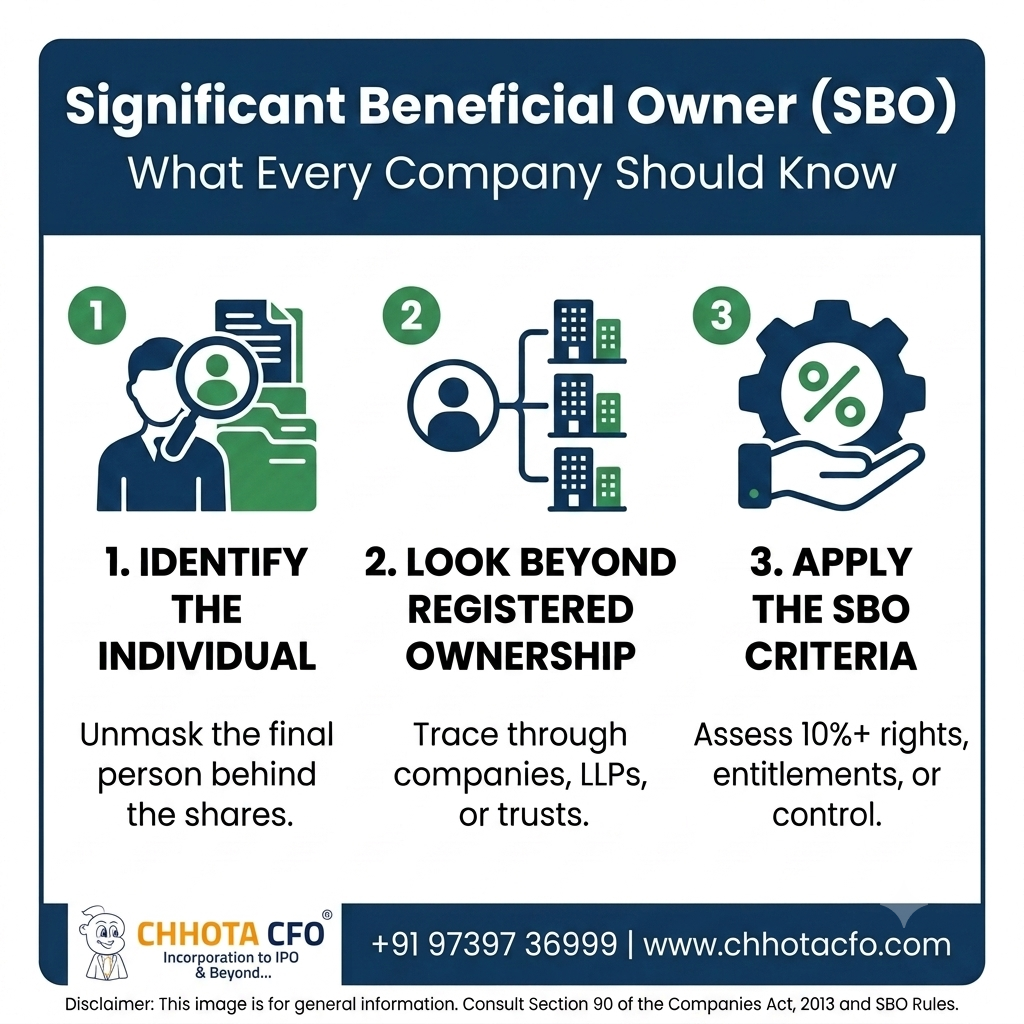
The concept of Significant Beneficial Ownership (“SBO”) under Section 90 of the Companies Act, 2013, read with the Companies (Significant Beneficial Owners) Rules, 2018 (“SBO Rules”), is intended to identify the individual who ultimately holds significant rights, entitlements, influence or control in a company, even where the shares are held through one or more intermediary entities.
In many cases, the name appearing in the Register of Members may not reveal the individual who ultimately stands behind the shareholding. For example, shares may be registered in the name of another company, LLP, or trust, while an individual holds the ultimate interest. The SBO framework requires the reporting company to look beyond such registered ownership and identify the individual who ultimately satisfies the prescribed criteria.
Need Help With SBO Compliance?
Under Rule 2(1)(h) of the SBO Rules, an SBO is an individual who, acting alone or together, or through one or more persons or trusts, possesses one or more prescribed rights or entitlements in the reporting company.
Broadly, the provisions cover an individual who:
An important aspect of the definition is that an individual must have an indirect right or entitlement in the reporting company. Therefore, an individual does not become an SBO merely because he or she directly holds 10% or more of the company’s shares.
The distinction between direct and indirect holding is central to SBO identification.
Direct Holding | Indirect Holding |
Mr A directly holds 15% in ABC Private Limited, and his name appears in its Register of Members. | PQR Private Limited holds 30% in ABC Private Limited, and Mr A holds 60% in PQR Private Limited. |
A direct holding above 10% alone does not automatically make Mr A an SBO. | Since Mr A holds a majority stake in PQR Private Limited, his indirect right or entitlement in ABC Private Limited must be examined. |
Mr A → ABC Pvt. Ltd. | Mr A → PQR Pvt. Ltd. → ABC Pvt. Ltd. |
Talk to Chhota CFO today and make your company’s SBO compliance investor-ready and audit-ready.
Ms. P
↓ 65% shareholding
Alpha Holdings Private Limited
↓ 35% shareholding
The Register of Members of XYZ Healthcare Private Limited shows Alpha Holdings Private Limited as the holder of 35% of its shares. Ms P does not directly appear as a shareholder of XYZ Healthcare Private Limited.
However, Ms P holds 65% in Alpha Holdings Private Limited, thereby holding a majority stake in the corporate shareholder, which, in turn, holds 35% in XYZ Healthcare Private Limited.
XYZ Healthcare Private Limited must therefore look beyond its immediate registered shareholder and examine whether Ms P satisfies the conditions for an indirect right or entitlement under the SBO Rules.
Subject to satisfaction of the applicable conditions, Ms P would be identified as an SBO of XYZ Healthcare Private Limited.
This illustrates the basic principle underlying Section 90: SBO compliance requires identifying the individual behind the ownership structure, not merely the name appearing in the Register of Members.
The BEN compliance framework can be summarised as follows:
Form | Compliance |
BEN-1 | Declaration by the SBO to the reporting company within the prescribed timeline. |
BEN-2 | Return filed by the reporting company with the Registrar within 30 days of receipt of BEN-1. |
BEN-3 | Register of Significant Beneficial Owners maintained by the reporting company. |
BEN-4 | Notice issued by the company where it has reasonable cause to believe that a person is an SBO or has relevant information concerning an SBO and the required information has not been provided. |
Importantly, the reporting company’s responsibility is not limited to filing BEN-2 after receiving BEN-1. Under Section 90, the company must take necessary steps to identify individuals who are SBOs in relation to the company and ensure compliance with the applicable provisions.
Accordingly, companies having body corporates, LLPs, trusts, or other non-individual entities as shareholders should periodically review their ownership structures. An SBO review should also be considered whenever there is a fresh allotment, transfer of shares, restructuring, acquisition, or change in the ownership or control of an existing corporate shareholder.
Section 90 is fundamentally a corporate ownership transparency provision. It seeks to identify the natural person who ultimately holds the prescribed rights or exercises significant influence or control through an indirect structure.
For compliance purposes, companies should therefore follow a simple approach:
Identify the registered shareholder → Trace the ownership chain → Identify the ultimate individual → Apply the SBO tests → Complete the applicable BEN compliances.
The identification exercise is the most important part of SBO compliance. BEN-1, BEN-2, BEN-3 and BEN-4 are the statutory mechanisms through which the outcome of that exercise is declared, reported, recorded and investigated, wherever required.
Disclaimer: This article is intended for general information and educational purposes only. The applicability of Section 90 of the Companies Act, 2013 and the SBO Rules should be determined based on the facts, ownership structure and rights involved in each case.
 Missed a FEMA Filing? Compounding vs Late Submission: What Should You Do?
 MCA Financial Year Flexibility Comes with a Tax Reporting Catch for Companies
 Fast Track Merger without NCLT approval
 Trademark Registration Bangalore: Fees, Eligibility & Steps
 Section 185 vs Section 186: Company Loan Rules Explained