Downstream Investment in India: Mandatory FIFP Intimation & Form DI Reporting – Complete Compliance Guide

Downstream investment in India with FIFP intimation and Form DI reporting compliance guide

Downstream investment is a key concept under India’s Foreign Direct Investment (FDI) framework. While Indian companies with foreign ownership or control are permitted to invest in other Indian companies, such investments are subject to specific conditions and reporting obligations under the Foreign Exchange Management Act, 1999 (FEMA), the Foreign Exchange Management (Non-Debt Instruments) Rules, 2019, and the Consolidated FDI Policy.

One of the most critical yet frequently overlooked compliances is the requirement to intimate the Department for Promotion of Industry and Internal Trade (DPIIT) through the Foreign Investment Facilitation Portal (FIFP).

Failure to comply may result in violations under FEMA and may require compounding before the Reserve Bank of India (RBI).

Need Help With Downstream Investment Compliance?

What is a Downstream Investment?

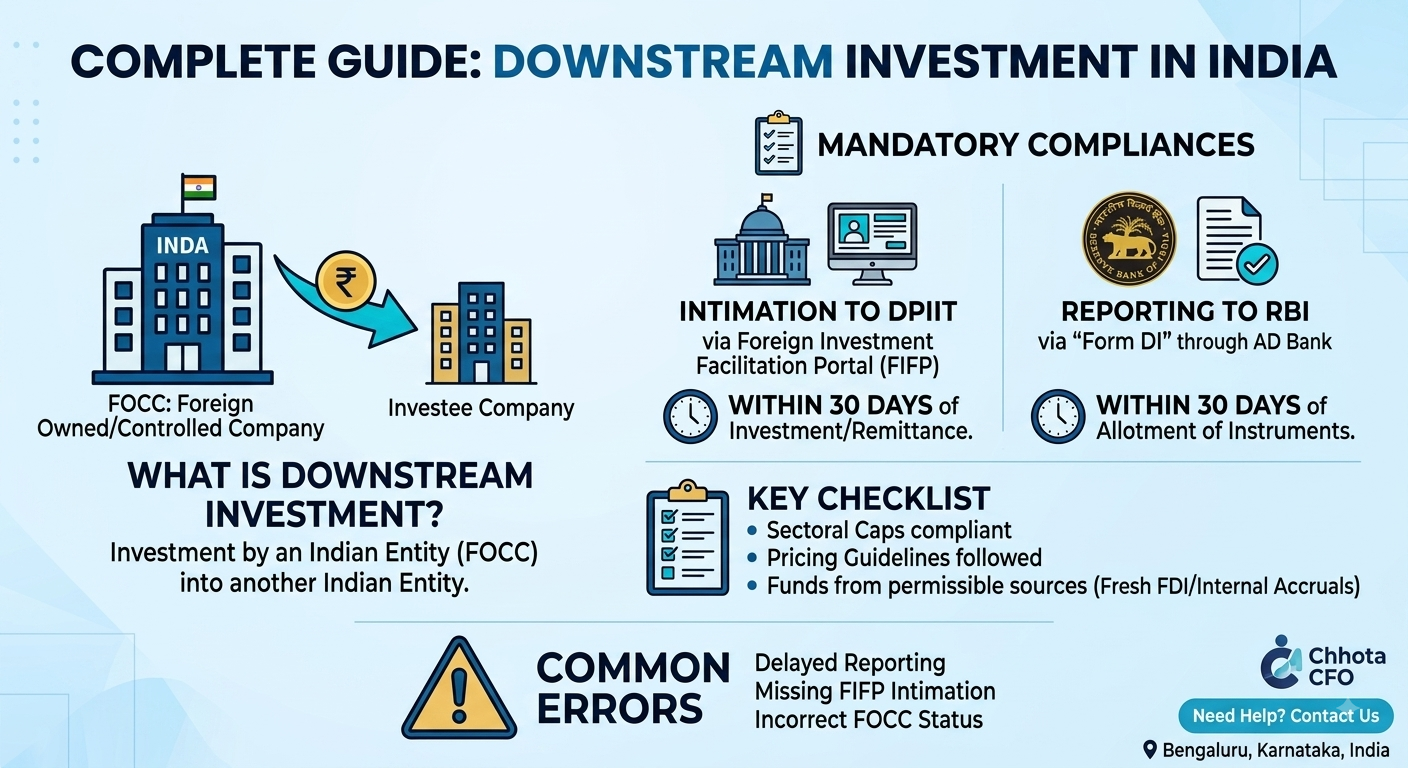
A downstream investment means an investment made by an Indian entity into another Indian entity where the investing company is considered foreign-owned or foreign-controlled.

Such investments are treated as indirect foreign investment in the investee company and must comply with the sectoral conditions, entry routes, pricing guidelines, and reporting requirements applicable to foreign investment.

Who Has to File the Downstream Investment Intimation?

The obligation to file the downstream investment intimation lies with the Indian entity making the downstream investment.

Accordingly, the filing is required where:

  • An Indian company is foreign-owned or controlled (FOCC) and invests in the capital instruments of another Indian company.
  • An investment vehicle (such as an Alternative Investment Fund, Real Estate Investment Trust, or Infrastructure Investment Trust), which has received foreign investment and is required to comply with the downstream investment provisions, makes an investment in another Indian entity.
  • Any other Indian entity covered under the FEMA (Non-Debt Instruments) Rules, 2019 that makes a downstream investment resulting in indirect foreign investment.

The responsibility to complete the filing rests with the investing Indian entity and not with the foreign shareholder or the investee company.

What is a Foreign-Owned or Controlled Company (FOCC)?

An Indian company is regarded as a Foreign-Owned or Controlled Company when:

  • More than 50% of its beneficial ownership is held by persons resident outside India; or
  • Control is exercised by persons resident outside India through the right to appoint directors, management rights, voting agreements, or shareholder arrangements.

Such companies are treated differently under the FDI policy because their investments in other Indian companies are regarded as indirect foreign investment.

Mandatory Intimation on the Foreign Investment Facilitation Portal (FIFP)

Every eligible downstream investment must be intimated to the DPIIT through the Foreign Investment Facilitation Portal.

This filing enables the Government to monitor:

  • Compliance with sectoral caps.
  • Entry routes (Automatic or Government Approval).
  • Ownership and control.
  • Indirect foreign investment.
  • Compliance with the Consolidated FDI Policy.

The filing is mandatory even if the downstream investment falls under the automatic route.

Timeline for Filing on FIFP

The investing Indian entity must intimate the DPIIT through the Foreign Investment Facilitation Portal within 30 days of:

  • Making the downstream investment; or
  • Remittance of funds, wherever applicable.

Delays may attract regulatory scrutiny and FEMA compliance issues.

RBI Reporting – Form DI

Apart from the DPIIT intimation, the downstream investment must also be reported to the RBI.

The reporting is done by filing Form DI through the company’s Authorised Dealer (AD) Bank.

Timeline

Form DI must be filed within 30 days from the date of allotment of capital instruments by the investee company.

Thus, two separate compliances arise:

  1. DPIIT Intimation through the Foreign Investment Facilitation Portal (FIFP).
  2. RBI Reporting through Form DI.

Completion of one filing does not dispense with the other.

Eligible Sources of Funds

A Foreign-Owned or Controlled Company may generally make downstream investments using:

  • Fresh foreign investment received into India.
  • Internal accruals (post-tax profits).
  • Share swap transactions, wherever permitted under FEMA.

Domestic borrowings should not be used where such utilisation is inconsistent with the FEMA framework governing downstream investments.

Key Compliance Checklist

Before making a downstream investment, ensure that:

  • The investing entity qualifies under the downstream investment provisions.
  • The proposed sector permits foreign investment.
  • Sectoral caps are not exceeded.
  • Entry route conditions are satisfied.
  • The Board of Directors approves the investment.
  • The source of funds is FEMA compliant.
  • FIFP intimation is filed within the prescribed timeline.
  • Form DI is filed with the AD Bank within the prescribed timeline.
  • Appropriate disclosures are made in the financial statements.

Common Compliance Errors

Some of the common mistakes observed include:

  • Assuming that only Form DI filing is sufficient.
  • Missing the FIFP intimation.
  • Incorrect determination of foreign ownership or control.
  • Using non-permissible funding sources.
  • Delayed reporting.
  • Failure to maintain proper Board resolutions and supporting documents.

Practical Example

ABC India Private Limited is 80% owned by a foreign corporation.

ABC subscribes to equity shares of XYZ Private Limited.

Since ABC is a Foreign-Owned or Controlled Company:

  • ABC is responsible for filing the downstream investment intimation on the FIFP.
  • ABC must ensure that Form DI is filed through its AD Bank within the prescribed timeline.
  • The investment must comply with all applicable sectoral conditions and FEMA requirements.

Conclusion

The downstream investment framework is designed to ensure transparency in indirect foreign investment into India. The compliance responsibility rests primarily with the investing Indian entity that is foreign-owned or controlled.

Businesses should establish robust internal compliance mechanisms to ensure timely filing of both the FIFP intimation and Form DI, while also ensuring compliance with the funding conditions and sectoral requirements prescribed under FEMA and the FDI Policy.

Timely compliance helps avoid regulatory exposure, facilitates future fundraising, and strengthens corporate governance.

How Chhota CFO Can Help

Our team provides comprehensive advisory and execution support for:

  • Determining FOCC status.
  • FEMA and FDI advisory.
  • Structuring downstream investments.
  • Drafting Board and shareholder resolutions.
  • Filing downstream investment intimation on the FIFP.
  • Form DI filing with the AD Bank.
  • FEMA compliance audits.
  • Transaction structuring and due diligence.

We assist startups, multinational groups, private equity funds, and Indian subsidiaries in ensuring seamless compliance with India’s foreign investment regulations.


Get expert FEMA & FDI compliance support from Chhota CFO. Contact our team today to make your downstream investment compliant and investor-ready.

FAQ

What is downstream investment in India?

Downstream investment refers to an investment made by an Indian entity into another Indian entity where the investing entity is treated as foreign-owned or foreign-controlled under the applicable FDI framework.

Is FIFP intimation mandatory for downstream investment?

As stated in the supplied draft, eligible downstream investments must be intimated to DPIIT through the Foreign Investment Facilitation Portal (FIFP), including investments falling under the automatic route.

Who is responsible for downstream investment reporting?

The Indian entity making the downstream investment is responsible for completing the applicable reporting and compliance requirements.

What is Form DI?

Form DI is the RBI reporting mechanism used for reporting downstream investment through the company's Authorised Dealer (AD) Bank.

Is FIFP filing and Form DI the same?

No. They are separate compliance requirements described in the article. FIFP relates to DPIIT intimation, while Form DI is reported to RBI through the AD Bank.

What is the deadline for FIFP intimation?

The supplied article states that the investing Indian entity must intimate DPIIT through FIFP within 30 days of making the downstream investment or remittance of funds, wherever applicable.

What is the deadline for Form DI?

The article states that Form DI must be filed within 30 days from the date of allotment of capital instruments by the investee company.

What is FOCC?

FOCC stands for Foreign-Owned or Controlled Company. The article uses this term for an Indian company that meets the stated foreign ownership or control criteria.

Can a foreign-owned Indian company invest in another Indian company?

Yes, the article explains that a foreign-owned or foreign-controlled Indian entity may make downstream investments, subject to applicable FEMA, FDI, sectoral, entry-route, pricing and reporting requirements.
Book a Call with an expert absolutely FREE for 15 minutes