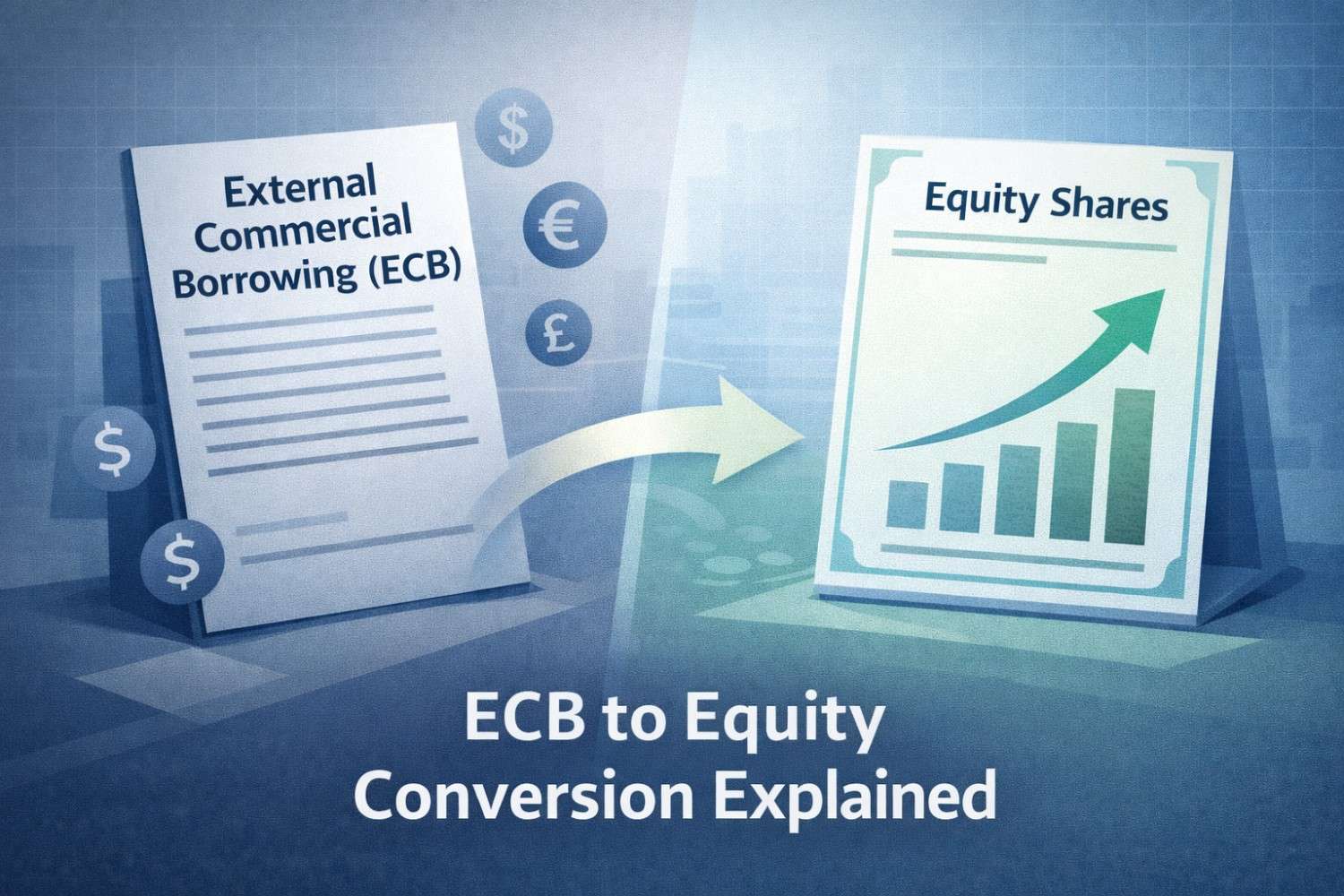
Many Indian companies sometimes borrow money from foreign lenders. Paying back this money can be hard when interest rates are high or cash is low. One option is to convert the loan into company shares, so the lender becomes a part-owner instead of a creditor. This can save money and strengthen the company.
Key Takeaways
ECB-to-equity conversion is a way to turn foreign loans into ownership. It improves finances but can change who controls the company.
- Turns debt into company shares.
- Must follow Indian rules (FEMA, RBI, FDI).
- May reduce ownership for current owners.
- Good alternative to paying back or refinancing loans.
What is the conversion of ECB into Equity?
This means a company gives shares to a foreign lender instead of repaying the loan or interest. The lender stops being a creditor and becomes a shareholder, sharing in profits and growth.
- The lender becomes a shareholder rather than a creditor.
- Relationship changes from debt to ownership.
- Governed by FEMA, RBI, FDI, and the Companies Act.
- Companies may need experts to follow rules.
Why Companies Opt for ECB-to-Equity Conversion
Companies use this when paying cash is difficult. It saves money, reduces debt, and aligns the lender’s goals with the company’s.
- Reduces debt and improves financial ratios.
- Saves cash for growth or daily operations.
- Cuts interest costs on converted loans.
- Aligns foreign lender with company growth.
- Often used by startups and growing companies.
Legal and Regulatory Framework Governing ECB Conversion
ECB conversion is legal but must follow strict rules. Breaking them can cause penalties. Companies must comply with multiple laws simultaneously.
- Loan must allow conversion; if not, it should be amended.
- Follow FDI rules: sector limits and ownership caps.
- Shares must be priced reasonably by a professional.
- Interest converted must follow the ECB and tax rules.
Corporate Approvals and Documentation Requirements
Before conversion, companies must get approvals and file documents. This avoids legal or financial problems.
- Board approval for conversion and share issuance.
- Shareholder approval may be required.
- Amend loan and shareholder agreements.
- Report to the Authorised Dealer bank for RBI.
- Founders’ agreements help manage dilution and control changes.
- Accurate filings and timelines are essential.
Impact on Capital Structure and Shareholding
ECB conversion affects company finances and ownership. Companies need to plan carefully to avoid conflicts.
- Debt decreases, share capital increases → improves net worth.
- Lender becomes a shareholder → may dilute current owners.
- Check voting rights and ownership percentages.
- Consider the foreign investor’s future exit plans.
Accounting and Disclosure Treatment
Proper accounting is needed for transparency and audits.
- Debt removed, equity recognised at fair value.
- Differences adjusted as per accounting rules.
- Must disclose in financial statements, registers, and ROC filings.
Tax Implications to Consider
ECB conversion may have tax consequences, especially if interest is converted into shares.
- Withholding tax may apply to interest.
- Tax authorities may check valuation issues.
- Seek tax advice before conversion.
Key Risks and Strategic Considerations
Conversion has benefits but also risks. Companies must weigh them before proceeding.
- Ownership dilution – cannot be reversed easily.
- Regulatory risk – must follow all rules.
- Valuation disputes – shares must be reasonably priced.
- Governance impact – foreign lender becomes part-owner.
- Professional advice is recommended.
Is ECB Conversion Suitable for Private Limited Companies?
Yes, it works for startups and growth companies. It helps manage debt and prepare for future funding.
- Bridges debt funding and long-term equity.
- Helps with future fundraising or restructuring.
- Suitability depends on growth plans, control, and rules.
Conclusion: A Strategic Tool That Demands Precision
Converting External Commercial Borrowings into equity helps Indian companies reduce loan burden and save cash. Instead of paying back the loan, the company issues shares, thereby improving its financial strength.
This also turns the foreign lender into a business partner. As a shareholder, the lender benefits when the company grows, not from regular loan payments.
But this step must be planned carefully. It affects company ownership, control, and legal rules, so FEMA, RBI, and FDI guidelines must be followed.
If done correctly, ECB-to-equity conversion can be a good option for Indian companies. It supports long-term growth and makes the company financially stable.