Section 44AD Presumptive Taxation: A Smart Tax Saving Strategy for Small Businesses in India

Why Section 44AD is a Game-Changer for Small Businesses in India

Small business owners in Jaipur, Surat, Nagpur, and Coimbatore struggle with taxes. Tax rules feel complex and take too much time to navigate. Income tax Section 44AD—the       Taxation Scheme—makes it simple. It cuts your tax burden and speeds up compliance.

Even though this scheme has clear benefits, many MSMEs do not use it as much as they could. Learning how it works can help you save money, reduce paperwork, and avoid extra audits.
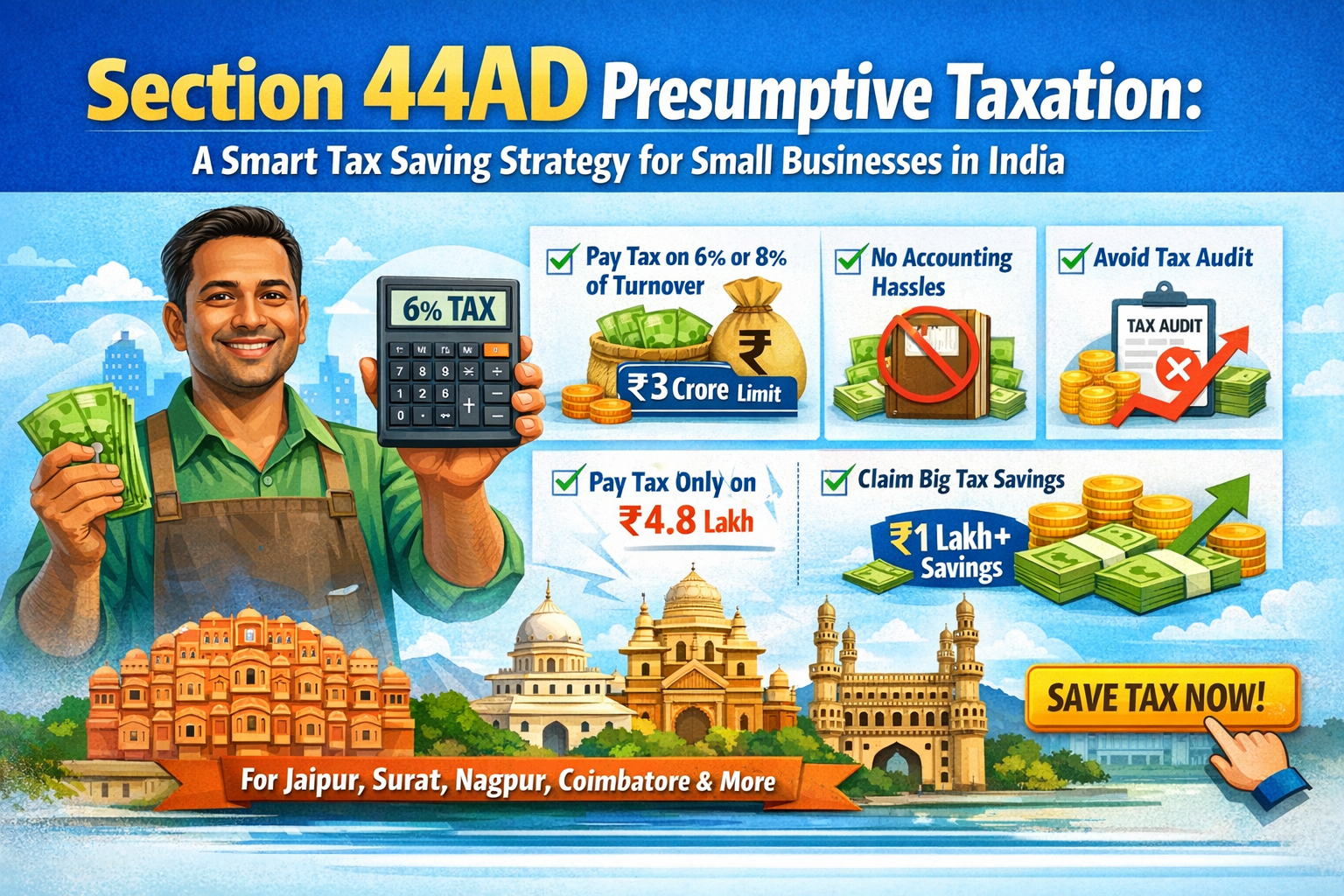
Section 44AD presumptive taxation for MSMEs in India showing 6% and 8% tax benefits, turnover limit ₹3 crore, and tax saving advantages for small businesses

What is Section 44AD Presumptive Taxation?

Section 44AD lets eligible businesses report a set percentage of their turnover as income. No need for detailed books or records.

  • 8% of turnover is considered profit for cash transactions
  • 6% of turnover is considered profit for digital transactions

This means you do not need to track every expense or maintain full books of accounts. Your taxable income is calculated on a presumptive basis.

Example – How You Actually Save Tax

Let’s say your business turnover is ₹80 lakhs in a financial year and most payments are received digitally.

  • Presumptive income @6% = ₹4.8 lakhs
  • Tax is calculated only on ₹4.8 lakhs

Even if your real profit is much higher, say ₹20 lakhs, you still pay tax only on ₹4.8 lakhs. This makes Section 44AD a truly valuable and effective tax-saving option for small businesses.

Who Can Opt for Section 44AD?

This scheme is available to:

Eligibility Conditions:

  • Annual turnover must be up to ₹3 crores
  • Cash receipts should not exceed 5% of total turnover

Who is Not Eligible for Section 44AD?

You cannot use this scheme if you fall under these categories:

  • Limited Liability Partnerships (LLPs)
  • Private Limited or Public Companies
  • Professionals like doctors, lawyers, architects (covered under 44ADA)
  • Commission or brokerage businesses
  • Transport businesses (covered under Section 44AE)

6% vs 8% Rule – Why Digital Payments Matter

One of the biggest advantages of Section 44AD is the lower tax rate for digital transactions.

If your customers pay via UPI, bank transfer, or card:

  • You declare only 6% income instead of 8%

Example: 

  • Turnover: ₹2 Crores
  • At 8% → ₹16 Lakhs taxable income
  • At 6% → ₹12 Lakhs taxable income

This ₹4 lakh difference can save you up to ₹1 lakh in taxes. Encouraging digital payments directly increases your tax savings.

Key Benefits of Section 44AD for MSMEs

  • No need to maintain detailed books of accounts
  • No mandatory tax audit under Section 44AB
  • Lower compliance and accounting costs
  • Simple income tax filing using ITR-4
  • Advance tax payable in one instalment (by 15th March)
  • Suitable for small traders, retailers, and service businesses

The 5-Year Lock-in Rule You Must Know

While Section 44AD is beneficial, it comes with an important condition.

If you opt for this scheme and later decide to exit:

  • You cannot opt back into 44AD for the next 5 years
  • You must maintain books of accounts
  • Tax audit becomes compulsory

Important Tip:

Avoid switching out of the scheme without proper planning, even in low-profit years.

Section 44ADA – For Professionals

Is your startup a professional service? Think IT consulting, architecture, medical practice, legal advice, or accounting. You qualify for Section 44ADA—not 44AD.

The rules work similarly.

  • But the rate is 50% of gross receipts.
  • The limit is ₹75 lakhs (₹37.5 lakhs if you take cash payments).

Example: A freelance IT consultant earns ₹40 lakhs yearly. They declare ₹20 lakhs as taxable income. These beats tracking real profits if your actual margins are higher.

How to File Tax Under Section 44AD

Filing under this scheme is simple:

  • Use ITR-4 (Sugam) form
  • Declare total turnover and presumptive income
  • No need for balance sheet or P&L statements. 

Due Date: 

  • Usually 31st July for non-audit cases.

Conclusion

India has over 6 crore MSMEs and micro-enterprises. Section 44AD is a real tax benefit from the Income Tax Act. It reduces accounting work, skips audits, and often legally lowers your tax bill.

Are you a small business owner in Jaipur, Surat, Coimbatore, Nagpur, or Ahmedabad? Is your turnover under ₹3 crores? Talk to a qualified CA now if you haven’t tried this. Missing it could cost you ₹1 lakh or more each year.

FAQ

What is Section 44AD in income tax?

Section 44AD is a presumptive taxation scheme that allows small businesses in India to declare income as a fixed percentage (6% or 8%) of turnover without maintaining detailed books of accounts or undergoing a tax audit.

Who is covered under Section 144B?

Section 144B applies to all taxpayers selected for scrutiny assessment under the Income Tax Act, including individuals, businesses, and MSMEs, except in specific cases where personal hearings are required.

How are notices issued under Section 144B?

Notices are issued electronically through the Income Tax e-filing portal and also sent to the registered email ID of the taxpayer. Physical notices are generally not sent under this system.

What happens if you do not respond to a Section 144B notice?

Failure to respond may lead to a best judgment assessment under Section 144, where the tax officer determines your income based on available information, often resulting in higher tax liability and penalties.

Who is eligible for Section 44AD in India?

Section 44AD is available to: Resident Individuals Hindu Undivided Families (HUFs) Partnership Firms (excluding LLPs) The business turnover must be up to ₹3 crores, and cash receipts should not exceed 5% of total turnover.

What is the difference between 6% and 8% under Section 44AD?

6% rate applies to digital or banking transactions (UPI, NEFT, RTGS, cards) 8% rate applies to cash transactions Choosing digital payments reduces taxable income and helps save more tax.

What is the turnover limit for Section 44AD in FY 2025–26?

The turnover limit is ₹3 crores, provided that cash transactions do not exceed 5% of the total receipts during the financial year.

Which ITR form is used for Section 44AD?

You need to file ITR-4 (Sugam) to report income under Section 44AD. It is a simplified return form with minimal compliance requirements.

What are the benefits of Section 44AD for small businesses?

No need to maintain detailed books No audit requirement Lower compliance costs Simplified tax filing Better cash flow management

How much tax can I save using Section 44AD?

Tax savings depend on your actual profit margin. If your real profits are higher than 6% or 8%, you can significantly reduce taxable income and save ₹50,000 to ₹1,00,000+ annually.
Book a Call with an expert absolutely FREE for 15 minutes