Input Tax Credit Mistakes That Are Costing Indian Startups Lakhs in GST (And How to Fix Them)

Input Tax Credit mistakes in GST India for startups including GSTR-2B mismatch, ITC reversal rules, deadlines and compliance fixes

Why Input Tax Credit (ITC) Is Critical for Indian Startups

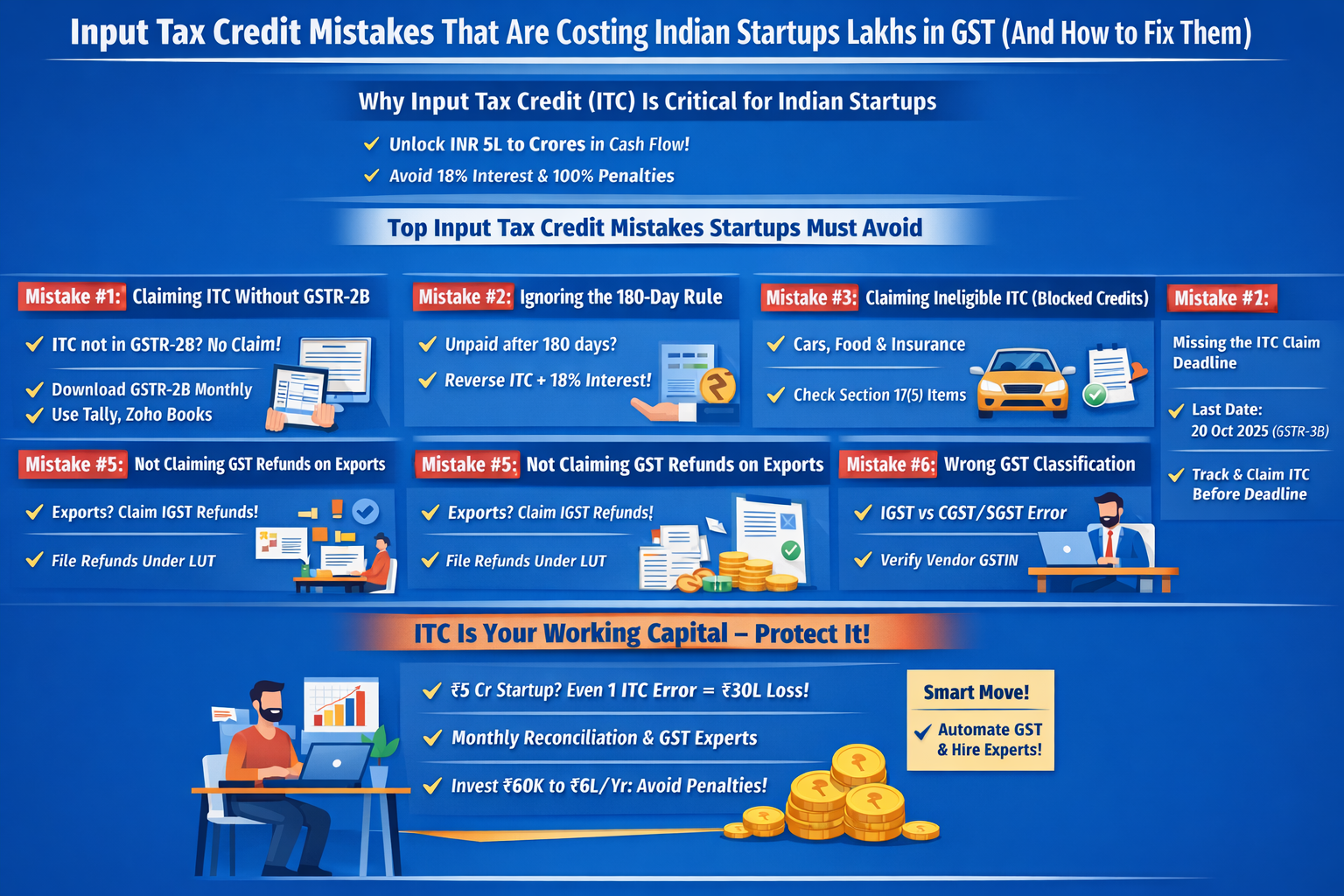
Input Tax Credit (ITC) is a game-changing pillar of India’s GST framework. Master it correctly, and it wipes out tax-on-tax cascades, potentially freeing up INR 5 lakhs to crores in annual cash flow for your startup or MSME.

However, poor ITC management can do the opposite, leading to:

  • GST notices and scrutiny
  • Interest @ 18% per annum
  • Penalties up to 100% of tax

Even after nearly a decade since GST’s 2017 rollout, ITC remains a compliance nightmare for countless Indian businesses. In this straightforward guide, we show the top 7 ITC mistakes startups make, along with clear steps to fix them and protect your profits.

Top Input Tax Credit Mistakes Startups Must Avoid

Mistake #1: Claiming ITC Without GSTR-2B Reconciliation

Many businesses rely only on purchase invoices recorded in their accounting software. But under GST rules, ITC can only be claimed if it appears in GSTR-2B.

If your supplier fails to file GSTR-1, your ITC won’t reflect in 2B—and claiming it anyway can trigger notices under Section 73 or 74.

Fix:

  • Download GSTR-2B every month
  • Match it with your purchase register
  • Use tools like Tally, Zoho Books, or ClearTax for auto-reconciliation

Mistake 2: Ignoring the 180-Day Payment Rule

Under GST rules, if you don’t pay your supplier within 180 days, the ITC claimed must be reversed along with interest.

This is a major issue for startups with delayed vendor payments.

Example:

 If ITC of ₹9 lakhs is claimed but invoices remain unpaid beyond 180 days:

  • Full ITC reversal required
  • Plus interest @ 18%

✅ Fix:

  • Track payable ageing monthly
  • Set alerts for invoices nearing 180 days
  • Prioritize payments to GST-registered vendors

Mistake 3: Claiming Ineligible ITC (Blocked Credits)

Certain expenses are not eligible for ITC, even if GST is charged. Many startups unknowingly claim these credits.

 Common blocked ITC:

  • Personal-use vehicles
  • Food, beverages, and catering
  • Employee benefits (insurance, memberships)
  • Construction-related expenses

Impact:

Wrong claims can result in heavy tax demands with penalties.

✅ Fix:

  • Train your accounts team on blocked credits
  • Review expenses before claiming ITC
  • Maintain a checklist for Section 17(5) items

Mistake 4: Missing the ITC Claim Deadline

CGST Act Section 16(4) slams the door on FY ITC claims after the earlier of: September’s GSTR-3B due date (20th Oct next FY) or GSTR-9 filing. For FY 2024-25, that’s by Oct 20, 2025—miss it, and April-June invoices vanish forever. Startups routinely overlook early-year bills, then scramble too late.

Rule:

ITC must be claimed before:

  • September return of the next financial year OR
  • Filing of annual return (whichever is earlier)

Missing this deadline means permanent loss of ITC.

✅ Fix:

  • Conduct monthly ITC reviews
  • Track unclaimed invoices
  • Avoid year-end bulk adjustments

Mistake 5: Not Claiming GST Refunds on Exports

Startups engaged in exports (especially SaaS and IT services) are eligible for GST income refunds. However, many fail to claim them.

This leads to huge working capital blockage.

Options available:

  • Export with IGST and claim refund
  • Export under LUT and claim ITC refund

Fix:

  • File refund applications regularly
  • Track export invoices and timelines
  • Ensure compliance with Rule 89 & 96

Mistake 6: Wrong GST Classification (IGST vs CGST/SGST)

Incorrect classification of GST leads to mismatches and payment issues.

Common error:

  • Booking IGST as CGST + SGST or vice versa

This creates:

  • ITC utilisation problems
  • Interest liability

Fix:

  • Train your finance team on place of supply rules
  • Verify vendor GSTIN location
  • Use automated accounting tools

Mistake 7: Not Apportioning ITC for Mixed Supplies

If your business deals in both taxable and exempt supplies, you cannot claim full ITC.

You must proportionately reverse ITC under GST rules.

High-risk sectors:

  • Fintech startups
  • Real estate businesses
  • Insurance companies

Fix:

  • Apply Rule 42 & 43 calculations
  • Separate taxable and exempt turnover
  • Review ITC monthly

Final Thoughts: ITC Is Your Working Capital – Protect It

For a startup with ₹5 crore annual expenses:

  • Even a small ITC error can cost ₹20–₹30 lakhs

That’s why ITC should be treated like a financial asset—not just a tax adjustment.

What Smart Startups Do

Successful businesses in cities like Hyderabad and Pune:

Pro Tip for MSMEs

Investing in GST compliance:

  • ₹60,000 – ₹200,000/year (consultant)
  • ₹3–6 lakhs/year (in-house expert)

This cost is minimal compared to penalties and lost ITC.
FAQ

What is Input Tax Credit (ITC) in GST?

Input Tax Credit (ITC) allows businesses to reduce the tax they pay on sales by claiming credit for GST already paid on purchases. This helps eliminate double taxation and improves cash flow for startups and MSMEs.

What are the new rules for GST Input Tax Credit (ITC)?

Under GST, Input Tax Credit can be claimed only when specific conditions are met. Key updated rules include: ITC can be claimed only if it appears in GSTR-2B Supplier must have filed GSTR-1 and paid tax Buyer must have a valid tax invoice Goods/services must be received Payment to supplier must be made within 180 days ITC must be claimed within the deadline under Section 16(4) Failure to comply can result in ITC reversal, interest (18%), and penalties.

What is eligible and ineligible Input Tax Credit under GST?

Eligible ITC includes: Purchases used for business purposes Raw materials, trading goods, and services Capital goods used in business operations Ineligible (Blocked) ITC includes: Personal expenses Motor vehicles (for personal use) Food, beverages, and catering services Club memberships and employee benefits Construction of immovable property Blocked credits are defined under Section 17(5) of the GST Act.

What are the eligibility and conditions for claiming ITC under Section 16?

As per Section 16 of the CGST Act, ITC can be claimed only if: You have a valid GST invoice or debit note You have received the goods or services The supplier has filed GST returns and paid tax ITC is reflected in GSTR-2B You file your GSTR-3B return Payment to supplier is made within 180 days All these conditions must be satisfied to legally claim ITC.

What is the difference between eligible and ineligible ITC in GST?

The difference depends on usage and legal restrictions: Eligible ITC: Credit that can be claimed when goods/services are used for business and all GST conditions are fulfilled. Ineligible ITC: Credit that cannot be claimed due to restrictions under GST law, even if GST is paid. Examples of ineligible ITC: Personal use expenses Employee-related benefits Certain capital expenditures like building construction Understanding this difference helps avoid GST notices and penalties.

Can I claim ITC without GSTR-2B?

No. As per GST rules, ITC can only be claimed if it appears in your GSTR-2B. If the supplier has not filed GSTR-1, the ITC will not be available and cannot be claimed legally.

What happens if ITC is wrongly claimed?

Wrong ITC claims can result in: Tax demand notices Interest at 18% per annum Penalties up to 100% of tax

What is the 180-day rule for ITC?

If payment to a supplier is not made within 180 days from the invoice date, the ITC claimed must be reversed along with interest.

What are blocked credits under GST?

Blocked credits are expenses where ITC is not allowed, such as: Personal vehicles Food and entertainment Employee benefits Construction-related costs

What is the last date to claim ITC?

ITC must be claimed before: September return of the next financial year OR Filing of annual return (whichever is earlier)

Can startups claim GST refund on exports?

Yes. Exporters can: Claim IGST refund OR Export under LUT and claim ITC refund
Book a Call with an expert absolutely FREE for 15 minutes