For most MSME owners in India, GST compliance feels like running on a treadmill that never stops. With monthly, quarterly, and annual filings, reconciliations, and the ever-present fear of a GST audit or notice, it is easy to miss a deadline or make a costly mistake. The penalties can sting hard – from INR 200 per day in late fees to 100% of the tax amount in cases of fraud.
This comprehensive GST compliance checklist is designed specifically for MSMEs and startups across India. Bookmark it, print it, and share it with your accountant. It could save you INR 5,00,000 or more in penalties and litigation costs over the course of a financial year.
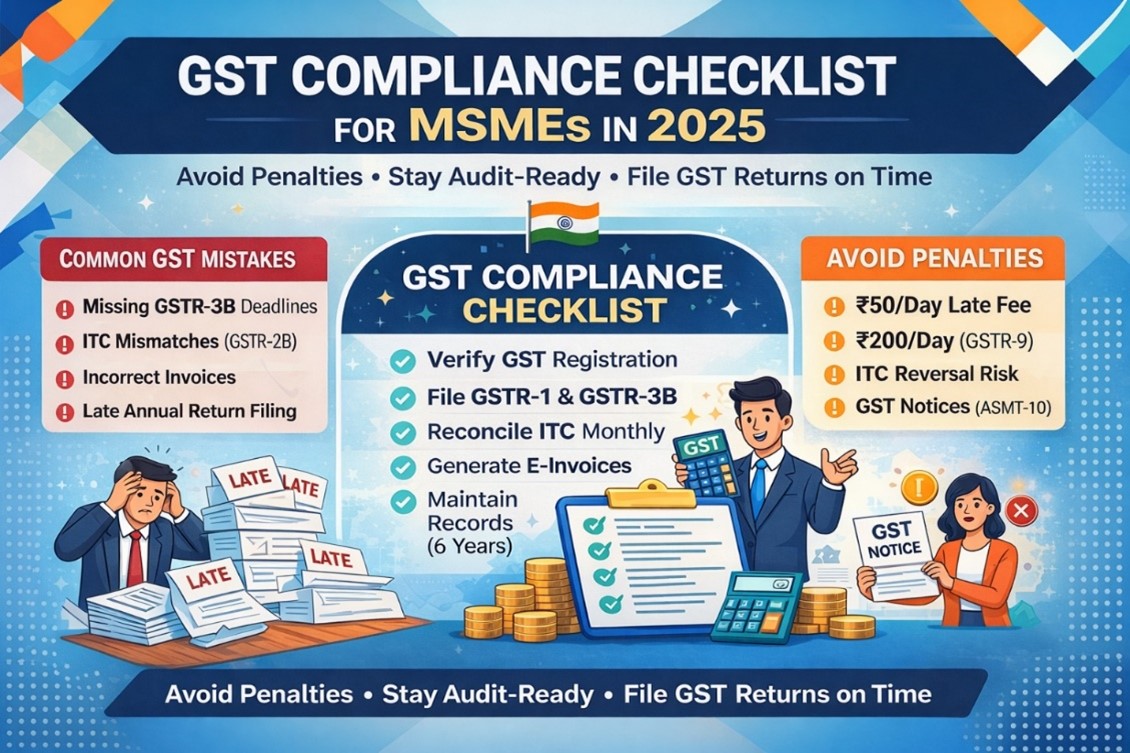
Step 1: Verify GST Registration Status and Detail
First, make sure your GST registration is still valid, and your information is up to date. Log in to the GST portal (gst.gov.in) and verify the following:
MSMEs with turnover above INR 5 crores must mandatorily file GSTR-1 monthly. Those below this threshold can opt for the quarterly QRMP (Quarterly Return Monthly Payment) scheme, but must still pay GST monthly using PMT-06.
Return / Payment | Applicable To | Due Date | Frequency | Notes |
GSTR-1 | Regular taxpayers | 11th of next month | Monthly | Outward supplies |
IFF (QRMP) | QRMP taxpayers | 13th of next month | Monthly (optional) | For B2B invoices |
PMT-06 | QRMP taxpayers | 25th of next month | Monthly | Tax payment |
GSTR-3B | Monthly filers | 20th of next month | Monthly | Summary return |
GSTR-3B (QRMP) | Quarterly filers | 22nd / 24th | Quarterly | Based on state |
GSTR-9 | All eligible taxpayers | 31st Dec (next FY) | Annual | Mandatory return |
GSTR-9C | Turnover > ₹5 Cr | 31st Dec (next FY) | Annual | Audit reconciliation |
Type of Return | Late Fee Per Day | Total (CGST + SGST) | Remarks |
Regular Return | ₹25 + ₹25 | ₹50/day | Subject to cap |
Nil Return | ₹10 + ₹10 | ₹20/day | Lower penalty |
Input Tax Credit mismatches between your GSTR-2B (auto-populated from suppliers’ GSTR-1) and your books are the number one cause of GST notices and demands for Indian MSMEs. The GST department’s ASMT-10 system flags mismatches automatically and issues notices – often for crores of rupees in disputed ITC.
To stay reconciliation-ready, follow these non-negotiable practices:
Different industries have unique GST compliance risks. Here are the most common traps:
Manufacturing MSMEs: All job-work transactions under Section 143 must be properly documented using valid challans. Goods sent for job-work must be returned within the prescribed timelines: 1 year for inputs and 3 years for capital goods. If these timelines are not met, the goods are considered a deemed supply and become liable for GST.
Service-Based Startups: If your startup provides services to clients overseas and gets paid in foreign currency, make sure to claim your IGST refund using the LUT (Letter of Undertaking) process. Many startups miss out on INR 5,00,000 to INR 50,00,000 each year by not filing for GST refunds on their exports.
E-commerce Sellers: If you sell on Amazon, Flipkart, or Meesho, a 1% TCS (Tax Collected at Source) is deducted by the platform. Reconcile this monthly with your GSTR-8 data visible in your GSTR-2B.
Real Estate Developers: Under-construction property sales have complex GST implications. Ensure you bifurcate land value (exempt) and construction value (taxable) in your documentation.
The most financially resilient MSMEs in India treat GST compliance as a month-end business process, not a last-minute scramble. With over 1.3 crore active GSTIN registrations in India, the GST department has unprecedented data visibility. Discrepancies that once went unnoticed now trigger automated notices within months.
Invest INR 15,000 to INR 30,000 per month in a qualified GST practitioner or accounting software. It will return multiples in avoided penalties, saved ITC, and the peace of mind to focus on growing your business.