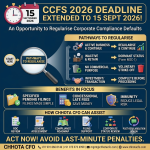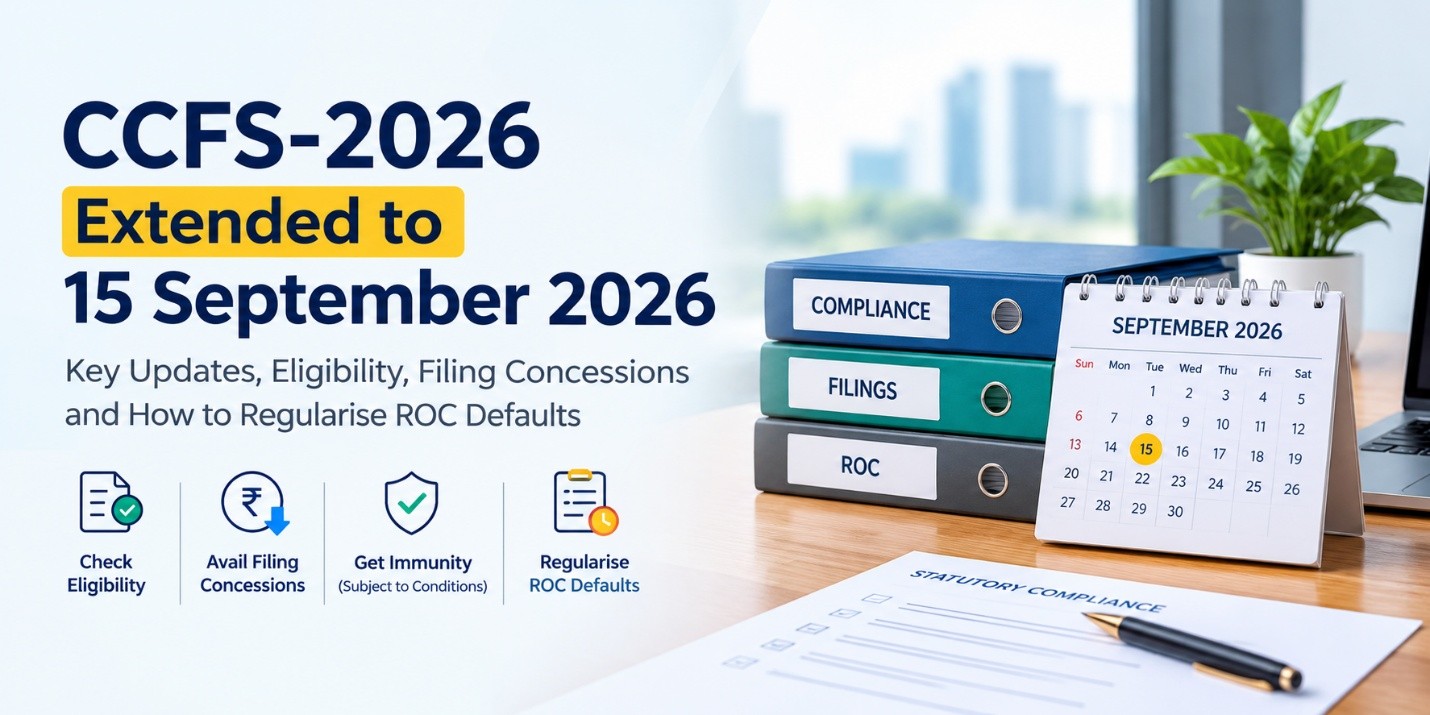
The Ministry of Corporate Affairs (“MCA”) has further extended the Companies Compliance Facilitation Scheme, 2026 (“CCFS-2026”) up to 15 September 2026, providing eligible companies additional time to regularise specified pending filings and avail the concessions available under the Scheme.
For businesses seeking professional support with corporate compliance, Chhota CFO can assist with compliance reviews, ROC filings and regularization planning.
The extension has been notified by MCA through General Circular No. 04/2026 dated 31 August 2026. The Scheme, which was earlier extended up to 31 August 2026, will now remain available until 15 September 2026.
The extension provides a limited but important window for companies with historical filing defaults to assess their compliance position and take appropriate corrective action.
Have pending ROC filings or historical compliance defaults? Contact Chhota CFO for a CCFS-2026 compliance review and understand the appropriate steps before the 15 September 2026 deadline.
Particulars | Position under CCFS-2026 |
Scheme | Companies Compliance Facilitation Scheme, 2026 |
Issuing Authority | Ministry of Corporate Affairs |
Latest Circular | General Circular No. 04/2026 dated 31 August 2026 |
Extended validity | Up to 15 September 2026 |
Primary objective | Facilitate regularisation of specified pending statutory filings |
Eligible companies | Companies meeting the eligibility conditions prescribed under the Scheme |
Concession | Specified filings may be made with the concessional additional fee prescribed under the Scheme |
Immunity | Available in respect of specified defaults, subject to the conditions of the Scheme |
Other conditions | All other terms and conditions of CCFS-2026 continue to apply |
The extension is particularly relevant for companies that have accumulated filing defaults with the MCA over one or more financial years.
Instead of treating the Scheme simply as a reduced-cost filing mechanism, companies should use the additional window to undertake a comprehensive review of their statutory position.
A company with pending filings may, depending on its circumstances, need to consider one of the following courses of action:
Company’s position | Possible approach |
Active business and intends to continue operations | Regularise pending compliances and continue as an active company |
Temporarily inactive but intended to be retained | Evaluate eligibility for dormant status |
No business or future commercial purpose | Examine eligibility for voluntary strike-off |
Historical filing defaults | Identify and complete eligible pending filings under CCFS-2026 |
Planning investment, restructuring or transaction | Complete pending compliances before proceeding with the transaction |
The appropriate course should be determined after reviewing the company’s financial, statutory and operational position.
CCFS-2026 may be particularly relevant to companies that have:
Eligibility, however, should be determined on a form-wise and company-specific basis rather than assuming that every outstanding filing automatically qualifies for the Scheme.
Companies with overdue filings should also review their annual ROC filings to identify outstanding compliance requirements.
A company considering regularization should review its records beyond the immediately visible overdue filings.
Compliance area | Review required |
Annual filings | Pending financial statements and annual returns |
Auditor-related filings | Appointment/reappointment and related filings |
Director-related compliance | DIN status, appointments, resignations and related filings |
Share capital | Changes in authorized/paid-up capital and allotments |
Charges | Creation, modification and satisfaction of charges |
Registered office | Current registered office and related statutory records |
Shareholding | Current ownership and historical changes |
Other event-based filings | Forms arising from corporate events or changes |
Other statutory compliances | Tax, GST, FEMA and other applicable regulatory requirements |
This exercise is important because filing an overdue annual return or financial statement may not, by itself, resolve other outstanding statutory issues.
Not sure which pending filings are eligible under CCFS-2026? Contact Chhota CFO to review your ROC compliance position, identify outstanding requirements and plan the necessary regularization.
For companies that are no longer carrying on business, regularization should be accompanied by a decision regarding the company’s future.
Particulars | Dormant Status | Strike-Off |
Purpose | Retain the company while it remains inactive | Remove the company from the Register of Companies |
Suitable for | Companies that may be used in the future | Companies with no continuing commercial purpose |
Corporate existence | Continues | Ceases upon completion of the statutory process |
Future use | Company can potentially be reactivated | Fresh incorporation may be required for a future business |
Consideration | Ongoing statutory requirements continue | Eligibility and prescribed closure requirements must be satisfied |
The choice should be based on the company’s future requirements rather than solely on the cost of compliance.
The extension provides additional time, but companies should not defer action until the final days.
Companies with multiple years of default may require time to:
Accordingly, companies should begin with a compliance gap assessment rather than waiting to initiate filings immediately before the deadline.
CCFS-2026 provides eligible companies with a structured opportunity to address historical compliance defaults under the concessions provided by MCA.
The latest extension to 15 September 2026 should therefore be viewed as a window to undertake a proper compliance review and regularize the company’s position, rather than merely as an extension for filing overdue forms.
For companies that have remained inactive, the exercise also provides an appropriate opportunity to evaluate whether continued existence, dormant status or voluntary closure is the most suitable course.
Businesses can also seek professional support from experienced Company Secretary services in Bangalore for statutory filings and corporate compliance.
At Chhota CFO, we assist companies in undertaking a structured review of their corporate compliance position, including:
Service | Scope |
ROC Compliance Review | Identification of pending and historical filings |
CCFS Assessment | Review of eligibility and applicability of the Scheme |
Compliance Roadmap | Year-wise and form-wise regularization plan |
Filing Support | Preparation and filing of applicable forms |
Corporate Status Review | Assessment of active, dormant or closure options |
Post-Regularization Review | Identification of continuing statutory obligations |
Companies with pending ROC compliances should use the available window proactively and complete the necessary assessment well before 15 September 2026.
The 15 September 2026 deadline should not be treated as a last-minute filing date. Contact Chhota CFO for CCFS-2026 assistance with compliance assessment, regularization planning and applicable filing support.