
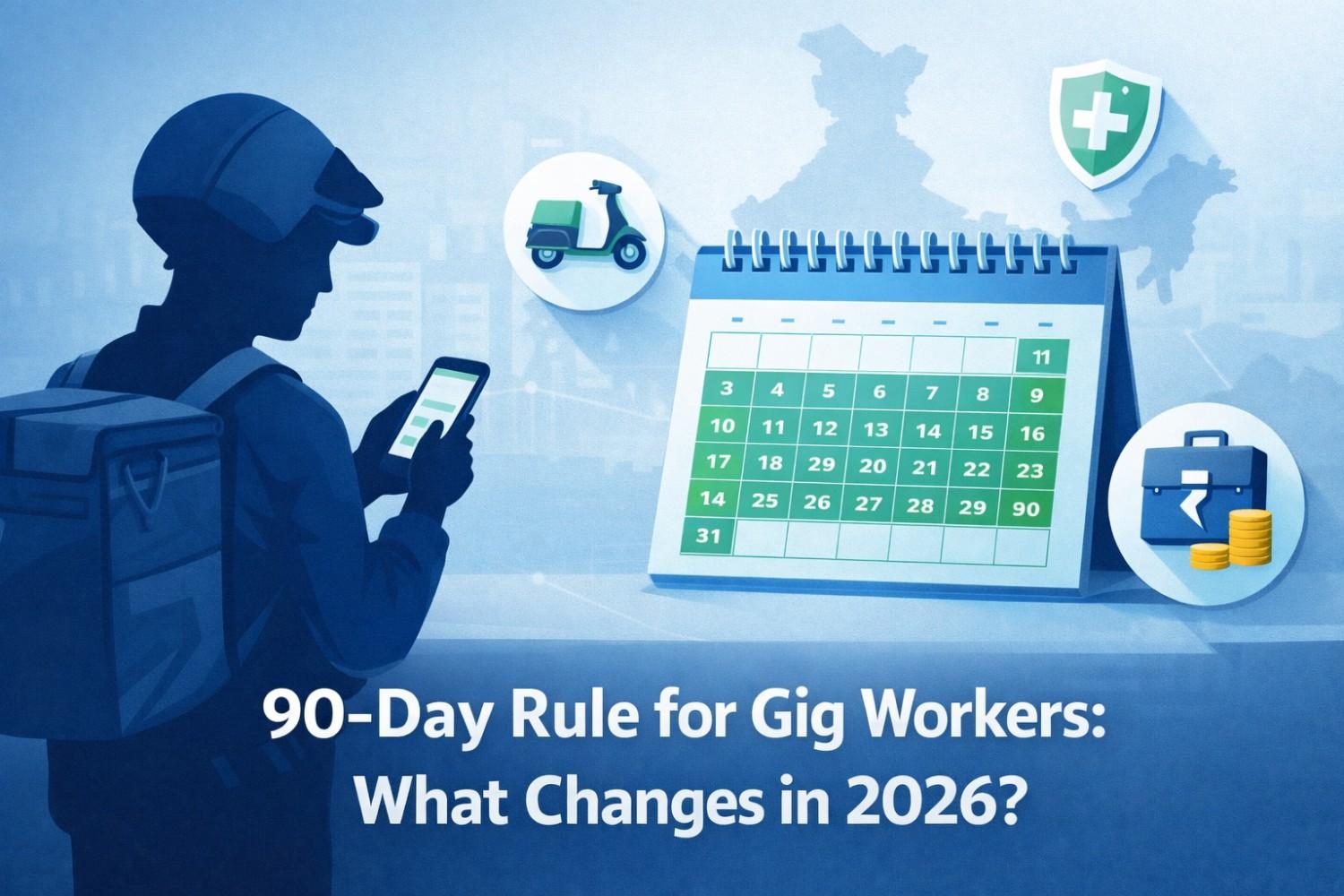
India’s gig economy employs millions. Yet for years, most gig workers have remained outside the country’s formal social security system. That gap may finally be closing as part of the broader implementation of the New Labour Codes 2025.
On December 30, 2025, the Central Government released draft rules proposing a minimum 90-day work requirement for gig and platform workers to access social security benefits under the Code on Social Security, 2020. If implemented from April 1, 2026, this would mark the first time India formally links gig work engagement to statutory welfare benefits.
But the proposal has also triggered sharp debate. Worker unions argue the threshold excludes most gig workers. Platforms worry about compliance complexity and HR policies. Policymakers say the rule prevents misuse and ensures benefits reach active workers.
This article explains what the 90-day rule actually says, how eligibility will be calculated, who benefits, who may be left out, and what to expect next.
The government’s stated objective is to extend structured social security to gig and platform workers while avoiding blanket eligibility for occasional or casual participants.
Under the draft rules, social security benefits would apply only to workers who demonstrate meaningful engagement with digital platforms during a financial year. Officials believe a minimum work threshold helps distinguish between regular workers and sporadic users of gig platforms.
The timing of the proposal is notable. It came a day before a nationwide strike by delivery and platform workers demanding better pay, safety, and social security. As a result, the rules have been closely scrutinised for whether they genuinely protect workers or merely formalise exclusions.
The draft rules define eligibility using engagement days, not income thresholds or hours worked.
If a gig worker is associated with one aggregator, they must have worked for at least 90 days in the previous financial year. If they work across multiple aggregators, the requirement increases to 120 days.
A key clarification matters here. A worker is treated as “engaged” on any calendar day on which they earn any amount, even ₹10. The amount earned does not matter. Only the act of earning on that day counts.
This means work does not have to be continuous. Engagement days can be spread across the year.
The rules take a broad view of engagement.
If a worker earns income from a platform on a given day, that day counts as one engagement day. This applies regardless of how many orders, rides, or tasks were completed.
Importantly, multi-platform work can be counted simultaneously. If a worker earns from two or three platforms on the same day, each engagement can be counted separately for cumulative eligibility. In practice, this allows faster accumulation of days for workers active across platforms.
The definition also covers workers engaged directly by aggregators or through subsidiaries, group entities, LLPs, or third-party arrangements. This is designed to prevent platforms from avoiding responsibility through contractual structures.
Once a worker meets the eligibility threshold, they become entitled to government-notified social security schemes under the Code on Social Security.
These include life and disability insurance, accident coverage, and health insurance. Eligible workers may also be linked to existing schemes, such as Ayushman Bharat, which provide hospitalisation coverage.
The framework also contemplates maternity benefits and long-term pension schemes. While some benefits may be rolled out in phases, the legal foundation for gig worker welfare would finally be in place, much like the recent updates to gratuity rules under the new codes.
The system will be funded primarily through mandatory contributions from platform aggregators.
Aggregators will be required to contribute between 1% and 2% of their annual turnover to a National Social Security Fund for gig workers. This contribution is capped at 5% of the total payments made to gig workers.
In effect, the lower of the two limits will apply. This cap is intended to prevent excessive financial burden on platforms while ensuring a steady welfare corpus.
The rules also address states that already have gig worker welfare laws. Contributions made to state-level funds will be adjusted against central obligations to avoid double-charging, though reconciliation may add compliance complexity.
e-Shram is India’s national database of unorganised workers. Registration is mandatory for accessing social security benefits.
Step 1: Visit eshram.gov.in or go to the Common Service Centre
Step 2: Complete Aadhaar-based electronic self-registration
Step 3: Submit KYC documents (Aadhaar, mobile number, bank details)
Step 4: Receive 12-digit Universal Account Number (UAN)
Step 5: Download the digital identity card
The rules require workers to keep their personal details up to date. Failure to do so may result in temporary loss of benefit eligibility, even if engagement thresholds are met.
Platforms must ensure their workers are registered and share verified engagement data with the government.
The biggest criticism centres on exclusion.
Platform data suggests that most gig workers do not work anywhere near 90 days a year. Industry leaders have publicly stated that the average delivery partner works fewer than 40 days annually. Seasonal migrants often work in short bursts around festivals or peak demand periods.
Under the proposed framework, a worker with 89 days of engagement receives no benefits at all. There is no pro-rata or partial protection.
Unions argue this creates a cliff-edge rule that ignores illness, maternity breaks, demand fluctuations, and platform-driven reductions in work availability. They warn that 60–70% of gig workers could remain outside the social security net despite contributing to platform growth.
Platforms face both financial and operational changes.
They must build systems to track engagement days accurately across workers and platforms. They must also integrate with government data systems and manage contribution calculations and reconciliations.
Some platforms have already increased incentives and payouts to retain workers amid growing unrest. Others are engaging with policymakers during the consultation period to seek clarity on implementation and dispute resolution mechanisms.
This proposal is part of India’s broader labour reform agenda under the four labour codes. Together, they aim to modernise wage laws, industrial relations, workplace safety, and social security.
For gig workers, the 90-day rule represents formal recognition. For the first time, the law acknowledges their role in the economy and creates a statutory welfare framework.
Whether this becomes a genuine safety net or a narrowly gated scheme will depend on how the final rules are shaped.
The 90-day work rule is a landmark policy shift. It brings gig workers into India’s formal social security architecture for the first time.
But it also exposes a core tension. Gig work is flexible, seasonal, and fragmented. Fixed eligibility thresholds may not reflect that reality.
The coming months of consultation will decide whether this reform delivers inclusive protection or formalises exclusion for most of India’s gig workforce.
 OSH Code 2020 Guide: India Workplace Safety for Employers & Workers
 Stop Filing Director KYC Every Year: New Once in 3 Years Rule Starts March 2026
 GST on Services Without Forex Receipt: DHL Express Delhi High Court Ruling Explained
 Income Tax Department Access to Social Media and Emails from April 1, 2026: What Really Changes?
 Take-Home Salary in 2026: How the New Labour Code Has Reshaped Your PayOSH Code 2020 Guide: India Workplace Safety for Employers & WorkersStop Filing Director KYC Every Year: New Once in 3 Years Rule Starts March 2026GST on Services Without Forex Receipt: DHL Express Delhi High Court Ruling ExplainedIncome Tax Department Access to Social Media and Emails from April 1, 2026: What Really Changes?Take-Home Salary in 2026: How the New Labour Code Has Reshaped Your Pay

