
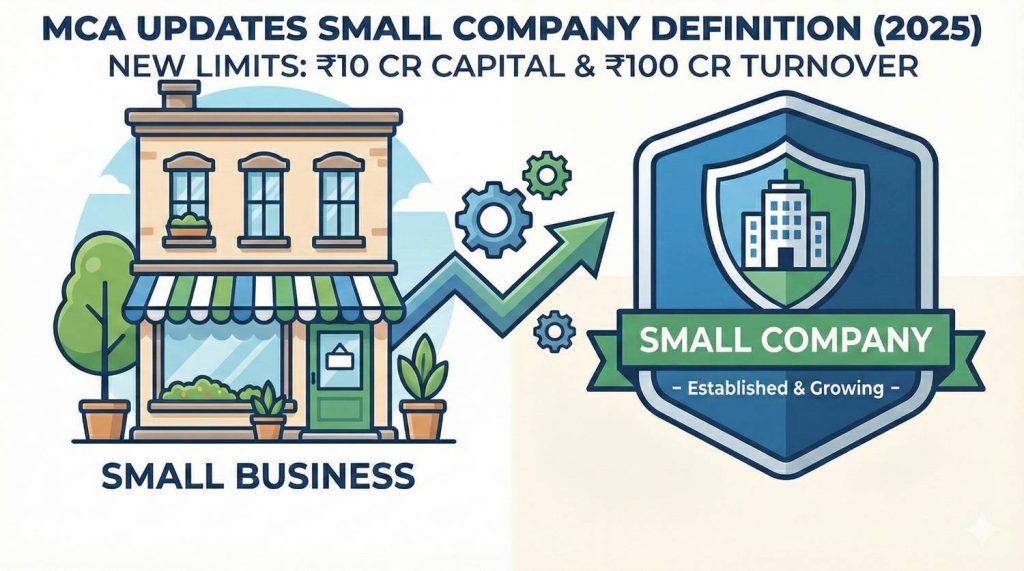
The Ministry of Corporate Affairs (MCA) has announced a major update to the definition of a Small Company under the Companies Act, 2013. Through the Companies (Specification of Definition Details) Amendment Rules, 2025, notified via G.S.R. 880(E) on 1 December 2025, the Government has expanded the financial limits for classifying a company as a Small Company.
This amendment will benefit thousands of private limited companies, MSMEs, and startups by reducing their compliance burden and supporting ease of doing business.
A company will now be considered a Small Company if both conditions below are satisfied:
Criteria | Earlier Threshold | New Threshold (Effective 1 Dec 2025) |
Paid-up Share Capital | Up to ₹4 crore | Up to ₹10 crore |
Turnover | Up to ₹40 crore | Up to ₹100 crore |
Even if a company meets the financial thresholds, it cannot be classified as a Small Company if it is any of the following:
Only private companies that meet the turnover and capital limits and are not listed under the exclusions can claim Small Company benefits.
The revised thresholds are aimed at:
This expansion adds more growth-stage private companies to the Small Company framework, particularly benefiting businesses considering conversion from proprietorship to a private limited company.
Qualifying as a Small Company unlocks substantial compliance relaxations under the Companies Act, 2013, including
The amendment is a deregulatory measure to align legal thresholds with economic growth and inflation.
However, its timing has created a specific ambiguity for the current compliance season:
As of now, this requires urgent clarification from the MCA to ensure uniform compliance. Companies in this situation should consult with a professional – consider our virtual CFO services for SME compliance and strategy until official guidance is issued.
If your company is a private firm and not among the excluded types, follow these steps to assess your status and next steps:
The MCA’s 2025 amendment significantly increases the Small Company limits to ₹10 crore of paid-up capital and ₹100 crore of turnover. This policy change strengthens India’s business environment and supports MSME and startup growth by expanding eligibility and easing regulatory burdens.
 Income Tax Department Access to Social Media and Emails from April 1, 2026: What Really Changes?
 Take-Home Salary in 2026: How the New Labour Code Has Reshaped Your Pay
 ITC on Rooftop Solar Plants Used for Captive Consumption (GST Explained)
 Government Proposes Lower CSR Thresholds and Mandatory CSR-Experienced Director
 GST Composition Scheme vs Standard GST in 2025: Which Is Better for Your Small Business?Income Tax Department Access to Social Media and Emails from April 1, 2026: What Really Changes?Take-Home Salary in 2026: How the New Labour Code Has Reshaped Your PayITC on Rooftop Solar Plants Used for Captive Consumption (GST Explained)Government Proposes Lower CSR Thresholds and Mandatory CSR-Experienced DirectorGST Composition Scheme vs Standard GST in 2025: Which Is Better for Your Small Business?

