
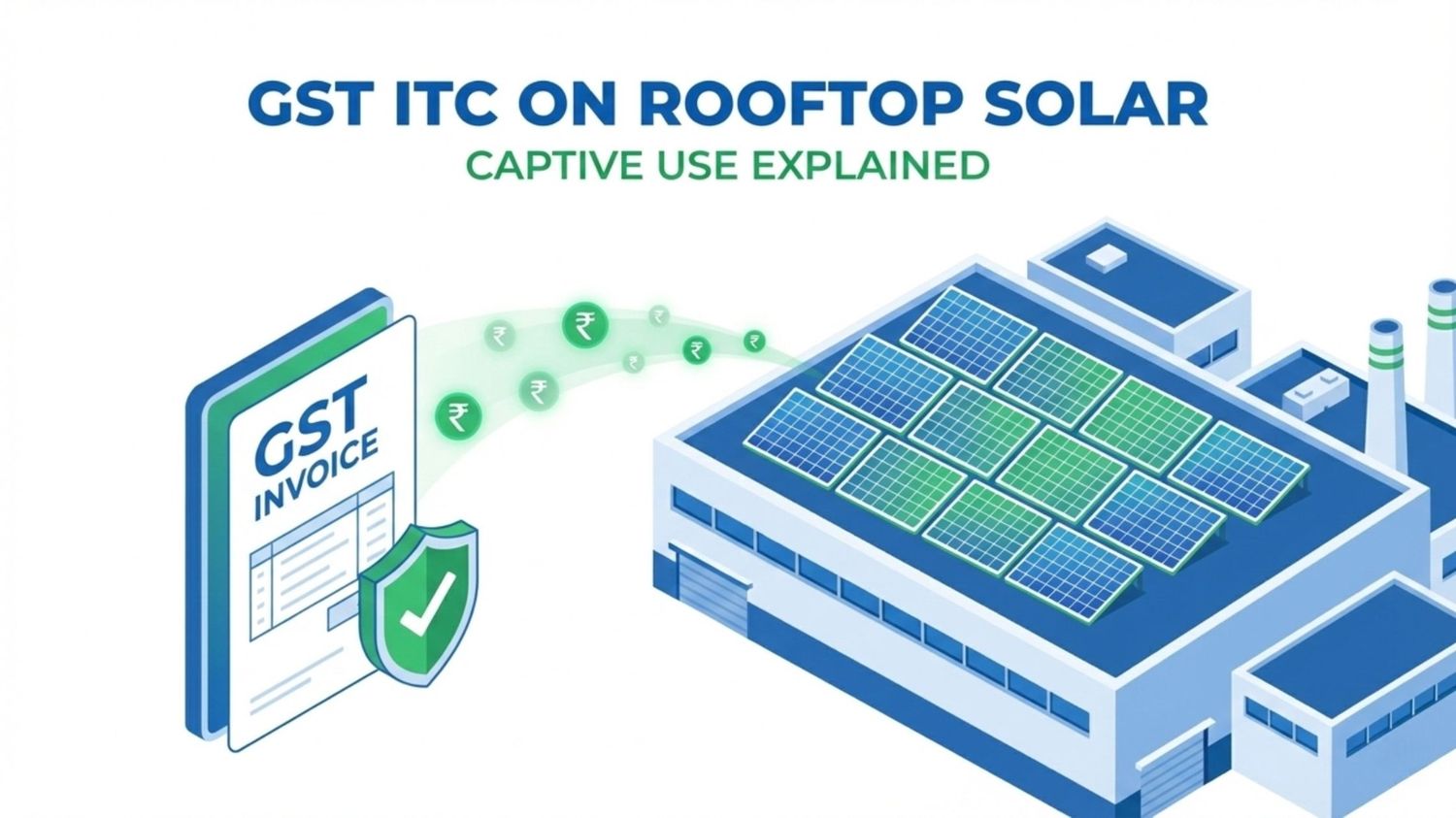
Input Tax Credit (ITC) is available on rooftop solar plants used for captive consumption when structured correctly. Recent Advance Ruling Authority (AAR) and appellate decisions have brought long-awaited clarity: rooftop solar systems installed for business use are treated as “plant and machinery,” not blocked immovable property, making ITC on goods and services admissible under GST.
For businesses investing in rooftop solar to reduce power costs and meet ESG goals, this interpretation can significantly lower the net project cost in INR, sometimes by several crores.
This guide explains when ITC is allowed, why rooftop solar qualifies as plant and machinery, key judicial precedents, and how CFOs can safeguard credit eligibility amid evolving GST compliance changes.
Under the GST law, a registered person may claim ITC on tax paid on inputs, input services, and capital goods used in the course or furtherance of business.
Rooftop solar plants installed on factories, warehouses, malls, IT parks, or commercial buildings directly support business operations by:
When the system is used for captive consumption, the GST paid on procurement and installation is eligible for credit, provided the statutory conditions are satisfied.
The main area of dispute has been Section 17(5)(d) of the CGST Act, which disallows ITC for goods and services used in the construction of immovable property (other than plant and machinery) on one’s own account.
Tax authorities frequently argued that:
This approach resulted in frequent disputes and audit objections. A detailed list of such restricted credits is explained here.
The turning point lies in the statutory explanation to Section 17(5).
Legal Definition That Matters
“Plant and machinery” includes:
It excludes only land, buildings, and civil structures.
AARs in Rajasthan, Tamil Nadu, Kerala, and Gujarat have ruled that rooftop solar plants:
Even though mounted on rooftops, the system remains an independent plant and machinery.
Once capitalised in the books, ITC is not subject to Section 17(5)(d).
While classification as plant and machinery is critical, captive consumption of electricity is the deciding factor.
ITC is permitted where:
The Kerala AAR allowed ITC for a mall rooftop plant because electricity was used for taxable common-area maintenance services, which were billed with GST.
ITC is not allowed where:
In such cases, Sections 17(2) and 17(3) apply, restricting credit irrespective of plant classification.
For rooftop solar plants used entirely for captive consumption, ITC generally covers the entire project value, including:
Authorities have confirmed that inputs, capital goods, and input services are all eligible, subject to Section 16 conditions.
For large installations, this can mean substantial INR savings, materially improving project economics.
To ensure ITC withstands audit scrutiny, businesses should ensure:
The recipient must have a valid GST registration and use the plant for business purposes.
The system must be capitalised as “plant and machinery”, not as a building or civil structure.
Electricity must be used for taxable or zero-rated supplies. If partly used for exempt supplies, proportionate ITC reversal is mandatory.
Strong documentation is critical. Businesses should maintain:
Weak documentation and the absence of a legal position are often the reasons ITC is challenged.
Some of the most cited rulings include:
In contrast, rulings on the supply of power to state utilities (such as TANGEDCO) have denied ITC because the output is exempt.
To maximise ITC benefits in INR terms, finance teams should:
In many cases, post-ITC project costs drop sharply, reducing payback periods from 5–6 years to 3–4 years. Many organisations involve a virtual CFO to manage such cross-functional compliance.
Mitigation: Maintain copies of relevant AAR rulings and professional opinions, aligning facts with accepted precedents.
If excess power is later exported to the grid:
Proactive reversals reduce exposure to interest and penalties in INR.
Rooftop solar plants used for captive consumption now receive strong, consistent support under the GST ITC.
The three pillars of a defensible position are:
For manufacturers, malls, logistics parks, and energy-intensive businesses, this clarity transforms GST on rooftop solar from a sunk cost into a strategic tax credit, strengthening both financial returns and sustainability outcomes.
When structured correctly, rooftop solar is no longer just an energy decision—it’s a GST-efficient capital investment.
 Income Tax Department Access to Social Media and Emails from April 1, 2026: What Really Changes?
 Take-Home Salary in 2026: How the New Labour Code Has Reshaped Your Pay
 Government Proposes Lower CSR Thresholds and Mandatory CSR-Experienced Director
 GST Composition Scheme vs Standard GST in 2025: Which Is Better for Your Small Business?
 How to Reclassify Your Company as a Small Company Under the New 2025 RulesIncome Tax Department Access to Social Media and Emails from April 1, 2026: What Really Changes?Take-Home Salary in 2026: How the New Labour Code Has Reshaped Your PayGovernment Proposes Lower CSR Thresholds and Mandatory CSR-Experienced DirectorGST Composition Scheme vs Standard GST in 2025: Which Is Better for Your Small Business?How to Reclassify Your Company as a Small Company Under the New 2025 Rules

